




















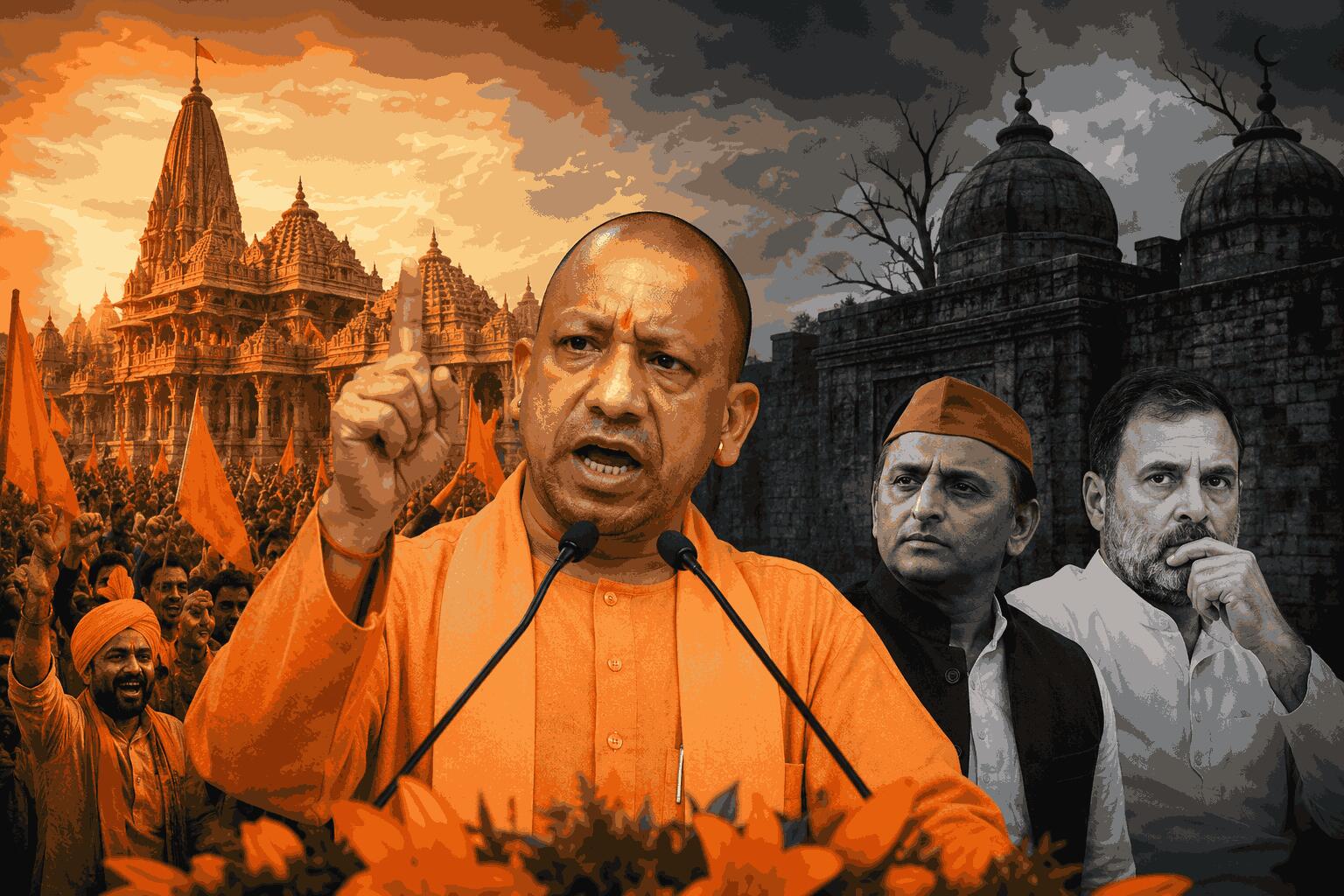
The political discourse in Uttar Pradesh has once again shifted towards questions of faith, identity, and governance after Chief Minister Yogi Adityanath launched a blistering attack on the Samajwadi Party (SP) and the Congress. Framing Sanatan as the foundation of India’s civilisational ethos, Yogi accused the Opposition of practising selective secularism and neglecting the cultural aspirations of the Hindu majority.
Addressing a public gathering in Barabanki, the Chief Minister alleged that previous SP and Congress governments prioritised constructing boundary walls around graveyards while ignoring temples and traditional religious celebrations. He claimed that restrictions on events such as Kanwar Yatra, Ram Navami processions, and Janmashtami reflected what he described as a distorted interpretation of secularism. These remarks are part of the BJP’s continuing effort to project itself as the principal defender of Sanatan traditions and India’s cultural heritage.
The timing of the speech is politically significant. With electoral calculations already beginning to shape public discourse, cultural and religious identity is once again emerging as a major campaign theme. By repeatedly invoking Sanatan, the BJP seeks to consolidate support among voters who view the preservation of India’s ancient traditions as an essential part of national development. The Opposition, meanwhile, continues to reject such allegations, arguing that the ruling party uses religious issues to divert attention from governance and economic concerns.
Beyond immediate political rhetoric, the debate reflects a broader transformation in Indian electoral politics. Discussions surrounding Sanatan have increasingly become intertwined with conversations about infrastructure, tourism, heritage restoration, and cultural revival. Projects linked to temples, pilgrimage circuits, and religious tourism are frequently presented as symbols of both economic growth and civilisational pride, giving cultural narratives a direct connection with governance.
Yogi Adityanath’s remarks also demonstrate how ideological positioning has become central to political messaging. Rather than limiting criticism to administrative issues, he portrayed the contest as one between those who support Sanatan values and those whom he accused of weakening India’s cultural identity. Such framing has become a recurring feature of political campaigns in Uttar Pradesh, where religion and governance are often discussed together.
For the Opposition, the challenge lies in responding without allowing the debate to remain exclusively on cultural terrain. SP and Congress have consistently maintained that constitutional secularism guarantees equal respect for all communities and have criticised the BJP for what they describe as polarising political rhetoric. The disagreement therefore extends beyond individual speeches and reflects competing visions of governance, national identity, and public policy.
Whether these exchanges ultimately reshape voter preferences will become clearer as election campaigning gathers pace. However, one conclusion is already evident: debates surrounding Sanatan have evolved beyond purely religious discussions and now occupy a prominent place in India’s wider political narrative. As political parties sharpen their strategies, Sanatan is likely to remain one of the defining themes influencing public discourse in the months ahead.