






















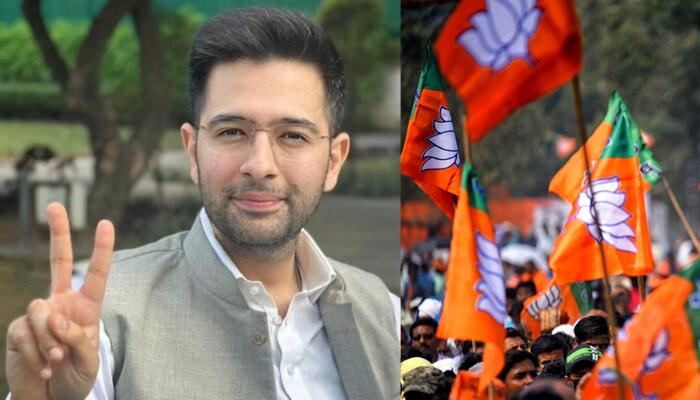
Raghav Chadha, senior Aam Aadmi Party (AAP) Rajya Sabha MP, resigned from the party and joined the Bharatiya Janata Party (BJP) along with six other MPs. The announcement came as part of a coordinated political realignment inside Parliament.
Rather than following a standard defection route, the group invoked Paragraph 4 of the Tenth Schedule of the Constitution. This provision allows a merger if two-thirds of a legislative party agrees. Consequently, it protects members from disqualification and creates a legal pathway for political transition.
As a result, AAP’s strength in the Rajya Sabha has reduced significantly, while the BJP has gained a numerical advantage in the Upper House.
The numbers that enabled the constitutional merger
Since AAP holds ten Rajya Sabha seats, the threshold for merger stood at seven MPs. Chadha stated that exactly this number formed a coordinated bloc, thereby crossing the constitutional requirement.
The MPs involved include Raghav Chadha, Swati Maliwal, Harbhajan Singh, Sandeep Pathak, Ashok Mittal, Rajinder Gupta, and Vikram Sahney.
Following this, the group submitted formal documents to the Rajya Sabha Chairman. They confirmed compliance with constitutional procedure, ensuring they retained membership while changing party affiliation.
Chadha cites ideological drift inside AAP
Addressing the media alongside Sandeep Pathak and Ashok Mittal, Chadha said he spent 15 years in AAP. He claimed the party had moved away from its founding principles.
According to him, the organisation no longer reflected “honest politics” and had drifted from its original ideological foundation.
“The AAP that I gave 15 years of my life to has now completely deviated from its principles, values, and core morals,” Chadha said.
He also framed the decision as alignment with what he described as “positive politics” under the BJP leadership model.
Internal tensions and leadership removal set the stage
Notably, the development follows visible internal friction within AAP. Chadha was recently removed as the party’s Rajya Sabha deputy leader, a decision that reflected growing differences within the parliamentary leadership.
That removal intensified internal tensions. Soon after, seven MPs coordinated their exit, turning internal disagreement into a formal parliamentary split.
Therefore, what began as organisational conflict quickly escalated into a structural political shift.
AAP alleges “Operation Lotus” and political pressure
In response, AAP leader Sanjay Singh strongly reacted and accused the BJP of running “Operation Lotus” to destabilise opposition parties.
He alleged that central agencies and political pressure tactics were being used to engineer defections, particularly targeting opposition strength in Punjab.
Punjab Chief Minister Bhagwant Mann also raised concerns. He claimed that ED and CBI actions were being misused for political purposes and linked recent developments to broader opposition weakening strategies.
ED raids on Ashok Mittal add political context
In addition, the political environment intensified after reports of Enforcement Directorate raids under FEMA at premises linked to Ashok Mittal in Punjab and Haryana.
Mittal, a businessman and educationist, heads the Lovely Group and serves as Chancellor of Lovely Professional University. He is also among the MPs who joined the BJP through this merger process.
Earlier, AAP leaders had alleged proximity between Chadha and the BJP leadership, suggesting coordination behind the political shift. However, these claims remained part of competing narratives within the party.
BJP gains while defectors cite governance model
Meanwhile, the defecting MPs expressed support for Prime Minister Narendra Modi’s leadership and governance approach. They said they were joining the BJP to pursue what they described as constructive political engagement.
Ashok Mittal’s inclusion adds further significance. He had earlier replaced Raghav Chadha in the Rajya Sabha after internal restructuring within AAP. Now, both leaders have exited together, underscoring the scale of the shift.
A structural setback for AAP in the Rajya Sabha
Ultimately, the exit of seven out of ten MPs has significantly reduced AAP’s presence in the Upper House. At the same time, it has strengthened the BJP’s parliamentary position.
Therefore, the episode goes beyond a routine political defection. It highlights how constitutional provisions, timing, and internal fractures can reshape parliamentary power.
In effect, a legal merger has transformed into a major political realignment inside the Rajya Sabha.