























A growing storm of controversy surrounding “St. Xavier” has once again exposed deep concerns about accountability, institutional response, and the widening gap between reputation and reality. What began as outrage over controversial remarks has now escalated into arrests, police action, and a nationwide debate over responsibility—yet questions remain whether the institution at the center has chosen silence over scrutiny.
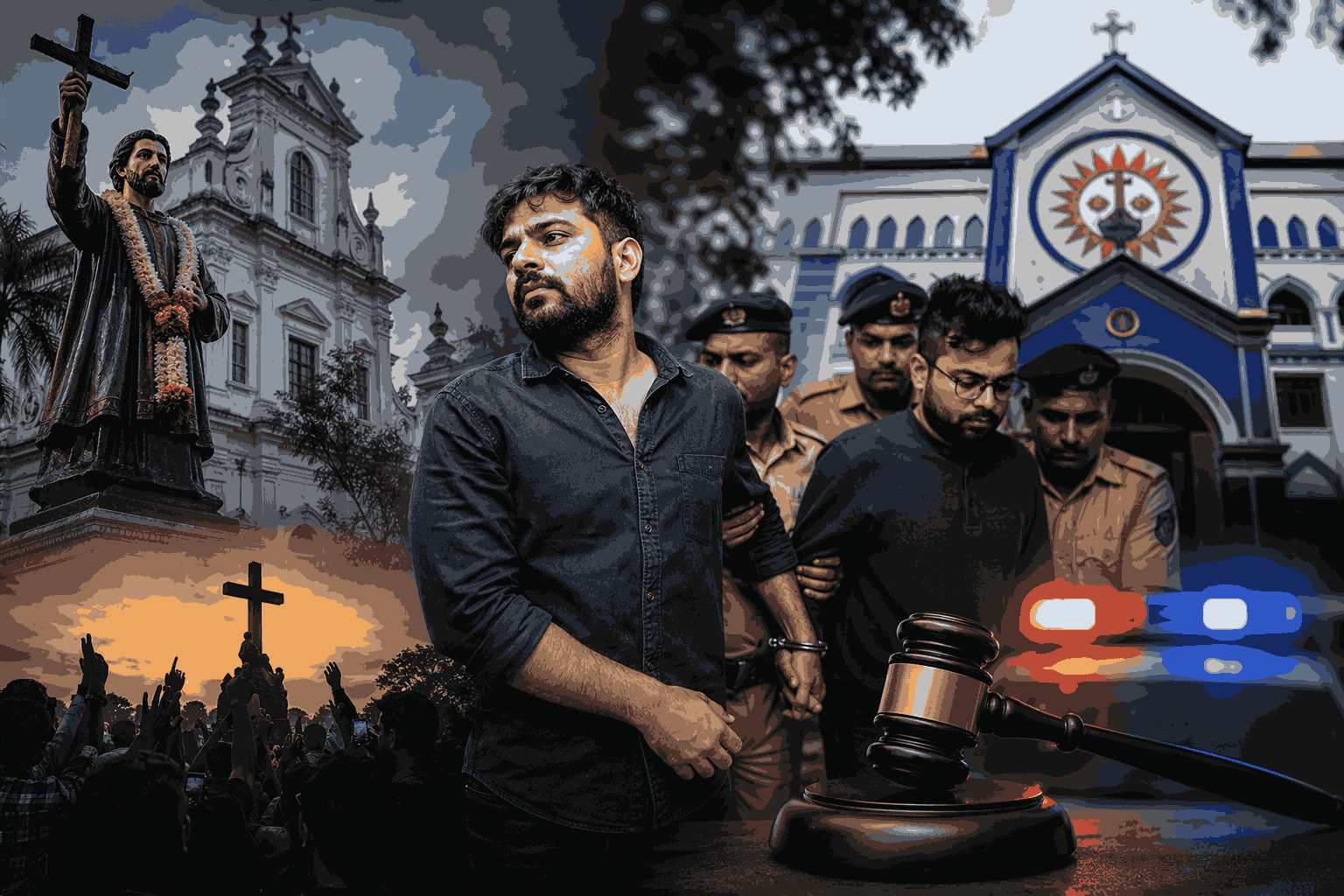
The latest flashpoint emerged from Goa, where YouTuber Gautam Khattar triggered widespread anger after allegedly making derogatory remarks about St. Francis Xavier, a revered figure in the state. The fallout was immediate and explosive. Police registered a case citing “hurting religious sentiments,” and multiple complaints poured in from across Goa, highlighting the intensity of public reaction. (The Indian Express)
As outrage intensified, law enforcement moved swiftly. A non-bailable warrant was issued against Khattar after he failed to comply with police notices, and a lookout circular was also initiated to prevent him from leaving the country. The seriousness of the situation was underscored by the transfer of the case to the crime branch, with multiple police teams deployed across states to track him down.
In a significant development, authorities arrested his brother, Madhav Khattar, who was accused of recording and disseminating the controversial speech on social media. The arrest marked a turning point in the investigation, signaling that law enforcement was willing to widen the net to include all those linked to the incident.
Yet beyond the arrests and legal proceedings, a deeper and more uncomfortable question persists: where does institutional responsibility begin and end?
Critics argue that controversies involving St. Xavier-linked narratives are not isolated incidents but part of a broader pattern where institutions rely heavily on legacy prestige while failing to respond decisively to crises. In this case, while political parties, civil society groups, and law enforcement agencies acted swiftly, the perceived silence or lack of visible accountability from institutional quarters has drawn sharp criticism.
Observers point out that institutions of such stature cannot afford ambiguity during moments of public outrage. The expectation is not merely damage control but proactive engagement—clear condemnation, transparent communication, and tangible steps to address the fallout. Instead, what many see is a vacuum that allows speculation and anger to grow unchecked.
The incident also highlights how quickly reputations can unravel in the digital age. A single video clip, amplified through social media, has the power to ignite statewide protests, trigger legal action, and force authorities into rapid response mode. In such an environment, institutions like St. Xavier are no longer insulated by history or prestige—they are subject to continuous, real-time scrutiny.
Moreover, the case has reopened debates about the broader ecosystem in which such controversies arise. Critics question whether platforms, organizers, and associated networks exercise sufficient caution when hosting or promoting speakers. When controversial statements emerge, the responsibility does not end with the individual speaker; it extends to those who enabled the platform and failed to anticipate potential fallout.
The Goa controversy, therefore, is not merely about one individual’s remarks—it is about the systems that allowed those remarks to gain traction and the institutional responses that followed. It is also about the growing impatience of the public with perceived inaction or evasiveness.
Importantly, the law enforcement response has set a precedent. The swift filing of FIRs, issuance of warrants, and arrests demonstrate a willingness to act decisively in cases involving public sentiment and communal harmony. This stands in stark contrast to the slower, often opaque responses that critics associate with institutional bodies.
For many observers, the unfolding developments represent a moment of reckoning. Institutions tied to the St. Xavier name now face a critical choice: engage transparently and rebuild trust, or risk further erosion of credibility in the face of mounting scrutiny.
As the investigation continues and authorities pursue the main accused, the spotlight remains firmly on the broader system. In an era where accountability is demanded instantly and publicly, silence is no longer a neutral stance—it is itself a statement.
The controversy has made one thing clear: prestige alone is no longer enough. Institutions must now prove, consistently and visibly, that they are willing to uphold the standards they claim to represent—or face the consequences of a public that is no longer willing to look the other way.