





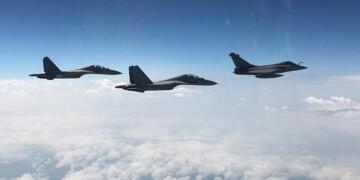










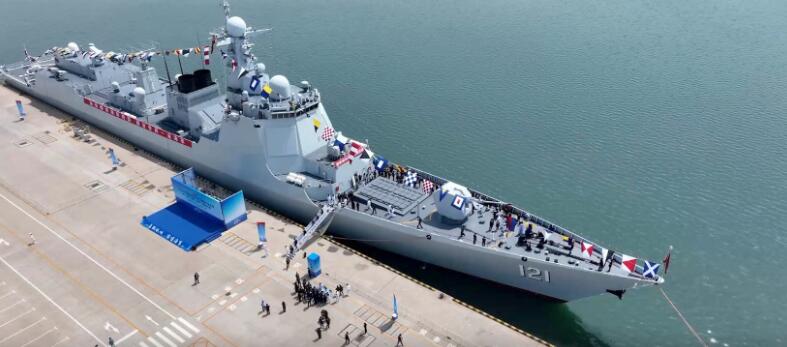
Every April, China puts on a show, as warships sail in tight formation, naval aircraft streak across the sky and state media broadcasts it all with the kind of reverence usually reserved for national mythology, a proud, peaceful navy, rising to take its rightful place among the world’s great maritime powers.
It is a compelling image. It is also, for anyone watching, what is actually happening in the South China Sea, almost entirely disconnected from reality.
Because while the parade plays out on television, a very different kind of naval activity is unfolding a few hundred nautical miles away. No formations, no ceremony, just Filipino fishermen and coast guard crews being rammed, surrounded, and blasted with water cannons by Chinese vessels that vastly outsize them.
The gap between these two images is not a coincidence. It is the strategy. Take what has been happening around the Second Thomas Shoal, a contested outpost where the Philippines maintains a small, deliberately grounded naval vessel as a sovereignty marker. Resupplying that vessel has become one of the most tense and regularly documented flashpoints in the region.
Chinese coast guard ships and maritime militia vessels have repeatedly moved to block those resupply missions. The tactics have included deliberate collisions, aggressive circling, and water cannon attacks that have damaged Philippine vessels and put crew members at genuine risk. Manila has described these operations as “ramming and towing”, reckless, illegal, and entirely intentional.
In December 2023 alone, water cannons were fired multiple times at Philippine ships during routine missions. Equipment was damaged, missions were disrupted, and then, the next day, everything continued as normal, because for Beijing, this is normal.
These are not isolated flare-ups, they are part of a consistent, calculated pattern. Maritime analysts and monitoring groups tracking activity in the South China Sea have reported that on any given day, close to 200 Chinese maritime militia vessels operate near disputed features in the sea.
These are fishing boats that are not quite fishing boats, civilian in appearance, coordinated in behaviour, and deeply integrated into China’s broader strategy of asserting control without pulling a trigger.
It is what strategists call “grey zone” warfare. Stay below the threshold of open conflict. Move slowly enough that no single action justifies a military response. But move consistently, and over time, the facts on the water change.
China has also deployed what can only be described as swarming tactics, large clusters of militia vessels appearing near key locations during particularly sensitive moments, such as joint military exercises between the Philippines and the United States. The message is clear even without a single shot being fired: we are here, we are watching, and access to these waters is ours to grant or deny.
Underpinning all of this is Beijing’s flat refusal to accept the legal framework that governs the seas. In 2016, the Permanent Court of Arbitration issued a landmark ruling that invalidated China’s sweeping territorial claims in the South China Sea, the so-called nine-dash line that Beijing uses to claim roughly 90 percent of the entire sea. The ruling was unambiguous. China ignored it, and has continued ignoring it ever since.
Artificial islands have been built. Military assets have been deployed on them. Access to waters that fall within other nations’ exclusive economic zones has been routinely restricted. Most recently, satellite imagery has shown physical barriers being installed near the Scarborough Shoal—another move that lawyers and regional governments have widely condemned as a violation of international law.
China’s response, broadly, has been to carry on regardless. What makes all of this particularly difficult to counter is the deliberate blurring of lines between civilian and military activity.
The maritime militia exists precisely because it is hard to respond to. When a coast guard vessel rams a fishing boat, that is an incident. When 200 vessels of ambiguous status surround a contested feature, what exactly is the appropriate response? Escalate and risk open conflict? Back down and cede ground? The ambiguity is not accidental, it is engineered.
Which brings us back to the parade. PLA Navy Day is not just a celebration. It is a narrative tool. By showcasing gleaming warships and disciplined formations, Beijing projects the image of a responsible, modern naval power engaged in peaceful maritime development. It is the face China wants the world to see—and crucially, the face that makes it easier to dismiss concerns about what is happening in the South China Sea as exaggeration or anti-China bias.
But that framing is becoming harder to maintain. For the nations directly in the firing line, literally, in the Philippines’ case, the disconnect between Beijing’s words and its actions has long since passed the point of being deniable. The incidents are too frequent, too well-documented, and too consistent to be explained away.
ASEAN nations, historically cautious about directly confronting China, are under growing pressure to coordinate more assertively. The Philippines in particular, has moved closer to the United States, leaning into its defence agreements and signalling that it is no longer willing to absorb Chinese coercion quietly. Whether the broader regional architecture can move fast enough to match the pace of Chinese expansion remains an open question.
PLA Navy Day, for all its polish, tells you more through what it leaves out than what it puts on display. There is no mention of the Second Thomas Shoal. No acknowledgement of water cannon attacks. No reference to the militia vessels that fan out across disputed waters every single day.
Just warships. Just a ceremony. Just the version of China’s navy that Beijing wants you to remember. The world is getting better at looking past it. The harder question is whether that awareness translates into action, before coercion quietly becomes the new normal in waters that matter enormously to global trade, regional stability, and the future of international law. The parade ends, the ships stay.