














TFIPOST हिन्दी
TFIPOST Global
Tfipost.com
Tfipost.com
No Result
View All Result
  • Premium
  • Politics
    • All
    • Analysis
    • Opinions
    • Trending
    From pilgrimage to metros, now without the wait

    From Kashi to Mumbai and Ayodhya to Pune: Modi Expands Rail Network with New Amrit Bharat Express Services

    Why is Making a Jet Engine so Hard | The failure of Kaveri

    Why is Making a Jet Engine so Hard | The failure of Kaveri

    Rajnath Singh at SCO, reaffirming India’s zero-tolerance stand on terrorism.

    “No More Double Standards”: Rajnath Singh’s SCO Message Rewrites India’s Terror Response Playbook

    Nepal PM Faces Fresh Controversy as Church Demolition Row Triggers Political Storm

    Nepal PM Faces Fresh Controversy as Church Demolition Row Triggers Political Storm

    • Analysis
    • Opinions
    • Trending
  • Economy
    • All
    • Business
    • Economy1
    • Finance
    India–New Zealand FTA signed in New Delhi, marking a “once in a lifetime” moment in trade ties.

    India, New Zealand Seal Fast-Tracked Trade Pact to Expand Duty-Free Access, Jobs and $5 Billion Trade Target

    Ahmadis in Pakistan: From Faith to Marginalisation Under Law and Society

    Ahmadis in Pakistan: From Faith to Marginalisation Under Law and Society

    Open Demat Account with Zero Annual Maintenance Charges What to Look For

    Open Demat Account with Zero Annual Maintenance Charges What to Look For

    Blood in the Meadows: How the Pahalgam Terror Attack Exposed Calculated Targeting of Civilians in Kashmir

    Blood in the Meadows: How the Pahalgam Terror Attack Exposed Calculated Targeting of Civilians in Kashmir

    • Business
    • Finance
  • Defense
    • All
    • Defence
    • Strategy
    • Weaponry
    Why is Making a Jet Engine so Hard | The failure of Kaveri

    Why is Making a Jet Engine so Hard | The failure of Kaveri

    Rajnath Singh at SCO, reaffirming India’s zero-tolerance stand on terrorism.

    “No More Double Standards”: Rajnath Singh’s SCO Message Rewrites India’s Terror Response Playbook

    Recovered arms and arrests have intensified scrutiny on a suspected cross-border terror network.

    Pakistan’s Proxy War Faces a Setback as Delhi Terror Plot is Crushed, 18 Weapons Seized

    The scars of Pahalgam endure, even as the nation moves forward

    Pahalgam Anniversary: Modi Signals Firm National Stand as India Reasserts Anti-Terror Resolve

    • Defence
    • Strategy
    • Weaponry
  • Geopolitics
    • All
    • Africa
    • Americas
    • Asia Pacific
    • Europe
    • South Asia
    • West Asia
    When law becomes an instrument of exclusion, persecution moves far beyond the courtroom.

    Ahmadis in Pakistan: From Faith to Marginalisation Under Law and Society

    When uranium becomes strategy, India moves first.

    India’s $4 Billion Uranium Coup with Kazakhstan Rewrites the Global Nuclear Balance

    “Fixing the World”: What a Century of Big Ideas Reveals About Us

    “Fixing the World”: What a Century of Big Ideas Reveals About Us

    Pakistan Tried to Bury an NYT Report. It Only Exposed Asim Munir’s Panic

    Pakistan Tried to Bury an NYT Report. It Only Exposed Asim Munir’s Panic

    • Africa
    • Americas
    • Asia Pacific
    • Europe
    • South Asia
    • West Asia
  • Knowledge
    • All
    • Culture
    • Education
    • History
    • Indology
    Chants of ‘Jai Badri Vishal’ Echo as Badrinath Portals Open; All Four Dhams Now Accessible to Pilgrims

    Chants of ‘Jai Badri Vishal’ Echo as Badrinath Portals Open; All Four Dhams Now Accessible to Pilgrims

    Kedarnath Dham Portals Open for Devotees After 181 Days Amid Vedic Chants, Traditional Rituals

    Kedarnath Dham Portals Open for Devotees After 181 Days Amid Vedic Chants, Traditional Rituals

    Sardar Patel and Amit Shah

    Sardar Patel’s 1947 Blueprint on Minority Quotas Resurfaces as Reservation Debate Returns to Centre Stage

    The 1973 Constitution and ‘Bhutto’ the Man Who Made It: What Pakistan Owes and What It Destroyed

    The 1973 Constitution and ‘Bhutto’ the Man Who Made It: What Pakistan Owes and What It Destroyed

    • Culture
    • History
    • Indology
  • Law
  • Lounge
    • All
    • Books
    • Cinema
    • Entertainment
    • Food
    • Games
    • Health
    • Lifestyle
    • Satire
    • Sports
    • technology
    • Travel
    When regulation meets the algorithm

    India Tightens Digital Control as Online Blocking Orders Surge to 24,300 Amid AI Deepfake Trend

    Digital Data Collection In India

    India’s Data Reset Begins: Census 2027 to Become First Fully Digital Population Count

    5 Facilities in Bengaluru Specializing in Mental Health Treatment for Those with Cancer

    5 Facilities in Bengaluru Specializing in Mental Health Treatment for Those with Cancer

    UNESCO World Book Day and Copyright Day

    World Book Day 2026: UNESCO’s Multilingual Push Aligns with India’s Deep Literary Continuum

    • Books
    • Cinema
    • Food
    • Health
    • Sports
    • technology
    • Travel
    • Satire
Tfipost.com
  • Premium
  • Politics
    • All
    • Analysis
    • Opinions
    • Trending
    From pilgrimage to metros, now without the wait

    From Kashi to Mumbai and Ayodhya to Pune: Modi Expands Rail Network with New Amrit Bharat Express Services

    Why is Making a Jet Engine so Hard | The failure of Kaveri

    Why is Making a Jet Engine so Hard | The failure of Kaveri

    Rajnath Singh at SCO, reaffirming India’s zero-tolerance stand on terrorism.

    “No More Double Standards”: Rajnath Singh’s SCO Message Rewrites India’s Terror Response Playbook

    Nepal PM Faces Fresh Controversy as Church Demolition Row Triggers Political Storm

    Nepal PM Faces Fresh Controversy as Church Demolition Row Triggers Political Storm

    • Analysis
    • Opinions
    • Trending
  • Economy
    • All
    • Business
    • Economy1
    • Finance
    India–New Zealand FTA signed in New Delhi, marking a “once in a lifetime” moment in trade ties.

    India, New Zealand Seal Fast-Tracked Trade Pact to Expand Duty-Free Access, Jobs and $5 Billion Trade Target

    Ahmadis in Pakistan: From Faith to Marginalisation Under Law and Society

    Ahmadis in Pakistan: From Faith to Marginalisation Under Law and Society

    Open Demat Account with Zero Annual Maintenance Charges What to Look For

    Open Demat Account with Zero Annual Maintenance Charges What to Look For

    Blood in the Meadows: How the Pahalgam Terror Attack Exposed Calculated Targeting of Civilians in Kashmir

    Blood in the Meadows: How the Pahalgam Terror Attack Exposed Calculated Targeting of Civilians in Kashmir

    • Business
    • Finance
  • Defense
    • All
    • Defence
    • Strategy
    • Weaponry
    Why is Making a Jet Engine so Hard | The failure of Kaveri

    Why is Making a Jet Engine so Hard | The failure of Kaveri

    Rajnath Singh at SCO, reaffirming India’s zero-tolerance stand on terrorism.

    “No More Double Standards”: Rajnath Singh’s SCO Message Rewrites India’s Terror Response Playbook

    Recovered arms and arrests have intensified scrutiny on a suspected cross-border terror network.

    Pakistan’s Proxy War Faces a Setback as Delhi Terror Plot is Crushed, 18 Weapons Seized

    The scars of Pahalgam endure, even as the nation moves forward

    Pahalgam Anniversary: Modi Signals Firm National Stand as India Reasserts Anti-Terror Resolve

    • Defence
    • Strategy
    • Weaponry
  • Geopolitics
    • All
    • Africa
    • Americas
    • Asia Pacific
    • Europe
    • South Asia
    • West Asia
    When law becomes an instrument of exclusion, persecution moves far beyond the courtroom.

    Ahmadis in Pakistan: From Faith to Marginalisation Under Law and Society

    When uranium becomes strategy, India moves first.

    India’s $4 Billion Uranium Coup with Kazakhstan Rewrites the Global Nuclear Balance

    “Fixing the World”: What a Century of Big Ideas Reveals About Us

    “Fixing the World”: What a Century of Big Ideas Reveals About Us

    Pakistan Tried to Bury an NYT Report. It Only Exposed Asim Munir’s Panic

    Pakistan Tried to Bury an NYT Report. It Only Exposed Asim Munir’s Panic

    • Africa
    • Americas
    • Asia Pacific
    • Europe
    • South Asia
    • West Asia
  • Knowledge
    • All
    • Culture
    • Education
    • History
    • Indology
    Chants of ‘Jai Badri Vishal’ Echo as Badrinath Portals Open; All Four Dhams Now Accessible to Pilgrims

    Chants of ‘Jai Badri Vishal’ Echo as Badrinath Portals Open; All Four Dhams Now Accessible to Pilgrims

    Kedarnath Dham Portals Open for Devotees After 181 Days Amid Vedic Chants, Traditional Rituals

    Kedarnath Dham Portals Open for Devotees After 181 Days Amid Vedic Chants, Traditional Rituals

    Sardar Patel and Amit Shah

    Sardar Patel’s 1947 Blueprint on Minority Quotas Resurfaces as Reservation Debate Returns to Centre Stage

    The 1973 Constitution and ‘Bhutto’ the Man Who Made It: What Pakistan Owes and What It Destroyed

    The 1973 Constitution and ‘Bhutto’ the Man Who Made It: What Pakistan Owes and What It Destroyed

    • Culture
    • History
    • Indology
  • Law
  • Lounge
    • All
    • Books
    • Cinema
    • Entertainment
    • Food
    • Games
    • Health
    • Lifestyle
    • Satire
    • Sports
    • technology
    • Travel
    When regulation meets the algorithm

    India Tightens Digital Control as Online Blocking Orders Surge to 24,300 Amid AI Deepfake Trend

    Digital Data Collection In India

    India’s Data Reset Begins: Census 2027 to Become First Fully Digital Population Count

    5 Facilities in Bengaluru Specializing in Mental Health Treatment for Those with Cancer

    5 Facilities in Bengaluru Specializing in Mental Health Treatment for Those with Cancer

    UNESCO World Book Day and Copyright Day

    World Book Day 2026: UNESCO’s Multilingual Push Aligns with India’s Deep Literary Continuum

    • Books
    • Cinema
    • Food
    • Health
    • Sports
    • technology
    • Travel
    • Satire
No Result
View All Result
Tfipost.com
Tfipost.com
No Result
View All Result
  • Premium
  • Politics
  • Economy
  • Defense
  • Geopolitics
  • Knowledge
  • Law
  • Lounge

ALL LIES DEMOLISHED: How NYT Columnist Asgar Qadri Used Fashion as a Weapon to attack Modi and India

Marmik Shah by Marmik Shah
23 November 2017
in Opinions
qadri modi fashion india nyt hindu

Image: opindia

Share on FacebookShare on X

New-York Times (NYT) is one of those organisations like the BBC, CNN and others which has time and again published articles mocking India. For them India is still a country of snake charmers and overflowing gutters.

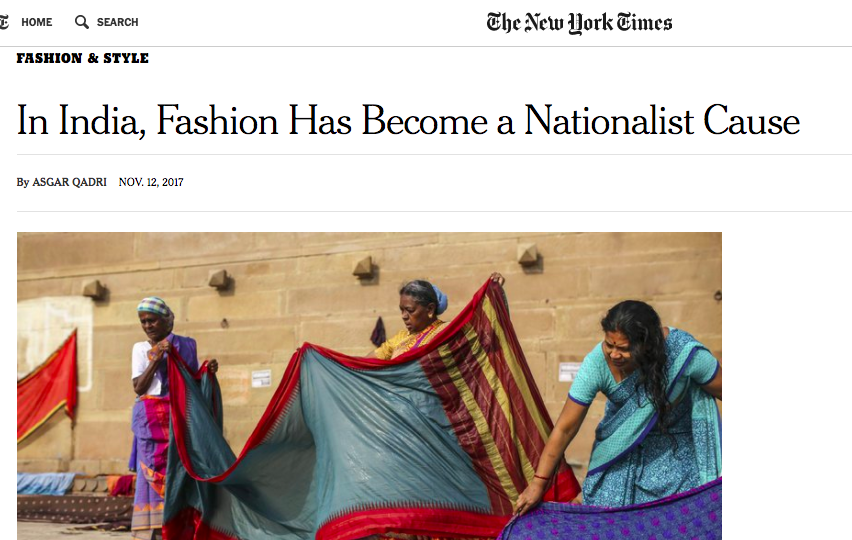
In what was a blatant display of their bile for India, the (NYT) published an article recently in the Fashion & Style segment.The Article was titled “In India, Fashion Has Become a Nationalist Cause” The Article links fashion, Hinduism and the Narendra Modi government in the most outrageous way!

The title itself was so cryptic that it took me a whole minute to deconstruct and understand the intent behind it and inturn the intent of the author, whose ultimate goal was to link fashion in India with the apparent rise in ‘aggressive’ nationalism and the present day government and give fashion a communal colour.

RelatedPosts

Sagarika Ghose Sparks Row With ‘Global Embarrassment’ Remark on US Murder Plot Case

Salman Rushdie Targets Hindu Nationalism, Internet Reminds Him of His Own Violent Attack

Rahul Gandhi’s Colombia Praise: Half-Truths and Hidden Ties

Load More

Now, while it may seem very improbable to link these three together, but the author, took it upon himself to weave an association between them all and present to us a spiteful article, where each word jumbled up to portray a biased one-sided view, and spewed venom against the present day government and the recent revival of the indigenous textile industry of India. The article, although meant to be a word on fashion, very subtly delved into the changing political scenario in India and eventually into atrocities against the minority population (Muslims) in the country under the leadership of the Modi Government. 

We are highlighting all the major points raised by the author (Mr. Asgar Qadri) in his article for the NYT and presenting a point by point rebuttal for the same:

Point one:

The article starts off by alleging that rising Hindu nationalism is one of the main causes which is restricting the country’s growth on the global level.

Rebuttal:

While the author may not like to acknowledge the facts and figures posted by Moody’s, it is the same “Hindu nationalist” government which he accused of stopping the growth, which was recently upgraded from to Baa2 from Baa3 ratings due to consistent reforms and progress in the country over the last 3 years since 2014. Apart from Moody’s the two biggest monetary organizations of the world viz. The World Bank and the IMF has expressed confidence in India’s economic state. Apart from these 3 Corporate bigshots like Indira Nuyi and Satya Nadella have praised the Modi Government for the jump in ‘ease of doing business in India’ rankings. Mr. Qadri must have been living under a rock to miss all these developments.

Point 2:

The author in the second paragraph, tries to invoke a feeling of prejudice against Indians by projecting the current government to be pro-hindu. He also said that the “BJP government since coming to power in 2014 had promoted traditional attire and had bypassed western styles”.

Rebuttal:

If the current government led by PM Modi was really so pro-Hindu, it wouldn’t have worked so tirelessly to abolish age old obsolete Islamic practices such as triple talaq. The government recently even lifted the rule which prohibited Muslim women to travel with a male companion for their HAJ pilgrimage, which until now was never done by the previous “secular” governments. 

It is disheartening to see that the author (Mr. Asgar Qadri) had completely disregarded the growth in the textiles and garments segment wherein, India’s textile and garments had shown a CAGR increase of 3.2 per cent in the last three years (since 2014) from Rs 2,47,546 crore in fiscal 2014-15 to Rs 2,63,494 crore in 2016-17. Not only this, the government had gone all out to increase the production of cotton and textiles in order to increase the exports in the textile sector, even allowing 100 per cent FDI in the Indian textiles sector under the automatic route.

Thus to my mind, if the “hindu-wadi” government is allowing 100% FDI in the textile sector, how is it stopping the potential growth of the country? That is something only Mr. Qadri can answer for (hopefully with facts and not with his absurd comparisons).

And if the production and exports in the textile sector increases, it would directly benefit the citizens of the country, irrespective of their religion, race or cast. Hence the presumption of Hindu population prospering while the Muslims languished in poverty is ridiculous if not preposterous.

Point 3:

In paragraph 3, the author completely transgressed into hardcore politics leaving behind the ‘main’ cause of fashion and style behind. Taking potshots by cryptically accusing the BJP government of appeasement politics, the author states:

“And with Narendra Modi, the party’s strongman of Hindu nationalism, as prime minister, fears that the country would head into a phase of aggressive nationalism have largely come true. Members of minority communities, accused of being disrespectful to cows, sacred to Hindus, have been lynched. Critics of Mr. Modi have been branded as “anti-national,” some shot and killed by Hindu nationalist activists.”

Rebuttal:

If standing up at the time of the playing of the national anthem or supporting the Armed Forces for its accomplishments against hardcore Islamic terrorists is aggressive nationalism, then yes, the country has indeed become aggressively nationalistic and patriotic after Narendra Modi became the PM of India. The country had gone into a slumber under the silent Manmohan Singh government since 2004 and it needed to be awakened by a lion’s roar.

As far as killings are concerned we really were unable to understand what Mr. Qadri meant by killing of Mr. Modi’s critics by Hindu nationalists. If he was referring to the murder of Gauri Lankesh, the journalist convicted for concocting false stories to sell her magazine (Lankesh Patrike), then the author should have known that the people suspected to have murdered Lankesh are not Hindu nationalists but members from her own clan (ultra left Maoists).

Fresh twist to Gauri Lankesh’s murder: ‘Ultra Left’ angle to the killing of the journalist #LankeshMurdered pic.twitter.com/XXfptO2IQG

— TIMES NOW (@TimesNow) September 6, 2017

Point 4:

Over here the author states that Mr. Modi had made traditional dress a priority and many in the fashion industry followed him, to please him.

Rebuttal:

How is it wrong if the Prime Minister of a particular country promotes the indigenous dress of his own country? Don’t the Saudi kings promote the Thobe (white gown and red scarf on the head), or the PM of Bhutan Tshering Tobgay promoting the “gho”, then how is it wrong if PM Modi promotes Kurta-Pyjama/Dhoti.

Secondly, if the people in the fashion industry were freely following Mr. Modi, isn’t it contradictory to the statements made by Mr. Qadri earlier in the article, where he had accused the government of pressing and pushing the traditional attire on the country. The above two statements are in absolute contradiction of each other and raise serious questions of neutrality of the author.

Point 5:

Going further, to give credence to his stray statements, Mr. Qadri quoted a statement from a self proclaimed expert on India, Miss Tereza Kuldova about how rising nationalism in India was a direct resultant in the rise in aesthetic production.

Rebuttal:

Who is Treza Kuldova and what is her study based on. Assuming but not admitting that Miss Kuldova is indeed right in her analysis, how is it a bad thing for India’s textile industry or the economy at large if the domestic manufacturing improves and increases the exports?

Point 6 coupled with Rebuttal:

After quoting a random anthropologist, Mr. Qadri abruptly transgressed into main stream politics again, instead of focusing on fashion and style, stating that Mr. Narendra Modi had tried to restore Indian-ness by introducing Make in India. He further quoted another Indian politician Shaina NC, who had initiated the revival of the Banarasi Textiles in 2015. While this was still fine, the author then absurdly hurried on to link this revival to Hinduism by claiming that a banarasi sari was anyway work by Hindu women (and not by a Christian or a Muslim woman) and hence this revival was not a revival of textiles or that of the rural economy but that of Hinduism. Sorry to say so, but such eccentric analogies only lead to the reader to question the ultimate motive of the author.

The only good thing here was the self admission of the author, Mr. Qadri where he stated that there was a revival of Indian-ness in fashion after Modi had become the PM, which leads us to a logically deduce that the Indian-ness in fashion was always there, but had somewhere been lost in the last 10 years of Italian rule [the smart reader would gauge the pun in this].

If this was not enough, the author in his bid to portray himself as a neutral entity, further forayed into the history of Indian politicians using native clothing for political gains. Mr. Qadri went to the extent of naming Gandhi ji and Nehru who are known for their trademark dhoti and Nehru jacket respectively as opportunistic politicians who used the native clothing for their political gains. While the fact about Gandhi topi/dhoti or the Nehru Jacket is that of a universal truth, one needs to accept the fact that these (the dhoti/Nehru jacket) were the daily attires of the common man back in the day. Be it lawyers or doctors, all used to wear a dhoti and a half jacket (which came to be known as Nehru Jacket later on), which formed a part of the formal Indian attire until the fad of shirt pants took Indians by the storm.

After painfully going through the article word by word, line by line, one would only imagine that getting any low beyond this point was not possible, but that is when Mr. Qadri surprised the reader again with his horrendous analytical skills, where he compared poverty with increasing social incomes for Muslims and then successfully concluding that because of the increase in textile production, the Hindus were becoming more and more aggressively nationalistic.

This is not all, he even gave a brief description of the gutters in Banaras, blaming PM Modi for not getting those fixed before pushing for a textile revolution in the country, thereby questioning PM Modi’s priorities.

Had it not been for reviewing the article and giving the reader the counter narrative, I would have never bothered to sit through the end and read this insidious piece. But having gone through it in detail, we have prepared a brief analysis and a detailed rebuttal for the sake and convenience of the reader to spare him from the agony of reading the article authored by Mr. Qadri who through his biased myopic vision has tried to create a feeling of unease amongst his readers in the West and that of inferiority amongst his readers in the East (South East). 

Conclusion:

This is not the 1st time media houses in the west have tried to distort and twist our culture, practices and history. These media organisations have forever been anti-India in their approach, be it the cartoon published by NY Times which tried to ridicule and belittle India’s Mars Mission or the one sided portrayal of the Aghori baba’s by CNN in their documentary, this piece by Mr. Asgar Qadri is no different and has rightly faced the wrath of Indians.

The article which sought to take pot-shots at the present day government, tried to take an alternative route of defaming the people of India and the Narendra Modi Government by linking present day fashion inspired by western ideology with the age old culture and tradition of India. But such shoddy pieces trying to link politics and fashion is not going to earn these paid media houses any brownie points considering, the people of India have finally found their identity. They no longer live in the shadows of their colonial past and are proud about their cultural roots.

Knowing all too well that their failed criticism towards the present day government on the economic front wouldn’t fetch them any brownie points, the NY Times tried an alternate way to target India and that was by communalising fashion and while their article failed miserably to ignite a fire of contempt for the Indian attire, it intriguingly prompted me to wear the dhoti/lungi even more frequently, to make it an everyday attire by replacing the track-pants and shorts.

Jai Hind

References: Special thanks to Mr. Dish Shah for his valuable inputs, helping us collate all facts and figures and present to the reader a comprehensive article.

Tags: Asgar QadrifashionHindu NationalismModi governmentNewyork Times
Share1146TweetSend
Previous Post

What a Tourist Guide in Kenya Said to me about PM Modi Will Make You Very Proud

Next Post

The Iconic Sankat Mochan Hanuman Idol in Karol Bagh Could be “Shifted”, For Ridiculous Reasons

Related Posts

Resolve of a Changing Bengal: Youth, Potential, and Call for Transformation
Opinions

Resolve of a Changing Bengal: Youth, Potential, and Call for Transformation

21 April 2026

The yearning for change in the soil of Bengal is not a sudden wave, it is a convergence of...

Redefining Terms of Truly Mutual Trade Deal: Sovereignty and Strategy in the US–Bangladesh Framework
Economy

Redefining Terms of Truly Mutual Trade Deal: Sovereignty and Strategy in the US–Bangladesh Framework

15 April 2026

The debate around Bangladesh’s emerging trade framework with the United States cannot be reduced to a binary choice of...

Race Against Iran Deadline: Was Pakistan’s Ceasefire Bid Driven by the White House?
Geopolitics

Race Against Iran Deadline: Was Pakistan’s Ceasefire Bid Driven by the White House?

9 April 2026

Pakistan attempted to position itself as a peacemaker in the escalating tensions involving Iran, but the reality behind the...

Load More

Leave a Reply Cancel reply

Your email address will not be published. Required fields are marked *

I agree to the Terms of use and Privacy Policy.
This site is protected by reCAPTCHA and the Google Privacy Policy and Terms of Service apply.

Currently Playing

From Runways to Warships: India’s Firefighting Warrior Built for Bases & Battles| IAF | VayuShakti

From Runways to Warships: India’s Firefighting Warrior Built for Bases & Battles| IAF | VayuShakti

00:05:40

Ethanol, EVs and Solar- How India’s Energy Game Is Changing | Modi on LPG & Crude Oil | war| Hormuz

00:05:21

Truth of IRIS Dena: 8 Days That Changed Narrative | War zone Reality, Not an Indian Navy Exercise

00:08:02

300 Million Euros for SCALP: Strategic Necessity or Costly Dependency on France300

00:04:06

Tejas Mk1A: 19th aircraft coupled but Not Delivered: What Is Holding Back the IAF Induction?

00:07:21
Facebook Twitter Instagram Youtube
tfipostTfipost.com
Right Wing | News Analysis | Indian Opinion
  • About us
  • Contact Us
  • Careers
  • Brand Partnerships
  • Terms of use
  • Privacy Policy
  • Sitemap

©2026 TFI Media Private Limited

No Result
View All Result
  • Premium
  • Politics
    • Analysis
    • Opinions
    • Trending
  • Economy
    • Business
    • Finance
  • Defense
    • Defence
    • Strategy
    • Weaponry
  • Geopolitics
    • Africa
    • Americas
    • Asia Pacific
    • Europe
    • South Asia
    • West Asia
  • Knowledge
    • Culture
    • History
    • Indology
  • Law
  • Lounge
    • Books
    • Cinema
    • Food
    • Health
    • Sports
    • technology
    • Travel
    • Satire
TFIPOST हिन्दी
TFIPOST Global

©2026 TFI Media Private Limited