
























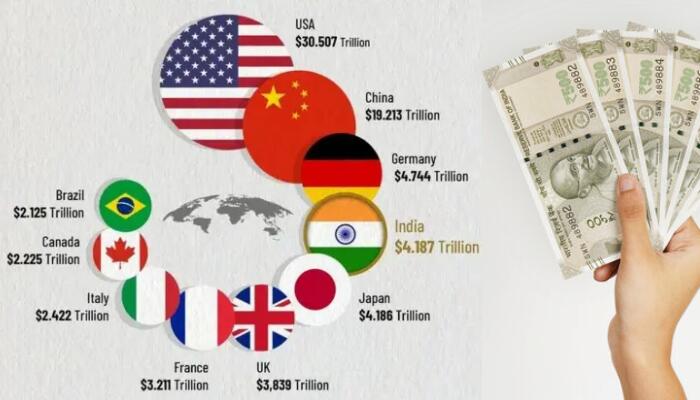
India’s economy closed FY 2025–26 with real GDP growth of 7.7%, marking a stronger-than-expected performance that highlights continued momentum in Asia’s third-largest economy. The final quarter of the fiscal year also remained robust, with growth at 7.8%, indicating sustained activity across key sectors despite global volatility and lingering geopolitical uncertainty.
The figures have been highlighted politically as evidence of economic stability under Prime Minister Narendra Modi, with the ruling establishment arguing that India is maintaining a durable growth path driven by domestic demand, investment revival and structural reforms.
BJP National President Nitin Nabin said the numbers reflect “robust economic activity and broad-based growth across sectors,” adding that the momentum is expanding opportunities for youth and strengthening overall economic confidence. The ruling Bharatiya Janata Party has framed the data as further validation of its long-term economic direction and its vision of Viksit Bharat 2047.
Services lead a broad-based sectoral expansion
The sectoral composition of FY 2025–26 shows that services remained the primary engine of growth. Trade, hotels, transport, communication, broadcasting and storage services expanded by 12.5% year-on-year, reflecting strong mobility, consumption activity and logistics-driven expansion.
Financial, real estate and professional services grew by 10.4%, reinforcing the strength of India’s financial ecosystem and knowledge economy. Manufacturing recorded a 7.3% increase, while construction expanded by 8.4%, supported by sustained infrastructure development and capital expenditure.
This widespread sectoral performance indicates that growth was not concentrated in a narrow segment but distributed across multiple drivers of the economy, strengthening overall macroeconomic stability.
Consumption and investment sustain momentum
For the full fiscal year, real GDP growth of 7.7% marginally exceeded earlier official estimates, signalling stronger-than-expected economic performance. Nominal GDP also expanded steadily, reflecting alignment between output growth and value creation.
Domestic demand remained the central pillar of expansion. Private consumption strengthened compared to the previous fiscal year, while gross fixed capital formation, a key indicator of investment activity, also accelerated. This combination of rising consumption and sustained investment has been critical in maintaining growth momentum despite global headwinds.
External risks temper outlook despite strong performance
While the headline growth figures remain strong, economists have flagged several risks that could weigh on performance in FY 2026–27. Elevated global energy prices, geopolitical tensions and potential climate-related disruptions, including El Niño-linked monsoon weakness, are expected to influence inflation, rural demand and investment sentiment.
Forecasts suggest that growth could moderate in the coming fiscal year, potentially easing towards the mid-6% range as global uncertainty persists and external pressures gradually filter into domestic economic activity.
A resilient expansion under global scrutiny
Despite these cautionary signals, the dominant policy narrative continues to emphasise resilience and continuity. The 7.7% growth print is being positioned as evidence that India remains firmly on a strong expansion path, supported by internal demand and diversified sectoral strength.
As FY 2025–26 concludes, the broader debate shifts towards sustainability rather than acceleration. The latest data strengthens the government’s claim of economic resilience under the current leadership, while economists continue to watch how long domestic drivers can offset a challenging global environment.