





















RelatedPosts
India has become the world’s fifth most digitalised economy, overtaking several advanced nations in a sharp upward shift in global rankings. The State of India’s Digital Economy (SIDE) 2026 report by the ICRIER-Prosus Centre for Internet and Digital Economy (IPCIDE) confirmed this position.
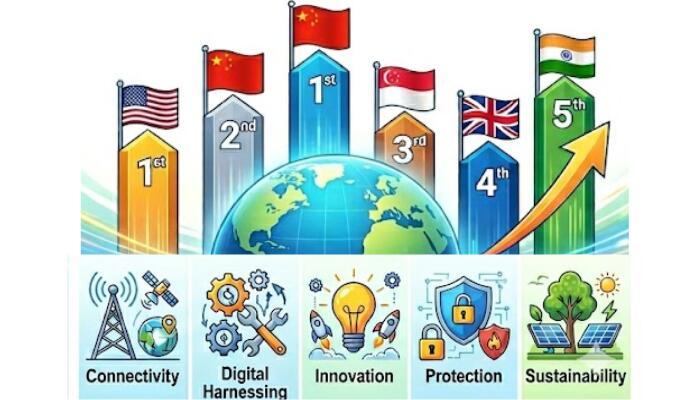
The report ranks India fifth on the CHIPS-Combined Index. Only the United States, China, Singapore and the United Kingdom rank above it. India stood at eighth place in 2025, showing a clear improvement in a single year.
CHIPS Index measures depth, not just access
The CHIPS framework evaluates 71 economies. It uses five pillars: connectivity, digital harnessing, innovation, protection and sustainability. The index focuses on how deeply digital systems operate within economies and institutions.
India improved its score across multiple pillars. The report links this rise to stronger digital public infrastructure and wider adoption of online services. It also notes that India now integrates digital tools more deeply into governance and economic activity.
Global digital power shifts towards a tripolar order
The report describes the global digital landscape as increasingly “tripolar”. The Indo-Pacific has gained influence alongside the North Atlantic bloc led by the United States and Europe.
This shift shows that digital power no longer sits in one region. Instead, it now spreads across multiple global centres. Asia plays a larger role in shaping digital growth and infrastructure.
AI and public digital systems drive India’s momentum
India’s rise reflects faster adoption of artificial intelligence. It also reflects rapid expansion of digital public infrastructure.
These changes have improved service delivery and widened access to digital platforms. They have also strengthened efficiency across sectors.
The SIDE 2026 report places India’s rise within a larger global shift. Digital strength now depends on innovation, integration and sustainability, not connectivity alone. India’s fifth-place ranking signals a stronger position in this changing global digital order.