






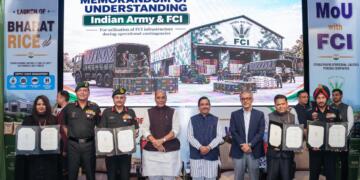















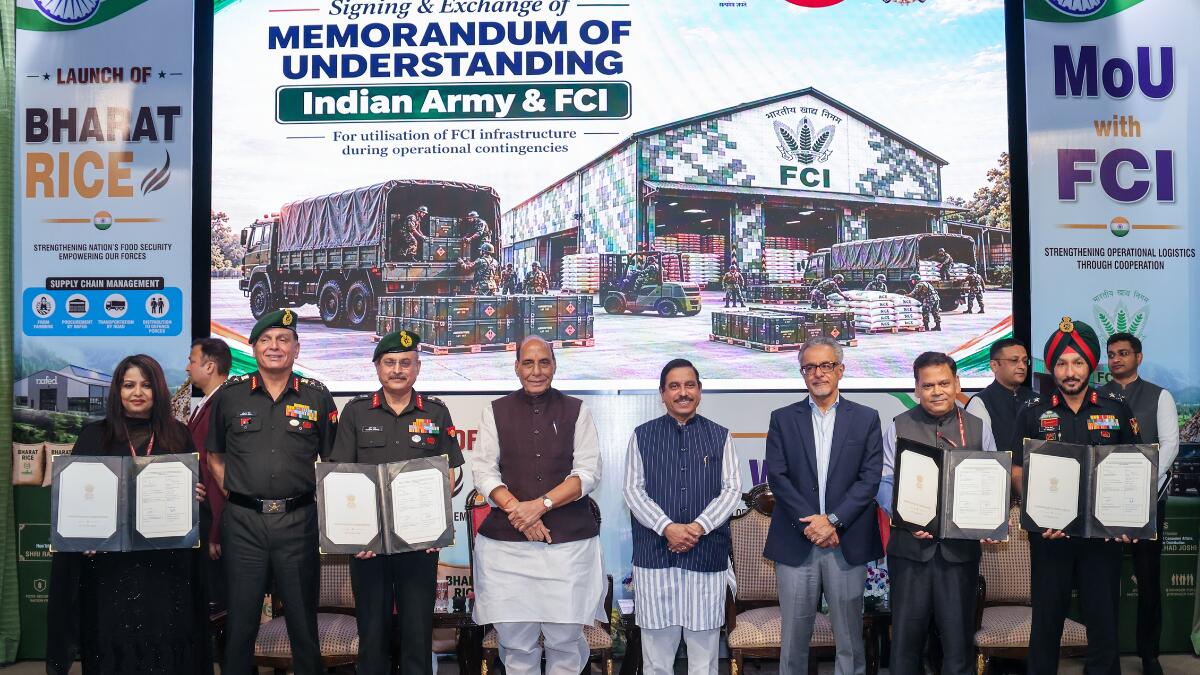
The Indian Army on Monday launched “Bharat Rice”, a defence-specification rice supply for troops, and signed an agreement with the Food Corporation of India (FCI) that lets it use the corporation’s warehouses, manpower and material-handling equipment during military emergencies. Defence Minister Rajnath Singh and Consumer Affairs, Food and Public Distribution Minister Pralhad Joshi attended the launch, according to a Press Information Bureau release.
Under the initiative, the rice will be delivered directly to Army Supply Depots, including those in Ladakh and the North East. Until now, depots collected it from local FCI facilities.
What Bharat Rice involves
The initiative is led by the Army’s Directorate General of Supplies and Transport and is based on feedback from troops about ration quality. The rice will be milled to prescribed defence specifications and supplied through the National Agricultural Cooperative Marketing Federation of India (NAFED) during Financial Year 2026-27. It will go through quality-control checks and must be free of foreign matter and admixtures, with minimal broken, damaged or discoloured grains.
It will be packed in 10 kg and 30 kg bags, which the Army says will make handling and transport easier, particularly at forward posts. The programme followed nearly 18 months of coordination among the Army, FCI, NAFED and the Department of Food and Public Distribution.
Singh said the change may look small, but it gives real operational relief to soldiers who carry rations to remote and difficult terrain. He described the rice as a link running from the farmer’s field to the soldier’s plate and tied it to the slogan “Jai Jawan, Jai Kisan”.
The FCI agreement
The memorandum of understanding gives the Army a formal framework to use identified FCI warehousing infrastructure, labour and equipment when operations require it. It is valid for five years and can be extended by mutual consent.
Coordination will happen at formation level between the Army’s Supply and Transport elements and FCI’s regional and divisional offices, and will be built into operational logistics plans. The Army says this will allow additional storage, rapid mobilisation, dispersal and forward positioning of rations, stores and equipment closer to operational areas. The release linked the initiative to the PM Gati Shakti infrastructure vision.
The agreement draws on lessons from Operation Sindoor, which the release says showed the need for logistics arrangements that can work in emergencies arising at short notice and lasting for long periods.
“Logistics is combat power”
Singh said logistics is itself combat power, and that modern wars are not won only at the front. Supply chains, storage capacity, transport networks, warehousing and timely replenishment matter just as much, he said. He added that the strategic review of Operation Sindoor suggested warning times in future conflicts could be extremely short, and that zero-warning scenarios and the growing role of technology could severely test the endurance of supply networks.
He pointed to FCI’s warehouses, modern silos, equipment and trained staff across the country, including in operationally important areas. He called the agreement a “dual-use” approach in which national infrastructure serves both civil and military needs, like fighter aircraft landing on expressways and Border Roads Organisation roads and bridges also being used by local residents. FCI godowns, he said, will no longer be limited to food storage and will become part of the Army’s supply chain. He called the pact a force multiplier for operational preparedness that reflects a “whole-of-government” and “whole-of-nation” approach.
Singh also said soldiers’ welfare is not a peripheral issue but an integral part of national security. Healthy food, robust equipment and thorough training lift morale, he said, and soldiers on the border should know the whole country stands behind them. He added that India now produces a significant share of its defence requirements domestically.
Joshi said it was a matter of pride for his department to provide superior-quality rice to those who guard the nation, and that feeding them well is a duty.
Other ration measures
The release said the Army has taken a series of steps in recent years to improve the quality and scale of rations, including additional rations for Agniveer recruits and greater commonality in ration scales across the three Services. It also said organic rations are proposed to be introduced.
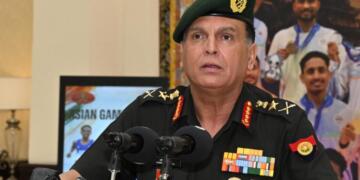
Army chief General Dhiraj Seth, Food and Public Distribution Secretary Sanjeev Chopra, and senior officials from the Defence Ministry, the Consumer Affairs and Food Ministry, FCI, NAFED and the cooperative sector were present at the launch.