





















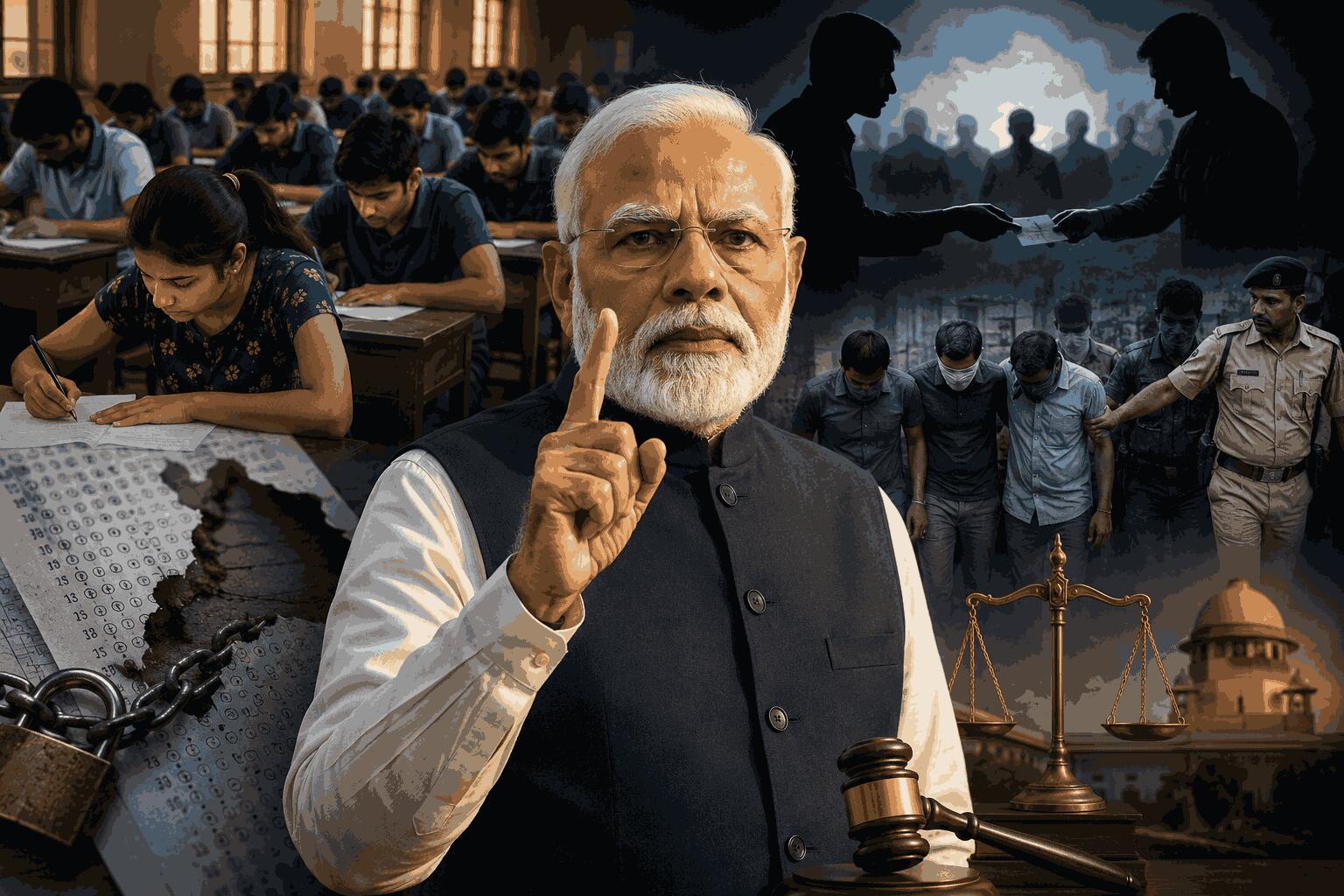
In a forceful intervention that seeks to restore confidence in India’s examination system, PM Modi has made it clear that those responsible for the NEET paper leak will face the harshest possible punishment.
Addressing lawmakers and party colleagues, PM Modi reportedly described the issue as a national concern that transcends partisan politics and directly affects the aspirations of millions of young Indians. His message was simple: the future of students cannot be compromised under any circumstances.
The significance of the statement lies not merely in its political tone but in the recognition that competitive examinations in India are often life-defining moments for families. For many students, years of preparation, financial sacrifice, and emotional investment culminate in a single examination. Any breach of integrity therefore strikes at the heart of public trust.
By demanding the “strictest” punishment for the accused, PM Modi has signalled that the government views paper leaks not as routine administrative failures but as crimes against meritocracy. According to officials, multiple arrests have already been made in connection with the case, and the Centre has emphasized swift action to contain the damage and identify those involved.
Yet punishment alone will not be enough. The deeper challenge is institutional. India’s examination ecosystem handles millions of candidates across thousands of centres, making security, logistics, and digital monitoring extraordinarily complex. The NEET controversy has once again exposed vulnerabilities that demand long-term reform rather than temporary crisis management.
That is why PM Modi has also called for a “foolproof” examination system, stressing that young people must be able to trust the fairness of national tests. This is perhaps the most consequential part of his intervention. A democracy can absorb political disagreement; it cannot easily absorb a collapse of faith in merit-based opportunity.
Critics will argue that repeated examination controversies show that existing safeguards have not worked. Supporters will counter that the government’s rapid response, arrests, and public acknowledgement of the problem demonstrate seriousness. Both perspectives contain some truth. What ultimately matters is whether future examinations become demonstrably more secure.
For that reason, the coming months will be a test not only for investigators but also for policymakers. If PM Modi can convert the current outrage into structural reform—stronger encryption, tighter paper movement protocols, greater accountability for testing agencies, and faster prosecution of organised leak networks—the crisis may yet produce a stronger system than the one that failed.
There is also a broader political dimension. India’s youth population is ambitious, impatient, and deeply invested in education as a pathway to mobility. Recognizing that reality, PM Modi has repeatedly framed the issue as one involving the dreams of an entire generation rather than the fortunes of any single government or opposition party.
In the end, the credibility of competitive examinations rests on a simple promise: hard work must matter more than connections, money, or criminal networks. By declaring that students’ futures are non-negotiable, PM Modi has raised the stakes considerably. The country will now judge the government not by its words, but by whether every deserving student can once again walk into an examination hall believing that the contest is fair.