





















TFIPOST हिन्दी
TFIPOST Global
Tfipost.com
Tfipost.com
No Result
View All Result
  • Premium
  • Politics
    • All
    • Analysis
    • Opinions
    • Trending
    New address, old controversy as “Sheesh Mahal 2”

    From Flagstaff Road To Lodhi Estate: Kejriwal’s New Bungalow Triggers Fresh “Sheesh Mahal 2” Political Controversy

    The Bengal campaign takes a more aggressive turn.

    “Bengal Under Mafia Grip”: Yogi Adityanath Escalates Attack On TMC, Flags ‘Identity Crisis’ In Rally

    From AAP dissenter to BJP rebel, Swati Maliwal sharpens her attack on Kejriwal

    Did Swati Maliwal Just Puncture AAP’s Politics of Virtue?

    Ahmadis in Pakistan: From Faith to Marginalisation Under Law and Society

    Ahmadis in Pakistan: From Faith to Marginalisation Under Law and Society

    • Analysis
    • Opinions
    • Trending
  • Economy
    • All
    • Business
    • Economy1
    • Finance
    Ahmadis in Pakistan: From Faith to Marginalisation Under Law and Society

    Ahmadis in Pakistan: From Faith to Marginalisation Under Law and Society

    Open Demat Account with Zero Annual Maintenance Charges What to Look For

    Open Demat Account with Zero Annual Maintenance Charges What to Look For

    Blood in the Meadows: How the Pahalgam Terror Attack Exposed Calculated Targeting of Civilians in Kashmir

    Blood in the Meadows: How the Pahalgam Terror Attack Exposed Calculated Targeting of Civilians in Kashmir

    Indian economy is stronger than the ranking.

    IMF Ranking Jolt Misread: India’s Economy Strong, Sixth Spot Just a Statistical Glitch

    • Business
    • Finance
  • Defense
    • All
    • Defence
    • Strategy
    • Weaponry
    The scars of Pahalgam endure, even as the nation moves forward

    Pahalgam Anniversary: Modi Signals Firm National Stand as India Reasserts Anti-Terror Resolve

    Precision Strike: Indian Army Approves Procurement of Indigenous MPATGM to Modernise Infantry Wings

    Precision Strike: Indian Army Approves Procurement of Indigenous MPATGM to Modernise Infantry Wings

    Amit Shah on sensitive Gorkha land issue

    Shah Assures Constitutional Path for Gorkha Issue, Intensifies Attack on TMC at Bengal Rally

    Historic Leap for ‘Aatmanirbhar Bharat’ as First India-Made BrahMos Missiles from Lucknow Join Indian Army

    Historic Leap for ‘Aatmanirbhar Bharat’ as First India-Made BrahMos Missiles from Lucknow Join Indian Army

    • Defence
    • Strategy
    • Weaponry
  • Geopolitics
    • All
    • Africa
    • Americas
    • Asia Pacific
    • Europe
    • South Asia
    • West Asia
    Pakistan Tried to Bury an NYT Report. It Only Exposed Asim Munir’s Panic

    Pakistan Tried to Bury an NYT Report. It Only Exposed Asim Munir’s Panic

    The Strategic Double-Game: Pakistan’s Fatal Gambit in the US-Iran War

    The Strategic Double-Game: Pakistan’s Fatal Gambit in the US-Iran War

    When a repost became a foreign policy problem

    Trump’s India ‘Hellhole’ Insult Triggers Backlash as New Delhi Hits Back, US Scrambles for Damage Control

    PLA Navy Day Spectacle vs South China Sea Reality: How Beijing’s Naval Pageantry Masks Maritime Coercion

    PLA Navy Day Spectacle vs South China Sea Reality: How Beijing’s Naval Pageantry Masks Maritime Coercion

    • Africa
    • Americas
    • Asia Pacific
    • Europe
    • South Asia
    • West Asia
  • Knowledge
    • All
    • Culture
    • Education
    • History
    • Indology
    Chants of ‘Jai Badri Vishal’ Echo as Badrinath Portals Open; All Four Dhams Now Accessible to Pilgrims

    Chants of ‘Jai Badri Vishal’ Echo as Badrinath Portals Open; All Four Dhams Now Accessible to Pilgrims

    Kedarnath Dham Portals Open for Devotees After 181 Days Amid Vedic Chants, Traditional Rituals

    Kedarnath Dham Portals Open for Devotees After 181 Days Amid Vedic Chants, Traditional Rituals

    Sardar Patel and Amit Shah

    Sardar Patel’s 1947 Blueprint on Minority Quotas Resurfaces as Reservation Debate Returns to Centre Stage

    The 1973 Constitution and ‘Bhutto’ the Man Who Made It: What Pakistan Owes and What It Destroyed

    The 1973 Constitution and ‘Bhutto’ the Man Who Made It: What Pakistan Owes and What It Destroyed

    • Culture
    • History
    • Indology
  • Law
  • Lounge
    • All
    • Books
    • Cinema
    • Entertainment
    • Food
    • Games
    • Health
    • Lifestyle
    • Satire
    • Sports
    • technology
    • Travel
    Digital Data Collection In India

    India’s Data Reset Begins: Census 2027 to Become First Fully Digital Population Count

    5 Facilities in Bengaluru Specializing in Mental Health Treatment for Those with Cancer

    5 Facilities in Bengaluru Specializing in Mental Health Treatment for Those with Cancer

    UNESCO World Book Day and Copyright Day

    World Book Day 2026: UNESCO’s Multilingual Push Aligns with India’s Deep Literary Continuum

    Fashion Fusion Accessory Pairings That Modernize Your Look

    Fashion Fusion Accessory Pairings That Modernize Your Look

    • Books
    • Cinema
    • Food
    • Health
    • Sports
    • technology
    • Travel
    • Satire
Tfipost.com
  • Premium
  • Politics
    • All
    • Analysis
    • Opinions
    • Trending
    New address, old controversy as “Sheesh Mahal 2”

    From Flagstaff Road To Lodhi Estate: Kejriwal’s New Bungalow Triggers Fresh “Sheesh Mahal 2” Political Controversy

    The Bengal campaign takes a more aggressive turn.

    “Bengal Under Mafia Grip”: Yogi Adityanath Escalates Attack On TMC, Flags ‘Identity Crisis’ In Rally

    From AAP dissenter to BJP rebel, Swati Maliwal sharpens her attack on Kejriwal

    Did Swati Maliwal Just Puncture AAP’s Politics of Virtue?

    Ahmadis in Pakistan: From Faith to Marginalisation Under Law and Society

    Ahmadis in Pakistan: From Faith to Marginalisation Under Law and Society

    • Analysis
    • Opinions
    • Trending
  • Economy
    • All
    • Business
    • Economy1
    • Finance
    Ahmadis in Pakistan: From Faith to Marginalisation Under Law and Society

    Ahmadis in Pakistan: From Faith to Marginalisation Under Law and Society

    Open Demat Account with Zero Annual Maintenance Charges What to Look For

    Open Demat Account with Zero Annual Maintenance Charges What to Look For

    Blood in the Meadows: How the Pahalgam Terror Attack Exposed Calculated Targeting of Civilians in Kashmir

    Blood in the Meadows: How the Pahalgam Terror Attack Exposed Calculated Targeting of Civilians in Kashmir

    Indian economy is stronger than the ranking.

    IMF Ranking Jolt Misread: India’s Economy Strong, Sixth Spot Just a Statistical Glitch

    • Business
    • Finance
  • Defense
    • All
    • Defence
    • Strategy
    • Weaponry
    The scars of Pahalgam endure, even as the nation moves forward

    Pahalgam Anniversary: Modi Signals Firm National Stand as India Reasserts Anti-Terror Resolve

    Precision Strike: Indian Army Approves Procurement of Indigenous MPATGM to Modernise Infantry Wings

    Precision Strike: Indian Army Approves Procurement of Indigenous MPATGM to Modernise Infantry Wings

    Amit Shah on sensitive Gorkha land issue

    Shah Assures Constitutional Path for Gorkha Issue, Intensifies Attack on TMC at Bengal Rally

    Historic Leap for ‘Aatmanirbhar Bharat’ as First India-Made BrahMos Missiles from Lucknow Join Indian Army

    Historic Leap for ‘Aatmanirbhar Bharat’ as First India-Made BrahMos Missiles from Lucknow Join Indian Army

    • Defence
    • Strategy
    • Weaponry
  • Geopolitics
    • All
    • Africa
    • Americas
    • Asia Pacific
    • Europe
    • South Asia
    • West Asia
    Pakistan Tried to Bury an NYT Report. It Only Exposed Asim Munir’s Panic

    Pakistan Tried to Bury an NYT Report. It Only Exposed Asim Munir’s Panic

    The Strategic Double-Game: Pakistan’s Fatal Gambit in the US-Iran War

    The Strategic Double-Game: Pakistan’s Fatal Gambit in the US-Iran War

    When a repost became a foreign policy problem

    Trump’s India ‘Hellhole’ Insult Triggers Backlash as New Delhi Hits Back, US Scrambles for Damage Control

    PLA Navy Day Spectacle vs South China Sea Reality: How Beijing’s Naval Pageantry Masks Maritime Coercion

    PLA Navy Day Spectacle vs South China Sea Reality: How Beijing’s Naval Pageantry Masks Maritime Coercion

    • Africa
    • Americas
    • Asia Pacific
    • Europe
    • South Asia
    • West Asia
  • Knowledge
    • All
    • Culture
    • Education
    • History
    • Indology
    Chants of ‘Jai Badri Vishal’ Echo as Badrinath Portals Open; All Four Dhams Now Accessible to Pilgrims

    Chants of ‘Jai Badri Vishal’ Echo as Badrinath Portals Open; All Four Dhams Now Accessible to Pilgrims

    Kedarnath Dham Portals Open for Devotees After 181 Days Amid Vedic Chants, Traditional Rituals

    Kedarnath Dham Portals Open for Devotees After 181 Days Amid Vedic Chants, Traditional Rituals

    Sardar Patel and Amit Shah

    Sardar Patel’s 1947 Blueprint on Minority Quotas Resurfaces as Reservation Debate Returns to Centre Stage

    The 1973 Constitution and ‘Bhutto’ the Man Who Made It: What Pakistan Owes and What It Destroyed

    The 1973 Constitution and ‘Bhutto’ the Man Who Made It: What Pakistan Owes and What It Destroyed

    • Culture
    • History
    • Indology
  • Law
  • Lounge
    • All
    • Books
    • Cinema
    • Entertainment
    • Food
    • Games
    • Health
    • Lifestyle
    • Satire
    • Sports
    • technology
    • Travel
    Digital Data Collection In India

    India’s Data Reset Begins: Census 2027 to Become First Fully Digital Population Count

    5 Facilities in Bengaluru Specializing in Mental Health Treatment for Those with Cancer

    5 Facilities in Bengaluru Specializing in Mental Health Treatment for Those with Cancer

    UNESCO World Book Day and Copyright Day

    World Book Day 2026: UNESCO’s Multilingual Push Aligns with India’s Deep Literary Continuum

    Fashion Fusion Accessory Pairings That Modernize Your Look

    Fashion Fusion Accessory Pairings That Modernize Your Look

    • Books
    • Cinema
    • Food
    • Health
    • Sports
    • technology
    • Travel
    • Satire
No Result
View All Result
Tfipost.com
Tfipost.com
No Result
View All Result
  • Premium
  • Politics
  • Economy
  • Defense
  • Geopolitics
  • Knowledge
  • Law
  • Lounge

Not Just Strike-Ready: How the IAF’s Swadeshi FF Bot Is Redefining What Airbase Preparedness Means

Strikes on fuel depots near Tehran caused a river of fire to pour out along the streets, with the city engulfed in thick black smoke and toxic rain falling on surrounding neighbourhoods

Raisa Raje Malla by Raisa Raje Malla
6 April 2026
in Defence, Strategy, Trending, Weaponry
Not Just Strike-Ready: How the IAF’s Swadeshi FF Bot Is Redefining What Airbase Preparedness Means

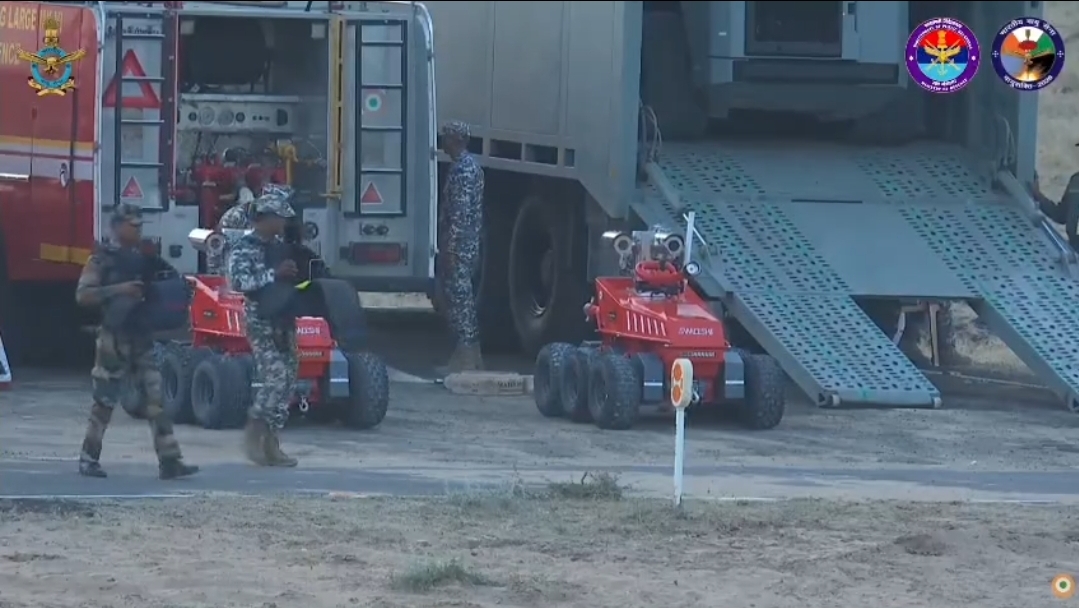
IAF’s firefighting robot in action during Vayu Shakti 2026

Share on FacebookShare on X

The images coming out of Iran since February 28, 2026, have rewritten the textbook on what modern aerial warfare actually looks like in its aftermath. Strikes on fuel depots near Tehran caused a river of fire to pour out along the streets, with the city engulfed in thick black smoke and toxic rain falling on surrounding neighbourhoods.

US B-52 bombers targeted an ammunition depot and airbase in Isfahan, causing vast explosions, the signature chain-reaction that military engineers have long warned about, where heat from one strike bleeds into adjacent munitions stores and fuel lines, turning a single hit into a rolling catastrophe.

RelatedPosts

Pakistan Tried to Bury an NYT Report. It Only Exposed Asim Munir’s Panic

Trump’s India ‘Hellhole’ Insult Triggers Backlash as New Delhi Hits Back, US Scrambles for Damage Control

Could India Become a Diplomatic Space in the West Asia Crisis? Rajnath Singh Hints at Possibility

Load More

What the ongoing conflict in Iran has made viscerally clear is something defence planners have understood in theory for years–in high-intensity warfare, fire is not the aftermath of a strike. It is the second weapon. And unlike the missile that started it, fire does not discriminate between a runway, a hangar, an armaments bay, and the fuel farm that keeps an entire air operation alive.

It is against this backdrop that the Indian Air Force’s wider preparedness activities around Vayu Shakti 2026 received a quietly consequential technological boost—an indigenously built Firefighting Robot, the FF Bot, emerging as one of the most significant support assets tested at Pokhran.

Developed through the start-up ecosystem nurtured by iDEX, the robot’s performance underscored India’s broader shift toward self-driven defence innovation at precisely the moment when the world’s most active war zone was demonstrating, in real time, why such a capability cannot be an afterthought.

The FF Bot is built to operate inside fuel storage zones, explosive environments, aircraft hangars, and high-risk corridors where human access becomes dangerous seconds after a fire breaks out. Its rugged frame, heat-resistant shielding, and remote-guided mobility allow it to move across debris, deliver fire suppressants and stream real-time visuals from deep inside compromised structures. The self-cooling system keeps it functional under sustained heat.

Its 360-degree turning radius is built for the confined geometries of military installations, narrow service corridors, blast-walled munitions bays, the cluttered undersides of aircraft hangars—and its thermal imaging cuts through smoke where optical cameras go blind. These are not features designed for a peacetime industrial fire. They are designed for the minutes after a missile lands on an airbase, and the question shifts from how to retaliate to whether the base will survive.

Defence officials noted that the robot’s demonstrations, run alongside the Air Force’s operational exercises, spoke directly to a gap that has existed for some time—the need for reliable support systems capable of protecting critical assets when they are most at risk. Bases handling aviation fuel, liquid oxygen, armaments and sensitive equipment face layered, compounding risks during emergencies.

Strikes across military sites in Iran damaged or destroyed communications infrastructure, fuel depots, maintenance facilities, and aircraft hangars in combinations that no single human response team could address simultaneously. The FF Bot’s value in such a scenario lies precisely in its ability to enter the most dangerous node of that cascade—the burning fuel line near the munitions store, the smoke-filled hangar where aircraft are still present before any human crew can safely follow.

The Indian Air Force’s engineering branches contributed to refinement trials, helping validate durability under high-temperature stress, uneven terrain and low-visibility conditions. Officials noted that the robot didn’t just meet the performance benchmarks set for base-level firefighting equipment it cleared them with room to spare. That result carries significance beyond the technical.

The FF Bot’s appearance alongside the Vayu Shakti preparedness cycle points to a shift in how India is thinking about defence readiness. Building strike capability is one part of the equation. Keeping the infrastructure that supports it—the fuel depots, the hangars, the armament stores intact and operational is the other. One does not work without the other, and for a long time, that second half of the equation did not receive nearly enough attention.

The robot’s journey from concept to field demonstration reflects the growing maturity of India’s defence-innovation ecosystem. Under iDEX, more than 300 companies have received cumulative orders of more than Rs 1,500 crore, replacing long procurement cycles with faster, problem-driven development loops.

For Swadeshi Empresa Pvt Ltd, the company behind the FF Bot, that meant early access to field feedback from fire-safety teams across defence bases—feedback that shaped the system through real operational demand rather than theoretical specifications. Each cross-service trial iteration produced refinements that are visible in the finished hardware. That process would have been unlikely without the structured access to trials and funding that iDEX made possible, and its results are now operationally credible in a way that matters.

What sets the FF Bot apart from imported alternatives is not just its price point but its adaptability, the fact that it has been shaped, iteration by iteration, by the people who will actually use it in the field. Indigenous technology is now finding its way into corners of military preparedness that were previously either neglected or dependent on foreign supply.

The images coming out of Iran since February 28, 2026, have rewritten the textbook on what modern aerial warfare actually looks like in its aftermath. Strikes on fuel depots near Tehran caused a river of fire to pour out along the streets, with the city engulfed in thick black smoke and toxic rain falling on surrounding neighbourhoods.

US B-52 bombers targeted an ammunition depot and airbase in Isfahan, causing vast explosions, the signature chain-reaction that military engineers have long warned about, where heat from one strike bleeds into adjacent munitions stores and fuel lines, turning a single hit into a rolling catastrophe.

What the ongoing conflict in Iran has made viscerally clear is something defence planners have understood in theory for years–in high-intensity warfare, fire is not the aftermath of a strike. It is the second weapon. And unlike the missile that started it, fire does not discriminate between a runway, a hangar, an armaments bay, and the fuel farm that keeps an entire air operation alive.

It is against this backdrop that the Indian Air Force’s wider preparedness activities around Vayu Shakti 2026 received a quietly consequential technological boost, an indigenously built Firefighting Robot, the FF Bot, emerging as one of the most significant support assets tested at Pokhran.

Developed through the start-up ecosystem nurtured by iDEX, the robot’s performance underscored India’s broader shift toward self-driven defence innovation at precisely the moment when the world’s most active war zone was demonstrating, in real time, why such a capability cannot be an afterthought.

The FF Bot is built to operate inside fuel storage zones, explosive environments, aircraft hangars, and high-risk corridors where human access becomes dangerous seconds after a fire breaks out. Its rugged frame, heat-resistant shielding, and remote-guided mobility allow it to move across debris, deliver fire suppressants and stream real-time visuals from deep inside compromised structures. The self-cooling system keeps it functional under sustained heat.

Its 360-degree turning radius is built for the confined geometries of military installations narrow service corridors, blast-walled munitions bays, the cluttered undersides of aircraft hangars and its thermal imaging cuts through smoke where optical cameras go blind. These are not features designed for a peacetime industrial fire. They are designed for the minutes after a missile lands on an airbase, and the question shifts from how to retaliate to whether the base will survive.

Defence officials noted that the robot’s demonstrations, run alongside the Air Force’s operational exercises, spoke directly to a gap that has existed for some time—the need for reliable support systems capable of protecting critical assets when they are most at risk. Bases handling aviation fuel, liquid oxygen, armaments and sensitive equipment face layered, compounding risks during emergencies.

Strikes across military sites in Iran damaged or destroyed communications infrastructure, fuel depots, maintenance facilities, and aircraft hangars in combinations that no single human response team could address simultaneously. The FF Bot’s value in such a scenario lies precisely in its ability to enter the most dangerous node of that cascade—the burning fuel line near the munitions store, the smoke-filled hangar where aircraft are still present before any human crew can safely follow.

The Indian Air Force’s engineering branches contributed to refinement trials, helping validate durability under high-temperature stress, uneven terrain and low-visibility conditions. Officials noted that the robot didn’t just meet the performance benchmarks set for base-level firefighting equipment it cleared them with room to spare. That result carries significance beyond the technical.

The FF Bot’s appearance alongside the Vayu Shakti preparedness cycle points to a shift in how India is thinking about defence readiness. Building strike capability is one part of the equation. Keeping the infrastructure that supports it the fuel depots, the hangars, the armament stores intact and operational is the other. One does not work without the other, and for a long time, that second half of the equation did not receive nearly enough attention.

The robot’s journey from concept to field demonstration reflects the growing maturity of India’s defence-innovation ecosystem. Under iDEX, more than 300 companies have received cumulative orders of more than Rs 1,500 crore, replacing long procurement cycles with faster, problem-driven development loops.

For Swadeshi Empresa Pvt Ltd, the company behind the FF Bot, that meant early access to field feedback from fire-safety teams across defence bases feedback that shaped the system through real operational demand rather than theoretical specifications. Each cross-service trial iteration produced refinements that are visible in the finished hardware. That process would have been unlikely without the structured access to trials and funding that iDEX made possible, and its results are now operationally credible in a way that matters.

What sets the FF Bot apart from imported alternatives is not just its price point but its adaptability the fact that it has been shaped, iteration by iteration, by the people who will actually use it in the field. Indigenous technology is now finding its way into corners of military preparedness that were previously either neglected or dependent on foreign supply.

The images coming out of Iran since February 28, 2026, have rewritten the textbook on what modern aerial warfare actually looks like in its aftermath. Strikes on fuel depots near Tehran caused a river of fire to pour out along the streets, with the city engulfed in thick black smoke and toxic rain falling on surrounding neighbourhoods.

US B-52 bombers targeted an ammunition depot and airbase in Isfahan, causing vast explosions, the signature chain-reaction that military engineers have long warned about, where heat from one strike bleeds into adjacent munitions stores and fuel lines, turning a single hit into a rolling catastrophe.

What the ongoing conflict in Iran has made viscerally clear is something defence planners have understood in theory for years–in high-intensity warfare, fire is not the aftermath of a strike. It is the second weapon. And unlike the missile that started it, fire does not discriminate between a runway, a hangar, an armaments bay, and the fuel farm that keeps an entire air operation alive.

Tags: airbase safetycombat preparednessdefence innovationdefence technologyemergency responseFF Botfire response systemFirefighting robotIAFiDEXIndian Air Forceindigenous technologyIranmilitary roboticsPokhran exercisestrikesUnmanned SystemsUS B-52 BombersVayu Shakti exercise
ShareTweetSend
Previous Post

‘BAPS Temple’ Row: Guardian Report, Legal Closure, and the Debate Over Allegations

Next Post

Live Dealer Roulette Online Casinos: A Real Player’s Guide to Real-Time Roulette

Related Posts

New address, old controversy as “Sheesh Mahal 2”
Politics

From Flagstaff Road To Lodhi Estate: Kejriwal’s New Bungalow Triggers Fresh “Sheesh Mahal 2” Political Controversy

25 April 2026

Arvind Kejriwal’s relocation to a government bungalow at 95 Lodhi Estate has brought a fresh political stir in Delhi....

The Bengal campaign takes a more aggressive turn.
Politics

“Bengal Under Mafia Grip”: Yogi Adityanath Escalates Attack On TMC, Flags ‘Identity Crisis’ In Rally

25 April 2026

West Bengal’s election contest sharpened as Uttar Pradesh Chief Minister Yogi Adityanath addressed a high-energy rally in Nadia district....

Ahmadis in Pakistan: From Faith to Marginalisation Under Law and Society
Economy

Ahmadis in Pakistan: From Faith to Marginalisation Under Law and Society

25 April 2026

The troubles of Ahmadis in Pakistan are not merely those of a religious minority, their story is about how...

Load More

Leave a Reply Cancel reply

Your email address will not be published. Required fields are marked *

I agree to the Terms of use and Privacy Policy.
This site is protected by reCAPTCHA and the Google Privacy Policy and Terms of Service apply.

Currently Playing

From Runways to Warships: India’s Firefighting Warrior Built for Bases & Battles| IAF | VayuShakti

From Runways to Warships: India’s Firefighting Warrior Built for Bases & Battles| IAF | VayuShakti

00:05:40

Ethanol, EVs and Solar- How India’s Energy Game Is Changing | Modi on LPG & Crude Oil | war| Hormuz

00:05:21

Truth of IRIS Dena: 8 Days That Changed Narrative | War zone Reality, Not an Indian Navy Exercise

00:08:02

300 Million Euros for SCALP: Strategic Necessity or Costly Dependency on France300

00:04:06

Tejas Mk1A: 19th aircraft coupled but Not Delivered: What Is Holding Back the IAF Induction?

00:07:21
Facebook Twitter Instagram Youtube
tfipostTfipost.com
Right Wing | News Analysis | Indian Opinion
  • About us
  • Contact Us
  • Careers
  • Brand Partnerships
  • Terms of use
  • Privacy Policy
  • Sitemap

©2026 TFI Media Private Limited

No Result
View All Result
  • Premium
  • Politics
    • Analysis
    • Opinions
    • Trending
  • Economy
    • Business
    • Finance
  • Defense
    • Defence
    • Strategy
    • Weaponry
  • Geopolitics
    • Africa
    • Americas
    • Asia Pacific
    • Europe
    • South Asia
    • West Asia
  • Knowledge
    • Culture
    • History
    • Indology
  • Law
  • Lounge
    • Books
    • Cinema
    • Food
    • Health
    • Sports
    • technology
    • Travel
    • Satire
TFIPOST हिन्दी
TFIPOST Global

©2026 TFI Media Private Limited