




















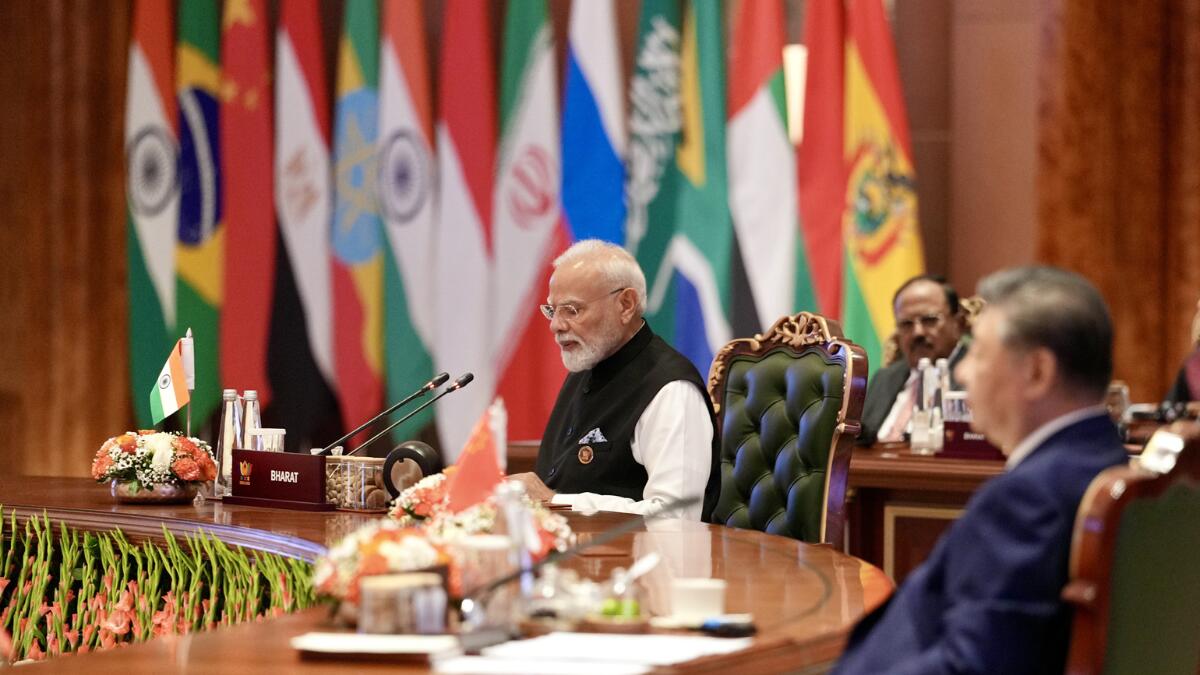
BRICS leaders on Saturday adopted the New Delhi Declaration 2026 by consensus, capping a tense day of back-channel negotiations that had pitted Iran against the United Arab Emirates over how the bloc should characterise the ongoing conflict in West Asia. The breakthrough, announced by Prime Minister Narendra Modi at the close of the summit’s opening day, marked a significant diplomatic win for India’s chairship of the 11-nation grouping.
A rift that nearly derailed the summit
Since BRICS operates strictly on consensus — meaning a single dissenting member can block any joint text — the disagreement between Tehran and Abu Dhabi threatened to leave India, as host and chair, without a unifying document altogether. The core sticking point was over language referencing the military campaign waged by the United States and Israel against Iran, and Tehran’s subsequent strikes on installations in the UAE and other parts of West Asia. Both countries reportedly held firm to their opening positions well into the negotiations, with talks continuing right up to the moment the declaration was finalised.
The dispute wasn’t new. India had been working the Sherpa channel for months to try to bridge the gap, and similar fault lines had already stalled consensus at several ministerial-level BRICS meetings earlier in the year. The hostilities in West Asia had also disrupted shipping through the Strait of Hormuz and pushed up global energy prices — giving the disagreement real economic stakes for the wider grouping, not just a diplomatic one.
Consensus, and why it mattered
That the declaration went through unanimously — with Modi announcing plainly, “No member has raised any objection. The New Delhi Declaration 2026 is adopted unanimously” — carried particular weight given that Iran, Saudi Arabia and the UAE all sit inside BRICS despite openly divergent, sometimes competing, positions on regional issues. Analysts framed the outcome as proof that India’s chairship had managed to hold together an increasingly large and diplomatically complex bloc, even as sharp divisions persisted underneath. The declaration itself also flagged concern over growing risks of nuclear escalation tied to the broader West Asia crisis, alongside the language addressing Iran and the UAE directly.
The moment carried some symbolic freight too: Iranian President Masoud Pezeshkian was the only visiting BRICS leader to hold a separate meeting with President Droupadi Murmu during the summit, and it marked the first time the bloc’s leaders had gathered together since the conflict began.
A unified line on terrorism — and on Pahalgam
Where the West Asia paragraph required delicate wording to survive, the bloc’s language on terrorism was unambiguous. The declaration stated:
“We express strong condemnation of any acts of terrorism as criminal and unjustifiable, regardless of their motivation, whenever, wherever and by whomsoever committed. We condemn in the strongest terms the terrorist attack in Jammu and Kashmir on 22 April 2025, during which 26 people were killed and many more injured.”
This is now the fourth consecutive BRICS document — following joint statements and declarations through 2025 — to explicitly name and condemn the Pahalgam attack, reflecting a consistent diplomatic line India has pushed since the incident. As in the earlier Rio de Janeiro Declaration, the New Delhi text condemned the attack without directly naming Pakistan or explicitly identifying cross-border sponsorship, though it went further on the structural commitments around counter-terrorism.
Members reaffirmed commitment to fighting terrorism “in all its forms and manifestations,” specifically citing the need to:
- Halt the cross-border movement of terrorists
- Disrupt terrorism financing networks
- Dismantle safe havens
- Hold all those involved accountable under national and international law
The declaration also welcomed the ongoing work of the BRICS Counter-Terrorism Working Group and its five subgroups, called for swift finalisation of the long-pending UN Comprehensive Convention on International Terrorism, and stressed the importance of countering extremism and radicalisation among young people. Leaders reiterated that terrorism should never be linked to any particular religion, nationality, civilisation or ethnic group.
The bigger picture
Coming as BRICS marks the 20th anniversary of its founding, the New Delhi Declaration’s passage — despite the Iran-UAE standoff — is being read in Indian diplomatic circles as validation of the grouping’s relevance at a moment when it has grown more unwieldy and more exposed to fault lines beyond its original five-member core. It also set the stage for the day’s other headline moment: Modi’s bilateral meeting with Chinese President Xi Jinping, held just hours after the declaration’s adoption.