
























RelatedPosts
India is set to undertake the world’s largest population enumeration with the launch of Census 2027, which will begin its first phase on April 1, 2026. Announcing the rollout in New Delhi, Registrar General and Census Commissioner of India Shri Mrutyunjay Kumar Narayan said the upcoming census will be conducted digitally for the first time and will introduce an online self-enumeration facility for citizens.
The exercise will be conducted in two phases across the country and will involve more than 30 lakh enumerators, supervisors and other officials. Census 2027 will be the 16th census in India’s history and the eighth since independence. The last national census was conducted in 2011.
Digital Transformation of the World’s Largest Census
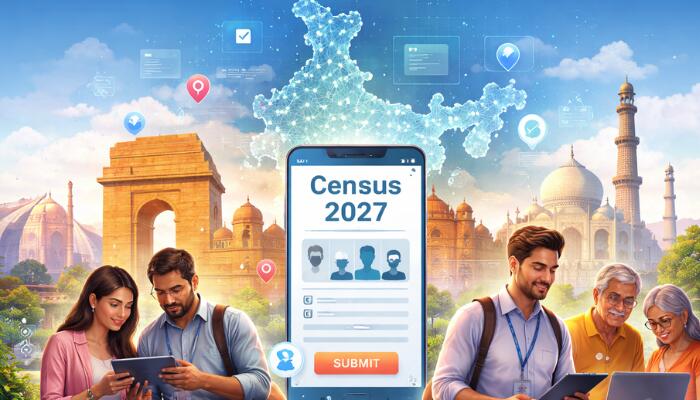
For the first time, enumerators will collect and submit data using a dedicated mobile application on their smartphones. In addition, residents will have the option to submit their details online before enumerators visit their homes.
The self-enumeration facility will be available through a secure web portal in 16 languages, including Hindi and English. Individuals will be able to log in using their mobile number and basic identification details, mark their location on a map, fill in household information and submit the form digitally. Once completed, the system will generate a unique Self-Enumeration ID, which must be shared with the enumerator for validation and inclusion in the final census data.
Officials said the digital transition is backed by extensive safeguards to ensure data security.
The portal has also been designed to manage several census operations, including generating appointment letters and identity cards for enumerators, allocating fieldwork, monitoring progress through dashboards and producing census records and summaries automatically.
Two-Phase Enumeration Process
The census will be carried out in two phases. The first phase, known as the Houselisting and Housing Census, will take place between April and September 2026, depending on the schedule of each state and union territory. This stage will gather information about housing conditions, household amenities and assets possessed by families.
Before this stage begins in each region, residents will be given a 15-day window for self-enumeration.
In Andaman and Nicobar Islands, areas under the New Delhi Municipal Council and Delhi Cantonment Board, Goa, Karnataka, Lakshadweep, Mizoram, Odisha, and Sikkim, the self-enumeration period will run from April 1 to April 15, 2026. Door-to-door houselisting in these regions will follow from April 16 to May 15.
Different schedules have been drawn up for other states. For example, Madhya Pradesh, Andhra Pradesh, Arunachal Pradesh, Chandigarh, Chhattisgarh and Haryana will have self-enumeration from April 16 to April 30, followed by houselisting between May 1 and May 30.
The second phase, which focuses on population enumeration, will be conducted in February 2027. However, in Ladakh, Jammu and Kashmir and snow-bound areas of Uttarakhand and Himachal Pradesh, this phase will take place earlier in September 2026 due to climatic conditions.
This stage will collect detailed demographic, socio-economic, educational, migration and fertility information from every individual. As decided by the Cabinet Committee on Political Affairs, caste enumeration will also be included in this phase.
Scale, Training and Legal Framework
The Census of India is conducted under the Census Act of 1948 and the Census Rules of 1990. The Government of India formally notified its intention to conduct Census 2027 in the Gazette of India on June 16, 2025.
The reference date for the census will be midnight on March 1, 2027. For Ladakh, Jammu and Kashmir and snow-covered non-synchronous areas of Uttarakhand and Himachal Pradesh, the reference date will be midnight on October 1, 2026.
The government has approved ₹11,718.24 crore for the exercise, covering enumerators’ honorarium, training, logistics, and digital infrastructure.
Administrative boundaries across the country have been frozen from January 1, 2026, to March 31, 2027, to ensure consistency in data collection. The census will cover 36 states and union territories, 7,092 sub-districts, 5,128 statutory towns, 4,580 census towns and nearly 6.4 lakh villages.
To prepare for the exercise, 100 national trainers have already been trained by subject experts. These trainers have prepared around 2,000 master trainers, who are now training roughly 45,000 field trainers. Together, they will train around 3.1 million enumerators and supervisors in nearly 80,000 batches across the country.
Officials say the combination of digital tools, extensive training and citizen participation through self-enumeration is expected to make Census 2027 one of the most technologically advanced population surveys ever undertaken in India.