























RelatedPosts
Importantly, the census will also include caste enumeration following a decision taken by the Cabinet Committee on Political Affairs on 30 April 2025. With this move, the government will expand the scope of national demographic data beyond Scheduled Castes and Scheduled Tribes for the first time in decades.
A shift from paper to fully digital counting
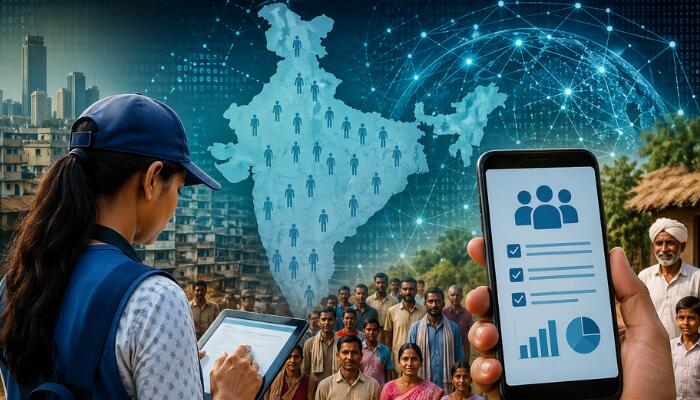
Census 2027 will mark India’s 16th census overall and 8th after Independence. To begin with, the government will replace traditional paper-based collection with mobile applications for enumerators across the country.
In addition, officials will use a centralised Census Management and Monitoring System (CMMS) to track progress in real time at block, district, state and national levels. As a result, authorities expect faster processing and improved accuracy of data.
Meanwhile, the government will also introduce a self-enumeration system. Citizens will submit their details through a secure online portal, which will generate a unique ID for verification during field visits.
Furthermore, satellite-based mapping tools and the House Listing Block Creator system will ensure full geographic coverage and eliminate duplication or missing households.
Two-phase nationwide exercise
To ensure structured implementation, the census will run in two phases.
First, the Housing Listing and Housing Enumeration phase will take place between April and September 2026. During this stage, enumerators will collect data on housing conditions, household assets, and basic amenities.
Next, the Population Enumeration phase will take place in February 2027. This phase will capture detailed demographic, socio-economic, cultural, migration, and fertility-related data. Notably, it will also include caste enumeration.
However, regions such as Ladakh, Jammu and Kashmir, Uttarakhand, and Himachal Pradesh will follow a modified schedule due to snowfall and terrain challenges.
The government has fixed 1 March 2027 as the reference date for the census.
Strong legal safeguards and data security
The census operates under the Census Act, 1948, and Census Rules, 1990, while the Constitution places it under the Union List. Consequently, the Centre leads the exercise, while states and Union Territories support implementation.
Importantly, Section 15 of the Census Act guarantees strict confidentiality of personal data. It prevents disclosure of individual information under RTI, in courts, or to any external agencies.
At the same time, the government will secure all data through end-to-end encryption and store it in certified Critical Information Infrastructure data centres. These systems comply with ISO/IEC 27001:2022 standards and undergo regular security audits.
Massive workforce and nationwide training push
To execute the exercise, the government will deploy nearly 31 lakh enumerators and supervisors along with over 1 lakh census officials. In addition, authorities are conducting more than 80,000 training sessions to ensure accuracy and consistency.
Moreover, around 18,600 technical personnel will support field operations, creating an estimated 1.02 crore human-days of employment.
Earlier, the government also conducted a pre-test across 5,000 census blocks in November 2025 to validate systems and workflows. Meanwhile, administrative boundaries were frozen on 1 January 2026 to ensure consistency across regions.
A turning point in India’s data governance
Census 2027 goes far beyond a population count. Instead, it represents a structural shift in how India collects, processes, and uses data for governance.
With real-time dashboards, digital tools, citizen self-reporting, and caste enumeration, the exercise aims to create a more precise and responsive policy framework.
Ultimately, Census 2027 is not just a statistical exercise. It is India’s full-scale entry into a digital-first data governance system.