













TFIPOST हिन्दी
TFIPOST Global
Tfipost.com
Tfipost.com
No Result
View All Result
  • Premium
  • Politics
    • All
    • Analysis
    • Opinions
    • Trending
    Great Nicobar Project at the Crossroads: Strategic Ambition Meets Global Propaganda Battle

    Great Nicobar Project at the Crossroads: Strategic Ambition Meets Global Propaganda Battle

    Five-State Exit Polls Hint at NDA sweep Across Key Battlegrounds

    Five-State Exit Polls Hint at NDA sweep Across Key Battlegrounds

    ECI Introduce QR-Based ID for Counting Centre Security

    ECI Introduce QR-Based ID for Counting Centre Security

    The Timothy Initiative Under Fire Over Conversion Tactics

    The Timothy Initiative Under Fire Over Conversion Tactics

    • Analysis
    • Opinions
    • Trending
  • Economy
    • All
    • Business
    • Economy1
    • Finance
    AI, access, and accountability: Goyal’s push to transform India’s procurement system through GeM

    Goyal Speeds Up GeM Revamp, Pushes AI Tools and Wider Access to Reform Procurement System

    What are the Benefits of Critical Health Insurance in Serious Illness Cases?

    What are the Benefits of Critical Health Insurance in Serious Illness Cases?

    How Digital Verification Works In Online Personal Loan Applications

    How Digital Verification Works In Online Personal Loan Applications

    Top Features to Look for in the Best Health Insurance Plan

    Top Features to Look for in the Best Health Insurance Plan

    • Business
    • Finance
  • Defense
    • All
    • Defence
    • Strategy
    • Weaponry
    India called the shots, not the ceasefire: Rajnath SIngh

    India Chose the Moment, Not the Pressure: Rajnath Singh Says Operation Sindoor Halt Was a Strategic Call

    Why is Making a Jet Engine so Hard | The failure of Kaveri

    Why is Making a Jet Engine so Hard | The failure of Kaveri

    Rajnath Singh at SCO, reaffirming India’s zero-tolerance stand on terrorism.

    “No More Double Standards”: Rajnath Singh’s SCO Message Rewrites India’s Terror Response Playbook

    Recovered arms and arrests have intensified scrutiny on a suspected cross-border terror network.

    Pakistan’s Proxy War Faces a Setback as Delhi Terror Plot is Crushed, 18 Weapons Seized

    • Defence
    • Strategy
    • Weaponry
  • Geopolitics
    • All
    • Africa
    • Americas
    • Asia Pacific
    • Europe
    • South Asia
    • West Asia
    Karachi Pact 1949: How Pakistan Cemented Control Over Gilgit-Baltistan Without Its People’s Consent

    Karachi Pact 1949: How Pakistan Cemented Control Over Gilgit-Baltistan Without Its People’s Consent

    When law becomes an instrument of exclusion, persecution moves far beyond the courtroom.

    Ahmadis in Pakistan: From Faith to Marginalisation Under Law and Society

    When uranium becomes strategy, India moves first.

    India’s $4 Billion Uranium Coup with Kazakhstan Rewrites the Global Nuclear Balance

    “Fixing the World”: What a Century of Big Ideas Reveals About Us

    “Fixing the World”: What a Century of Big Ideas Reveals About Us

    • Africa
    • Americas
    • Asia Pacific
    • Europe
    • South Asia
    • West Asia
  • Knowledge
    • All
    • Culture
    • Education
    • History
    • Indology
    Chants of ‘Jai Badri Vishal’ Echo as Badrinath Portals Open; All Four Dhams Now Accessible to Pilgrims

    Chants of ‘Jai Badri Vishal’ Echo as Badrinath Portals Open; All Four Dhams Now Accessible to Pilgrims

    Kedarnath Dham Portals Open for Devotees After 181 Days Amid Vedic Chants, Traditional Rituals

    Kedarnath Dham Portals Open for Devotees After 181 Days Amid Vedic Chants, Traditional Rituals

    Sardar Patel and Amit Shah

    Sardar Patel’s 1947 Blueprint on Minority Quotas Resurfaces as Reservation Debate Returns to Centre Stage

    The 1973 Constitution and ‘Bhutto’ the Man Who Made It: What Pakistan Owes and What It Destroyed

    The 1973 Constitution and ‘Bhutto’ the Man Who Made It: What Pakistan Owes and What It Destroyed

    • Culture
    • History
    • Indology
  • Law
  • Lounge
    • All
    • Books
    • Cinema
    • Entertainment
    • Food
    • Games
    • Health
    • Lifestyle
    • Satire
    • Sports
    • technology
    • Travel
    Minor rape survivor’s pregnancy termination and reproductive rights

    SC Reinforces Bodily Autonomy in Teen Rape Survivor Case, Questions State Control Over Abortion Rights

    594 km of speed, scale and connectivity; the Ganga Expressway opens a new development corridor across Uttar Pradesh.

    Modi Opens 594-Km Ganga Expressway, Unveils Uttar Pradesh’s New High-Speed Growth Corridor

    When regulation meets the algorithm

    India Tightens Digital Control as Online Blocking Orders Surge to 24,300 Amid AI Deepfake Trend

    Digital Data Collection In India

    India’s Data Reset Begins: Census 2027 to Become First Fully Digital Population Count

    • Books
    • Cinema
    • Food
    • Health
    • Sports
    • technology
    • Travel
    • Satire
Tfipost.com
  • Premium
  • Politics
    • All
    • Analysis
    • Opinions
    • Trending
    Great Nicobar Project at the Crossroads: Strategic Ambition Meets Global Propaganda Battle

    Great Nicobar Project at the Crossroads: Strategic Ambition Meets Global Propaganda Battle

    Five-State Exit Polls Hint at NDA sweep Across Key Battlegrounds

    Five-State Exit Polls Hint at NDA sweep Across Key Battlegrounds

    ECI Introduce QR-Based ID for Counting Centre Security

    ECI Introduce QR-Based ID for Counting Centre Security

    The Timothy Initiative Under Fire Over Conversion Tactics

    The Timothy Initiative Under Fire Over Conversion Tactics

    • Analysis
    • Opinions
    • Trending
  • Economy
    • All
    • Business
    • Economy1
    • Finance
    AI, access, and accountability: Goyal’s push to transform India’s procurement system through GeM

    Goyal Speeds Up GeM Revamp, Pushes AI Tools and Wider Access to Reform Procurement System

    What are the Benefits of Critical Health Insurance in Serious Illness Cases?

    What are the Benefits of Critical Health Insurance in Serious Illness Cases?

    How Digital Verification Works In Online Personal Loan Applications

    How Digital Verification Works In Online Personal Loan Applications

    Top Features to Look for in the Best Health Insurance Plan

    Top Features to Look for in the Best Health Insurance Plan

    • Business
    • Finance
  • Defense
    • All
    • Defence
    • Strategy
    • Weaponry
    India called the shots, not the ceasefire: Rajnath SIngh

    India Chose the Moment, Not the Pressure: Rajnath Singh Says Operation Sindoor Halt Was a Strategic Call

    Why is Making a Jet Engine so Hard | The failure of Kaveri

    Why is Making a Jet Engine so Hard | The failure of Kaveri

    Rajnath Singh at SCO, reaffirming India’s zero-tolerance stand on terrorism.

    “No More Double Standards”: Rajnath Singh’s SCO Message Rewrites India’s Terror Response Playbook

    Recovered arms and arrests have intensified scrutiny on a suspected cross-border terror network.

    Pakistan’s Proxy War Faces a Setback as Delhi Terror Plot is Crushed, 18 Weapons Seized

    • Defence
    • Strategy
    • Weaponry
  • Geopolitics
    • All
    • Africa
    • Americas
    • Asia Pacific
    • Europe
    • South Asia
    • West Asia
    Karachi Pact 1949: How Pakistan Cemented Control Over Gilgit-Baltistan Without Its People’s Consent

    Karachi Pact 1949: How Pakistan Cemented Control Over Gilgit-Baltistan Without Its People’s Consent

    When law becomes an instrument of exclusion, persecution moves far beyond the courtroom.

    Ahmadis in Pakistan: From Faith to Marginalisation Under Law and Society

    When uranium becomes strategy, India moves first.

    India’s $4 Billion Uranium Coup with Kazakhstan Rewrites the Global Nuclear Balance

    “Fixing the World”: What a Century of Big Ideas Reveals About Us

    “Fixing the World”: What a Century of Big Ideas Reveals About Us

    • Africa
    • Americas
    • Asia Pacific
    • Europe
    • South Asia
    • West Asia
  • Knowledge
    • All
    • Culture
    • Education
    • History
    • Indology
    Chants of ‘Jai Badri Vishal’ Echo as Badrinath Portals Open; All Four Dhams Now Accessible to Pilgrims

    Chants of ‘Jai Badri Vishal’ Echo as Badrinath Portals Open; All Four Dhams Now Accessible to Pilgrims

    Kedarnath Dham Portals Open for Devotees After 181 Days Amid Vedic Chants, Traditional Rituals

    Kedarnath Dham Portals Open for Devotees After 181 Days Amid Vedic Chants, Traditional Rituals

    Sardar Patel and Amit Shah

    Sardar Patel’s 1947 Blueprint on Minority Quotas Resurfaces as Reservation Debate Returns to Centre Stage

    The 1973 Constitution and ‘Bhutto’ the Man Who Made It: What Pakistan Owes and What It Destroyed

    The 1973 Constitution and ‘Bhutto’ the Man Who Made It: What Pakistan Owes and What It Destroyed

    • Culture
    • History
    • Indology
  • Law
  • Lounge
    • All
    • Books
    • Cinema
    • Entertainment
    • Food
    • Games
    • Health
    • Lifestyle
    • Satire
    • Sports
    • technology
    • Travel
    Minor rape survivor’s pregnancy termination and reproductive rights

    SC Reinforces Bodily Autonomy in Teen Rape Survivor Case, Questions State Control Over Abortion Rights

    594 km of speed, scale and connectivity; the Ganga Expressway opens a new development corridor across Uttar Pradesh.

    Modi Opens 594-Km Ganga Expressway, Unveils Uttar Pradesh’s New High-Speed Growth Corridor

    When regulation meets the algorithm

    India Tightens Digital Control as Online Blocking Orders Surge to 24,300 Amid AI Deepfake Trend

    Digital Data Collection In India

    India’s Data Reset Begins: Census 2027 to Become First Fully Digital Population Count

    • Books
    • Cinema
    • Food
    • Health
    • Sports
    • technology
    • Travel
    • Satire
No Result
View All Result
Tfipost.com
Tfipost.com
No Result
View All Result
  • Premium
  • Politics
  • Economy
  • Defense
  • Geopolitics
  • Knowledge
  • Law
  • Lounge

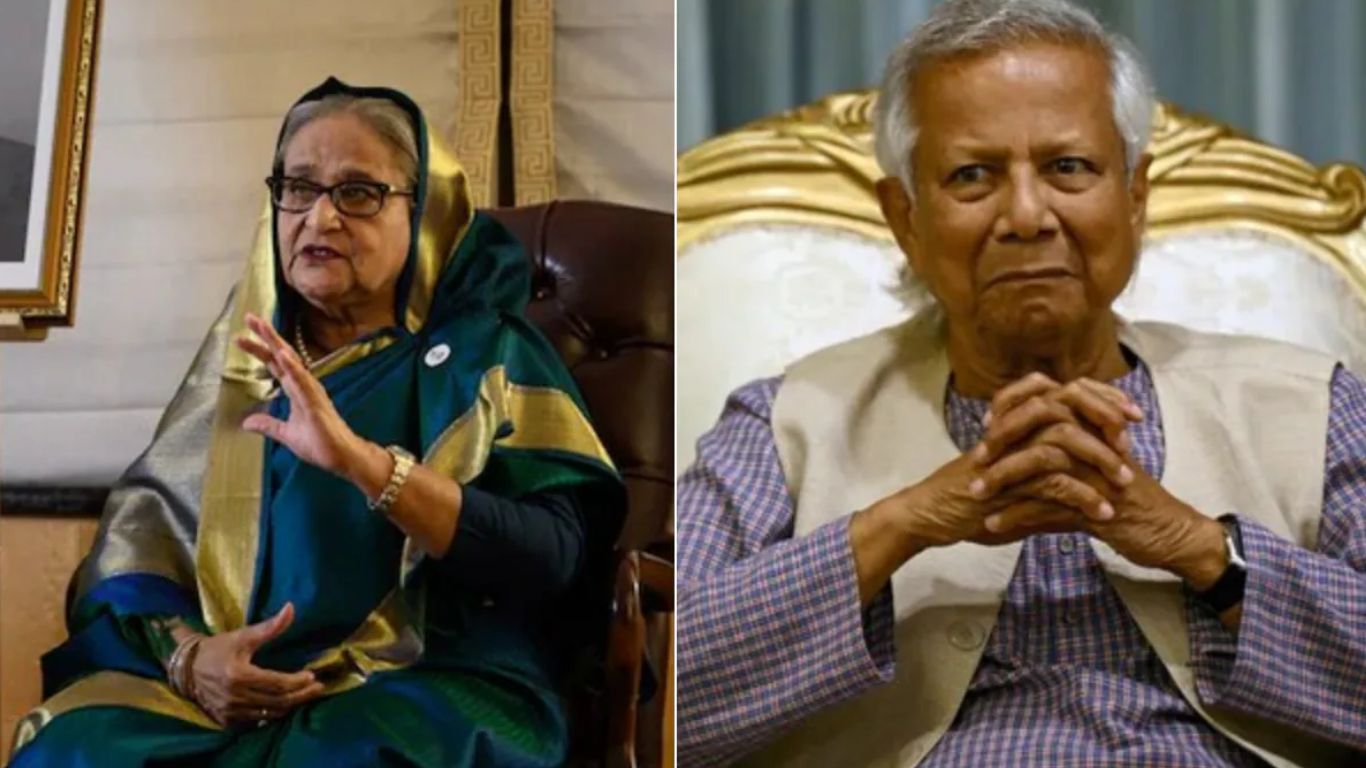
From Hasina to Yunus: How Bangladesh Was Quietly Rewired

Ashu Maan by Ashu Maan
30 December 2025
in Opinions
Yunus and Hasina

From Hasina to Yunus: How Bangladesh Was Quietly Rewired. Photo: NDTV

Share on FacebookShare on X

What unfolded in Bangladesh in 2024 was not a sudden democratic awakening. Nor was it an organic people’s revolt that spiralled out of control. It was a political unravelling that followed a familiar pattern—pressure from abroad, fractures within the state, street mobilisation driven by carefully chosen actors, and finally, a military that decided not to intervene.

Sheikh Hasina’s removal and Muhammad Yunus’s rapid elevation as Chief Adviser did not merely change governments in Dhaka. It altered the country’s strategic direction, reopened political space for Islamist actors long kept on the margins, and left Bangladesh more exposed to foreign influence than at any point since 1971.

RelatedPosts

Pakistan’s Proxy War Faces a Setback as Delhi Terror Plot is Crushed, 18 Weapons Seized

Terror for Hindus in Bangladesh continues, Body of Hindu Temple Caretaker Found in Southeastern Bangladesh

Redefining Terms of Truly Mutual Trade Deal: Sovereignty and Strategy in the US–Bangladesh Framework

Load More

Former Home Minister Asaduzzaman Khan Kamal has since claimed that the sequence bore the hallmarks of a pre-planned operation, describing it as a “perfect CIA plot,” with Pakistan’s ISI acting as a silent partner. At the centre of his allegation lies the role of Army Chief General Waker-Uz-Zaman, accused of withholding military support at the decisive moment.

Whether every element of this claim can be independently verified is beside the larger point. The outcome speaks for itself.

How a Protest Became a Collapse

The initial spark was unremarkable. In early July 2024, students protested recruitment quotas that favoured families of 1971 freedom fighters. The policy had long been criticised as a mechanism that benefited Awami League loyalists, and resentment had been building quietly for years. What changed was the speed and scale of escalation.

Within days, demonstrations spread across major campuses. By mid-July, confrontations turned violent. Police stations were attacked. Party offices were torched. Over 300 people were killed in clashes that bore little resemblance to spontaneous protest. Internet shutdowns followed. The government’s heavy-handed response only widened the rupture.

Behind the scenes, something more consequential was unfolding. As unrest peaked in early August, General Waker-Uz-Zaman reportedly held meetings with opposition figures and student organisers—contacts that would later be cited by Hasina loyalists as evidence of betrayal. On August 5, Sheikh Hasina resigned and fled the country. The army announced the transition on television. No election was announced. No constitutional roadmap was offered.

Within seventy-two hours, Muhammad Yunus returned to Dhaka and was sworn in. That speed mattered.

Washington’s Long Friction With Hasina

The breakdown between Washington and Sheikh Hasina did not originate in 2024. It had been building steadily. US sanctions on Bangladesh’s Rapid Action Battalion in 2021 marked the first rupture. Visa bans imposed in 2023 deepened it. When the Awami League won the January 2024 election amid an opposition boycott, the US publicly dismissed the result as lacking credibility.

Also Read: Imminent Hindu Genocide in Bangladesh: Exposed Conspiracy Signals Grave Threat to Minority Survival

By mid-2024, the dispute had become openly strategic. Hasina accused Western powers of seeking access to St. Martin’s Island, a small but strategically significant landmass in the Bay of Bengal.

She rejected any foreign military presence outright. Her remarks about a “white-skinned power” seeking to undermine Bangladesh’s sovereignty were unusually direct. Weeks later, she was gone. Washington’s response to her ouster was swift. Statements welcoming the interim government followed. Diplomatic engagement resumed. Aid flows reopened. The contrast was not subtle.

The Return of Islamist Street Power

One of the clearest consequences of Hasina’s fall was the sudden rehabilitation of Jamaat-e-Islami. During the July–August unrest, Jamaat cadres and its student wing, Islami Chhatra Shibir, were repeatedly visible at the centre of violent confrontations. Their mobilisation appeared organised, disciplined, and well-resourced. Hasina banned Jamaat on August 1 under anti-terror laws. Less than a month later, the Yunus administration reversed that decision.

The symbolism was unmistakable. Jamaat’s leadership re-entered mainstream politics almost overnight. Its historical role during 1971 was pushed aside. Its street machinery was back in play. For a country founded on secular nationalism, the shift was profound.

Pakistan’s Quiet Leverage

Parallel to these developments ran Pakistan’s long game. Reports circulating in Dhaka suggest that several student organisers had travelled outside Bangladesh as early as 2023, including visits to Pakistan and Gulf transit hubs. These meetings allegedly involved ISI intermediaries and focused on expanding agitation beyond quota reform.

By the time unrest peaked in 2024, coordination between Jamaat networks, BNP figures abroad, and digital propaganda channels was already in place. After Hasina’s flight, the pattern became clearer. “India Out” slogans replaced governance demands. Hindu neighbourhoods were attacked. Temples were vandalised. The unrest acquired a communal dimension that served no domestic reform agenda—but aligned neatly with Islamabad’s regional objectives.

Why India Was Made the Target

India’s decision to shelter Sheikh Hasina provided a convenient narrative pivot. Rather than confronting the constitutional vacuum left behind, the interim leadership and aligned groups redirected public anger outward. Floods were blamed on India. Economic distress was framed as foreign sabotage. Even internal violence was attributed to imaginary conspiracies.

The objective was not persuasion. It was distraction. By externalising blame, those who benefited from the transition avoided scrutiny. It also helped revive long-standing narratives that suit both Islamist mobilisation and Pakistan’s strategic messaging.

What Lies Ahead

Bangladesh now faces a precarious future. Investor confidence is fragile. The garment sector, already under pressure, is vulnerable to prolonged instability. Minority communities face renewed insecurity. Islamist actors, once marginalised, now shape street power. Above all, sovereignty is thinning. A weak, divided Bangladesh is easier to influence. It is more responsive to external pressure. It is less capable of independent strategic choice.

What replaced Sheikh Hasina was not a strengthened democracy. It was a managed transition that left the state weaker, the political field narrower, and the country more exposed than before. History will judge the outcome not by slogans raised in 2024, but by what Bangladesh loses in the years that follow.
Tags: #BangladeshBangladesh’s Rapid Action BattalionGeneral Waker-Uz-ZamanHasinaHome Minister Asaduzzaman Khan KamalJamaatyunus
ShareTweetSend
Previous Post

EXCLUSIVE: CAT Scraps DRDO Order Appointing BrahMos DG & CEO; Calls Selection Process Arbitrary

Next Post

The Metals Behind the Age of Machines: Why the World Is Chasing Rare-Earth Elements

Related Posts

Resolve of a Changing Bengal: Youth, Potential, and Call for Transformation
Opinions

Resolve of a Changing Bengal: Youth, Potential, and Call for Transformation

21 April 2026

The yearning for change in the soil of Bengal is not a sudden wave, it is a convergence of...

Redefining Terms of Truly Mutual Trade Deal: Sovereignty and Strategy in the US–Bangladesh Framework
Economy

Redefining Terms of Truly Mutual Trade Deal: Sovereignty and Strategy in the US–Bangladesh Framework

15 April 2026

The debate around Bangladesh’s emerging trade framework with the United States cannot be reduced to a binary choice of...

Race Against Iran Deadline: Was Pakistan’s Ceasefire Bid Driven by the White House?
Geopolitics

Race Against Iran Deadline: Was Pakistan’s Ceasefire Bid Driven by the White House?

9 April 2026

Pakistan attempted to position itself as a peacemaker in the escalating tensions involving Iran, but the reality behind the...

Load More

Leave a Reply Cancel reply

Your email address will not be published. Required fields are marked *

I agree to the Terms of use and Privacy Policy.
This site is protected by reCAPTCHA and the Google Privacy Policy and Terms of Service apply.

Currently Playing

From Runways to Warships: India’s Firefighting Warrior Built for Bases & Battles| IAF | VayuShakti

From Runways to Warships: India’s Firefighting Warrior Built for Bases & Battles| IAF | VayuShakti

00:05:40

Ethanol, EVs and Solar- How India’s Energy Game Is Changing | Modi on LPG & Crude Oil | war| Hormuz

00:05:21

Truth of IRIS Dena: 8 Days That Changed Narrative | War zone Reality, Not an Indian Navy Exercise

00:08:02

300 Million Euros for SCALP: Strategic Necessity or Costly Dependency on France300

00:04:06

Tejas Mk1A: 19th aircraft coupled but Not Delivered: What Is Holding Back the IAF Induction?

00:07:21
Facebook Twitter Instagram Youtube
tfipostTfipost.com
Right Wing | News Analysis | Indian Opinion
  • About us
  • Contact Us
  • Careers
  • Brand Partnerships
  • Terms of use
  • Privacy Policy
  • Sitemap

©2026 TFI Media Private Limited

No Result
View All Result
  • Premium
  • Politics
    • Analysis
    • Opinions
    • Trending
  • Economy
    • Business
    • Finance
  • Defense
    • Defence
    • Strategy
    • Weaponry
  • Geopolitics
    • Africa
    • Americas
    • Asia Pacific
    • Europe
    • South Asia
    • West Asia
  • Knowledge
    • Culture
    • History
    • Indology
  • Law
  • Lounge
    • Books
    • Cinema
    • Food
    • Health
    • Sports
    • technology
    • Travel
    • Satire
TFIPOST हिन्दी
TFIPOST Global

©2026 TFI Media Private Limited