
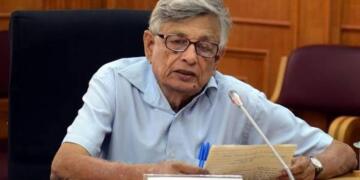



















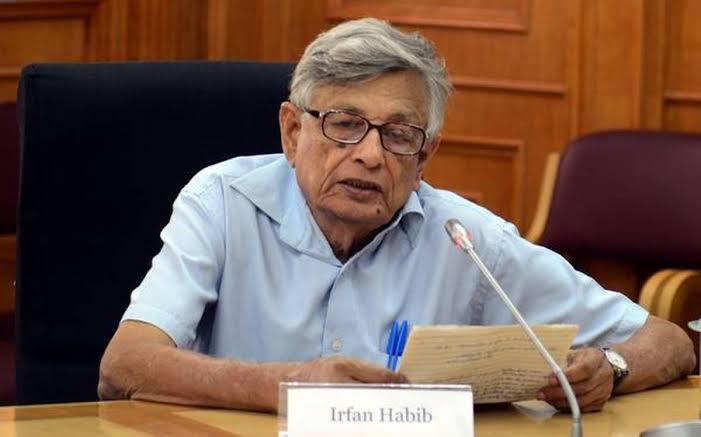
The Ayodhya Ram Mandir dispute has returned to the centre of India’s historical debate after Marxist historian Irfan Habib described the Supreme Court’s November 2019 judgment as “totally illegitimate” during an interview with ThePrint published on October 30, 2026. His remarks questioned the archaeological evidence supporting the existence of an earlier Hindu temple at the disputed site, reopening contentious questions about historical interpretation, the Archaeological Survey of India (ASI), and the relationship between scholarship and religious sentiment.
Speaking in Aligarh, the 95-year-old historian Irfan Habib argued that there was insufficient archaeological proof to establish that a temple had stood beneath the Babri Masjid. He also alleged that the excavation findings had been selectively interpreted, suggesting that certain structural remains were presented as evidence of a temple while other material was overlooked. His comments have reignited debate over the evidence examined during one of India’s most consequential legal disputes.
The controversy is significant because the Supreme Court’s judgment did not rest on a single archaeological claim. The November 2019 verdict considered documentary records, historical accounts, evidence concerning worship and possession, and findings from the ASI excavation. The court awarded the disputed land for the construction of a temple while directing that an alternative five-acre plot be provided for a mosque. It also held that the demolition of the Babri Masjid in December 1992 was unlawful.
In his interview, Irfan Habib challenged the interpretation of the excavation findings, arguing that architectural fragments could have originated elsewhere and subsequently been reused in the mosque’s construction. He also questioned whether the presence of particular stones could conclusively establish that a temple had existed at precisely the same location. These objections reflect a broader disagreement over how archaeological evidence should be interpreted when dealing with contested religious sites.
However, the excavation was not conducted in isolation from the judicial process. The Allahabad High Court ordered the ASI investigation in 2002, and the agency submitted its report in 2003. Its findings identified the remains of a substantial structure beneath the demolished mosque, with architectural features that the report associated with a pre-existing, non-Islamic structure. The report became an important part of the subsequent legal proceedings, although its interpretation attracted criticism from some historians and archaeologists.
The historical controversy also extends to allegations concerning restrictions on the excavation. According to a recent account cited by OpIndia, journalist Arvind Singh’s book, India’s Rogue Historians: How They Fought Against Hindus at Ayodhya & Lost, discusses arguments attributed to Habib before the excavation began. The account claims that he advocated limiting the depth of the investigation to two metres, raising concerns that deeper excavation could uncover remains from earlier historical periods.
These allegations have renewed scrutiny of the positions taken by historians during the Ayodhya dispute. Nevertheless, claims about the motives behind particular scholarly arguments must be distinguished from the documented archaeological findings and the legal conclusions ultimately reached by the courts.
Irfan Habib has also criticised recent changes to school history textbooks, accusing the government of distorting India’s historical record. During the same interview, he questioned the treatment of the caste system in the revised curriculum and argued that the changes diminished the importance given to historical figures such as Ashoka. His criticism places the Ayodhya controversy within a wider ideological disagreement over how Indian history should be taught and interpreted.
For supporters of the Ram Mandir, the excavation findings and the Supreme Court judgment represent important recognition of the site’s historical and religious significance. Critics, meanwhile, continue to question aspects of the archaeological interpretation and the broader implications of the verdict. The disagreement demonstrates how historical evidence can become entangled with contemporary political and religious identities.
Latest remakrsk of Irfan Habib have therefore brought an old dispute back into public discussion, but the central issue is not simply whether a historian agrees with a judicial verdict. It is whether competing interpretations can be evaluated against the complete documentary, archaeological, and legal record. The Supreme Court has delivered its judgment, while academic debate over historical interpretation continues.
Ultimately, the Ayodhya dispute illustrates the importance of separating scholarly criticism from unsupported allegations and political rhetoric. Archaeological conclusions must be assessed through evidence and established research methods, while judicial decisions must be understood in light of the full reasoning presented in the judgments. The continuing debate surrounding the Ram Mandir underscores why India’s contested past requires rigorous examination rather than selective readings of history.