



















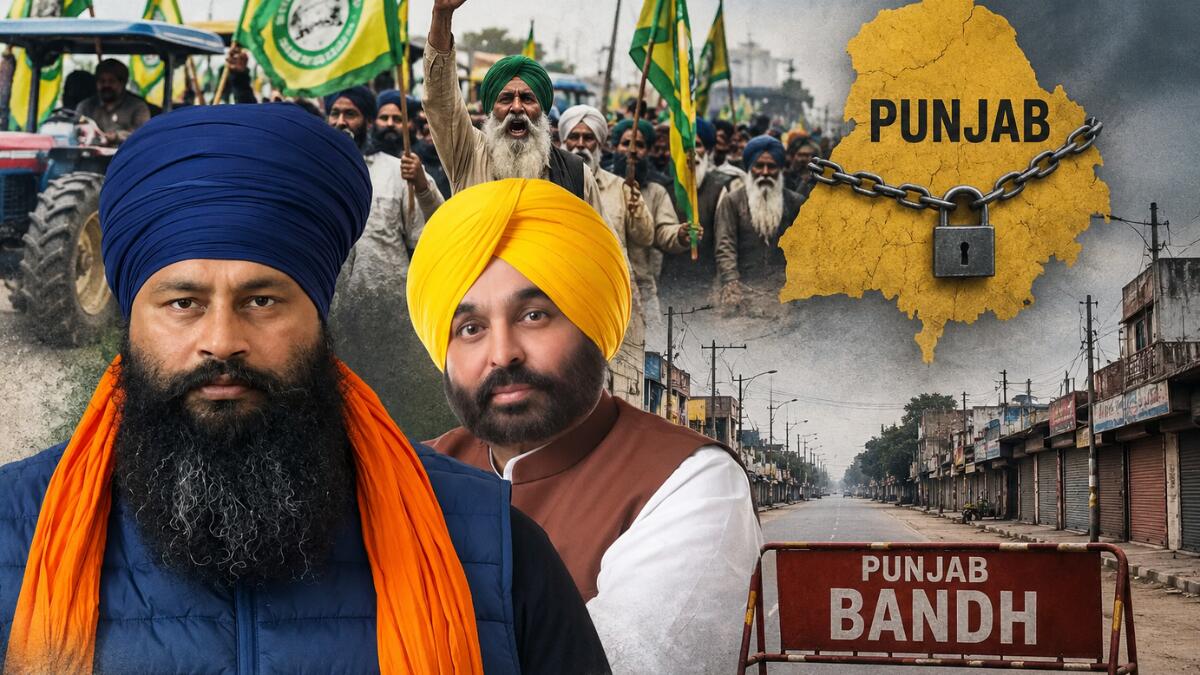
Punjab came to a partial standstill on Thursday as farmers, trade unions and opposition parties converged on a single demand: justice for Parvinder Singh Jhota, an anti-drug activist shot dead in Mansa, and accountability from a government that promised a drug-free state.
The shooting took place on October 13. Jhota went to a chemist’s shop to confront the owner over alleged drug sales. During the argument, the chemist opened fire, hitting him with three bullets. Doctors at the civil hospital declared him dead. The Bathinda Range DIG said one person had been arrested.
Police have reportedly pointed to personal enmity, an explanation that has done little to calm tempers. The victim’s family says the state failed him. His father says the Punjab government gave his son no security and has appealed to the Prime Minister and Union Home Minister to protect his grandchildren. For a government whose flagship campaign is “Yudh Nashean Virudh”, the war against drugs, the image of an activist gunned down while confronting an alleged drug seller is a political nightmare.
Farmers lead the charge
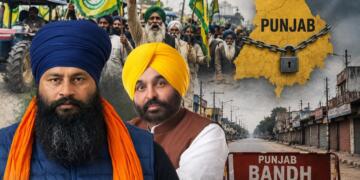
The anger quickly moved from the street to the unions. Kisan Mazdoor Sangharsh Committee leader Sarwan Singh Pandher led a protest at Amritsar’s Golden Gate, saying the Kisan Mazdoor Morcha and affiliated unions had appealed for support for the shutdown. Several farmer unions, student organisations and trade unions also announced plans to block National Highway-44, the key route linking Amritsar with Delhi. It was Jhota’s father, Bhim Singh, who called for the bandh on October 15.
The mood at the protests was openly hostile to the government. In Amritsar, farmers and members of various organisations raised slogans against the Bhagwant Mann-led government and demanded its dismissal, and Mann’s effigy was burned. In Ludhiana, a man claiming to be a Waris Punjab De member took down posters of the Chief Minister.
The bandh: shuttered markets, blocked roads
The bandh ran from 6 am to 5 pm. Markets and private schools stayed shut across many districts, and protesters blocked roads, including Gill Chowk in Ludhiana. The response varied by location. In Phagwara, markets were largely closed while road traffic kept moving. In Amritsar, markets shut and footfall at the Golden Temple fell.
The state’s handling added fuel. Police barricades on roads leading to Mansa sparked outrage after Congress leaders Channi and Ayali were stopped ahead of the bandh. Mann promised the strictest punishment for those involved in the murder, but the outrage has continued for days.
Opposition closes ranks against AAP
Every major opposition party has seized on the killing. The BJP, Congress and Shiromani Akali Dal accused the AAP government of “jungle raj”, and Punjab BJP chief Kewal Singh Dhillon demanded that the case be handed to the CBI, writing to Governor Gulab Chand Kataria to intervene.
BJP National President Nitin Nabin said the Aam Aadmi Party came to power promising a drug-free Punjab, and that people who stand up against drugs are now themselves at risk. Congress’s Sachin Pilot declared that Mann and his government have lost the moral authority to govern, citing attacks on police officers, sarpanchs and anti-drug activists. Congress MP Amrinder Singh Raja Warring called the killing proof of the complete failure of law and order.
AAP, the CJP and the Delhi question
Critics of AAP are also pointing to the party’s Delhi-based ecosystem, specifically the Cockroach Janta Party (CJP). The connections cited by opponents are documented. The CJP was launched on May 16 as a satirical response to remarks by CJI Surya Kant comparing unemployed youth to cockroaches. Its founder, Abhijeet Dipke, was an AAP social media volunteer from 2020 to 2023. AAP’s Ashutosh Ranka was named a CJP spokesperson. A breakaway faction, CJP-D, has alleged that eight of the twelve members of the CJP national committee had AAP ties. Dipke acknowledges a past AAP connection but says he currently has none, and AAP figures including Kejriwal appeared alongside him during the Jantar Mantar protests.
The charge from AAP’s critics is that the party is sheltering behind the CJP’s Delhi agitation while its government in Punjab faces public fury. The allegation remains unproven. Analyses of the CJP’s Punjab entry note that no publicly available evidence has established a formal relationship, funding arrangement or operational partnership between the CJP and AAP. CJP supporters maintain the movement is focused on student and examination issues.
The road ahead
The pressure on Mann is likely to build on several fronts. The motive in the killing will be scrutinised closely, since a finding of personal enmity versus drug-trade links will shape the political fallout. The demand for a CBI probe is gaining voice among the opposition. And the farmer unions, which have the organisational muscle to sustain agitation, could escalate beyond a one-day shutdown into prolonged highway blockades. For a government that staked its credibility on cleaning up Punjab, every day without answers deepens the damage.