








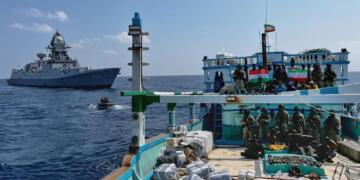















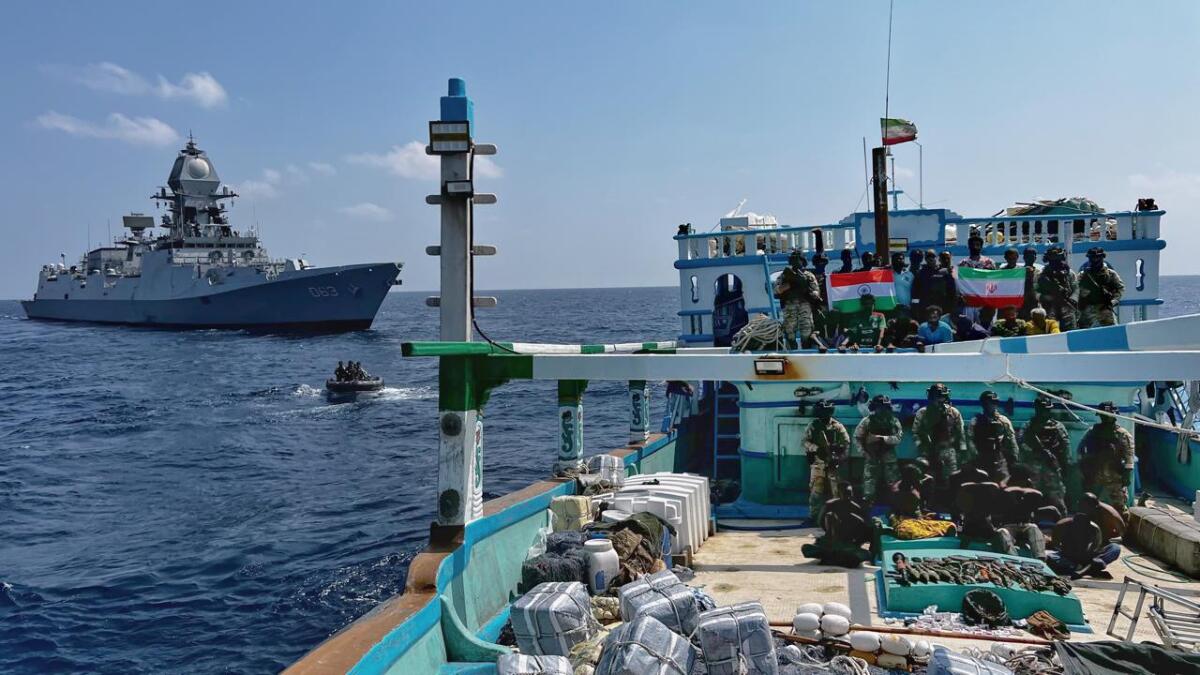
The Indian Navy has liberated the fishing vessel Azini from armed pirates in a swift, well-coordinated operation spanning more than 48 hours, bringing all 20 crew members to safety with no casualties or injuries. The warship that carried out the rescue was INS Kolkata. The operation took place more than 3,000 km from Mumbai, and Defence Minister Rajnath Singh congratulated the Navy on the swift localisation, interception and safe release of the crew and vessel.
The Azini was hijacked off the northeastern coast of Somalia, on October 29, between the towns of Bandar Bayla and Hafun, according to the Puntland Maritime Police Force. The seizure was a serious maritime security threat in itself, because a captured fishing vessel can be turned into a mother ship for launching further attacks on merchant shipping in the region.
The Navy tasked INS Kolkata, a mission-deployed warship, to intervene, with a maritime reconnaissance aircraft in support. The two platforms worked in close coordination and located the vessel after persistent surveillance. They then tracked its movements and used calibrated non-kinetic measures to contain it and prevent its escape. Marine Commandos were augmented through a precision airdrop by an Indian Air Force C-17 aircraft. The commandos then carried out a swift tactical intervention, secured the vessel, overcame the pirate threat and ensured the safe release of all 20 crew members. Iran’s embassy in New Delhi has thanked India for the rescue of its 20 nationals, praising the professionalism, courage and coordination of the armed forces.
The operation shows what seamless inter-service coordination can deliver in complex maritime security missions, and it reinforces India’s role as the first responder and preferred security partner in the Indian Ocean Region. The Navy says it remains committed to safeguarding seafarers, protecting vital trade routes and keeping the region’s waters safe, secure and stable.
How real is the piracy problem?
The danger is measurable. At least 13 attacks and six confirmed hijackings were recorded off Somalia and in the Gulf of Aden between April and late September 2026. More than 90 seafarers remain hostage in pirate networks. The pirates have also pushed farther than they used to. The tanker MT Eureka was taken on the Yemeni side of the Gulf of Aden, waters where Somali pirates rarely operated before. The Azini is not the first Indian success of this kind. In January 2024 the Navy rescued two Iranian-flagged fishing vessels within a single day, one with 17 crew and the other with 19 Pakistani crew.
Where do the pirates come from?
They operate from Somalia, chiefly the northeastern region of Puntland. Somali piracy emerged in the early 1990s after the government collapsed. It peaked around 2010 and then faded under international naval patrols and armed guards on ships. Somali analyst Mohamed Husein Gaas says piracy was suppressed, not solved. Economic desperation feeds recruitment. Surging fuel and food costs have derailed Somalia’s fragile recovery this year. The groups are also better armed and organised. Puntland’s maritime police cannot match assault teams of 30 armed men.
Wars, stretched navies and a widening threat
The wider conflicts around the Arabian Peninsula have given the pirates room to operate. The Houthi campaign in the Red Sea, which began after the Gaza war, pulled naval and surveillance assets toward Bab el-Mandeb. Since 2023 those assets have shifted away from the Somali coast, reducing counter-piracy coverage. The US-Iran war has stretched them further. Naval forces are now spread across the Red Sea, the Persian Gulf and the Somali Basin, leaving gaps that pirate groups exploit. Houthi attacks have also pushed tankers closer to the Somali coast, and high oil prices make them especially valuable targets.
Shipping companies are paying the price in time and money. Many are rerouting around the Cape of Good Hope, adding weeks and millions of dollars in fuel costs. Some vessels sail without armed security because of cost pressure from the longer routes. The worst fear is a formal alliance between the groups. A link between Al-Shabaab, the Houthis and Somali pirates would fundamentally change the regional dynamic, in the view of Dryad Global’s Corey Ranslem. Even a return to calm in the Gulf may not end the problem. Growing pirate capability, Somalia’s weak response and the economic conditions driving recruits could keep the threat alive after shipping normalises.
For India, the Azini rescue is both a success and a signal. It shows a navy able to find, contain and board a hijacked vessel thousands of kilometres from home, and it shows how much of the Indian Ocean’s security now depends on a few navies covering several crises at once.