



















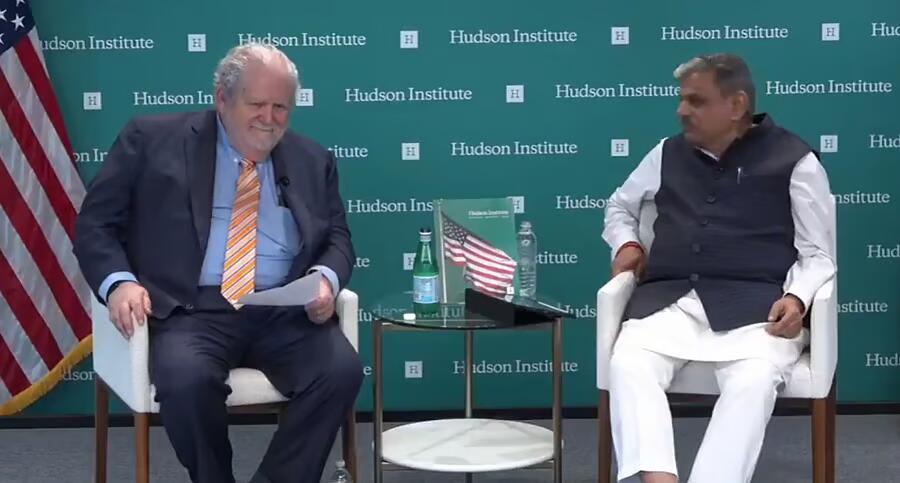
During a recent visit to the United States, Dattatreya Hosabale, General Secretary of the Rashtriya Swayamsevak Sangh, delivered a speech of Nonaggressive Hindus that has sparked both support and debate across academic and diaspora circles. Addressing a gathering of Indian-origin communities, he asserted that Hindus have historically maintained a peaceful and non-expansionist ethos, stating that they have never invaded other countries, enslaved populations, or imposed their beliefs by force.
Hosabale’s remarks centered around what he described as the core philosophy of Nonaggressive Hindus, presenting it as a defining feature of Hindu civilization. He emphasized that, unlike many historical empires that expanded through conquest, Hindu societies largely evolved through cultural exchange, trade, and intellectual dialogue. According to him, this legacy sets Hindu civilization apart in global historical narratives.
The audience, comprising professionals, scholars, and members of the Indian diaspora, responded positively to the speech. Many attendees viewed the articulation of Nonaggressive Hindus as a reaffirmation of their cultural identity, especially in a global environment where discussions about colonialism and historical accountability are increasingly prominent. For them, Hosabale’s message offered a sense of pride and perspective rooted in India’s civilizational history.
However, historians and analysts have offered more nuanced interpretations. While acknowledging that the Indian subcontinent did not pursue overseas colonialism in the same manner as European powers, some experts argue that the idea of Nonaggressive Hindus risks oversimplifying a complex past. They point to regional conflicts, dynastic wars, and political expansions within the subcontinent as part of the broader historical context that should not be overlooked.
Hosabale, nevertheless, maintained that the philosophical foundations of Hinduism emphasize coexistence, pluralism, and respect for diversity. He referenced traditional concepts such as “Vasudhaiva Kutumbakam,” which translates to “the world is one family,” to illustrate how the idea of Nonaggressive Hindus aligns with long-standing cultural values. He argued that these principles have guided social and cultural interactions over centuries.
The visit also included interactions with youth organizations and community groups, where Hosabale encouraged younger generations to engage with their heritage confidently. He urged them to understand the significance of Nonaggressive Hindus not just as a historical claim but as a living value system that can contribute positively to contemporary global society.
Observers note that the RSS has been actively expanding its engagement with the global Indian diaspora. Such visits are seen as part of a broader effort to shape narratives about India and Hindu identity on the international stage. The emphasis on Nonaggressive Hindus is particularly relevant in multicultural societies, where diaspora communities often navigate multiple identities and perspectives.
Critics, however, caution against adopting singular narratives about any civilization. They argue that while the concept of Nonaggressive Hindus may highlight important philosophical ideals, historical realities are often more layered and require balanced examination. This ongoing debate reflects larger global conversations about how histories are interpreted and represented.
As Hosabale’s remarks continue to circulate, they have generated significant discussion among scholars, policymakers, and diaspora communities alike. For supporters, the idea of Nonaggressive Hindus represents a proud assertion of a peaceful civilizational ethos. For others, it serves as a starting point for deeper inquiry into the complexities of history.
Regardless of differing viewpoints, the speech has ensured that conversations around identity, history, and cultural narratives remain active. The emphasis on Nonaggressive Hindus has brought renewed attention to how civilizations understand their past and present themselves in an interconnected world.