






















RelatedPosts
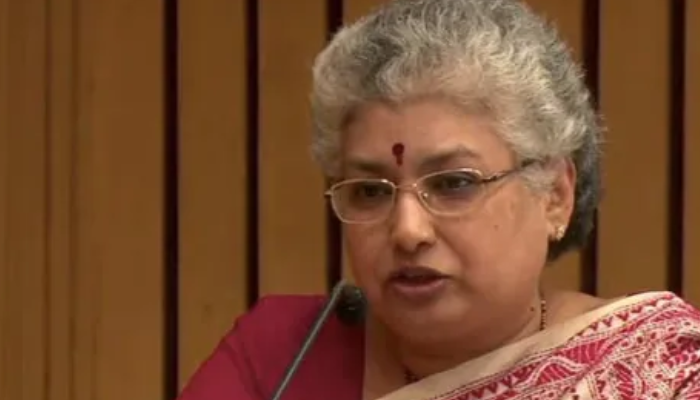
Supreme Court judge Justice B V Nagarathna called for a clear institutional push to improve gender representation in the legal profession, stating that at least 30 per cent of law officers representing the Union government, state governments and public sector bodies should be women. She said such a step would help women lawyers remain active in litigation and gain the courtroom visibility required for professional advancement.
Justice Nagarathna made the remarks while delivering the Dr Rajendra Prasad Memorial Lecture at Chanakya National Law University in Patna, where she spoke about constitutional governance and the structural foundations of democracy.
“30 per cent of the law officers of the central government and 30 per cent of the law officers of the state government must be women. And 30 per cent of the panel advocates in public sector organisations must be women,” she said while responding to a student’s question on women’s participation in litigation.
The lecture, titled “Constitutionalism beyond Rights: Why Structure Matters,” examined how constitutional stability depends not only on the rights it guarantees but also on the institutional design that distributes and restrains power. Supreme Court judge Justice Ahsanuddin Amanullah and the university’s vice chancellor Faizan Mustafa were also present at the event.
Domestic responsibilities continue to shape women’s legal careers
Justice Nagarathna pointed out that the relatively small number of women in litigation is closely linked to the multiple roles women are expected to manage, often balancing professional responsibilities with household duties.
“The reason is… because of the dual role that a woman plays… she also has her household to look after,” she said.
Highlighting the contrast in social expectations, she added, “When it comes to a successful man, there is always a woman behind him. But when it comes to a successful woman, there is a family behind her.”
According to the judge, these pressures often interrupt the steady professional engagement required to build a strong litigation practice.
Career interruptions affect courtroom recognition
Justice Nagarathna noted that many women advocates are compelled to step away from active practice due to pregnancy, childcare, and family commitments, often at critical stages in their professional journey.
“Many a time she has to drop out of the profession midway… and cannot return to the profession with a sufficient number of cases,” she said.
Such breaks, she explained, directly affect courtroom presence. Regular appearances before courts play an important role in shaping professional reputation and recognition.
“The lady lawyer in the profession becomes more critical for elevation,” she said, explaining that judges frequently consider advocates they regularly see arguing cases effectively when recommending names for judicial appointments.
Increasing women’s representation among law officers and panel advocates, she said, would strengthen their visibility in courts and improve their chances of being considered for elevation to the bench.
Structural reforms needed to sustain progress
Justice Nagarathna described the proposed 30 per cent representation as a structural solution aimed at addressing long-standing obstacles faced by women in litigation.
“If they are given an opportunity, they will continue to remain in the profession… their visibility in the profession would be greater,” she said.
Such measures, she added, could gradually build a stronger pool of experienced women advocates eligible for appointment to high courts and eventually the Supreme Court.
Despite the challenges, the judge expressed optimism about the future of women in the judiciary. She pointed out that women now make up more than half of recent entrants into judicial services, a trend she believes will eventually reshape representation at higher levels of the judicial system.
“In due course of time, they’ll all come to the high court and from the high court to the Supreme Court also… I’m very, very optimistic,” she said.
Constitutional design safeguards democracy
Linking the discussion to the broader theme of her lecture, Justice Nagarathna emphasised that constitutional democracy rests not only on the declaration of rights but also on the institutional framework that regulates power.
She began by recalling the legacy of Dr Rajendra Prasad, describing him as a towering constitutional figure who presided over the Constituent Assembly between 1946 and 1950 and later served as India’s first President. His conduct in office, she said, reflected a deep commitment to constitutional morality and institutional independence.
Referring to his 1960 address to the Bar Association of India, she noted that he had stressed the importance of each organ of the state functioning within its own sphere with restraint and mutual respect.
Justice Nagarathna argued that rights alone cannot safeguard liberty unless they are backed by strong institutional arrangements. Drawing on constitutional scholarship, she said rights without structural protection risk becoming “parchment guarantees”, promises written into law but lacking meaningful enforcement.
“The real constitution of any polity lies not only in the rights it declares, but in how it organises power,” she said.
She also referred to the evolution of constitutional jurisprudence on Parliament’s amending powers and the doctrine established in the landmark Kesavananda Bharati v. State of Kerala ruling. The judgment held that while Parliament can amend the Constitution, it cannot alter its fundamental framework.
“This doctrine is not about protecting individual rights alone; it is about preserving the structural integrity of the Constitution,” she said, adding that it prevents any authority from dismantling the institutional framework that limits its own power.