
























RelatedPosts
Indian athletics witnessed a defining moment in Ranchi as Gurindervir Singh stormed into history with a sensational 10.09-second run in the men’s 100 metres. He became the first Indian ever to breach the 10.10-second barrier.
The achievement came during the 29th National Senior Federation Cup at Birsa Munda Athletics Stadium. The Punjab sprinter shattered the national record and secured qualification for the Commonwealth Games. His performance also challenged a long-standing belief that Indian athletes cannot dominate elite sprinting.
The historic timing capped a dramatic 24-hour battle between Gurindervir and fellow sprinter Animesh Kujur for the title of India’s fastest man. In Friday’s semi-final heats, Gurindervir first broke the national record with a time of 10.17 seconds. Minutes later, Animesh answered with an even faster 10.15-second sprint to reclaim the record.
That reign lasted less than a day.
Gurindervir produced the race of his life. He exploded out of the blocks and maintained a relentless pace through the finish. He crossed the line in 10.09 seconds while Animesh finished in 10.20 seconds. The atmosphere inside the stadium reflected the scale of the achievement as spectators realised they had witnessed a historic moment for Indian athletics.
The stereotype Gurindervir wanted to destroy
For Gurindervir, the victory carried significance beyond medals and records.
The sprinter has spoken openly about the discouragement he faced during his teenage years. When he began taking athletics seriously at around 13, several coaches advised him to leave the 100m event and shift towards the 400m. He recalled being told Indians were not naturally suited for elite sprinting.
He also remembered hearing that there was “no future” for Indians in the 100 metres.
Rather than accepting those limitations, Gurindervir used them as motivation. He later said he wanted to prove Indian athletes possessed the strength, speed, and mentality needed to compete in sprinting’s most prestigious discipline.
Saturday’s historic run became his answer.
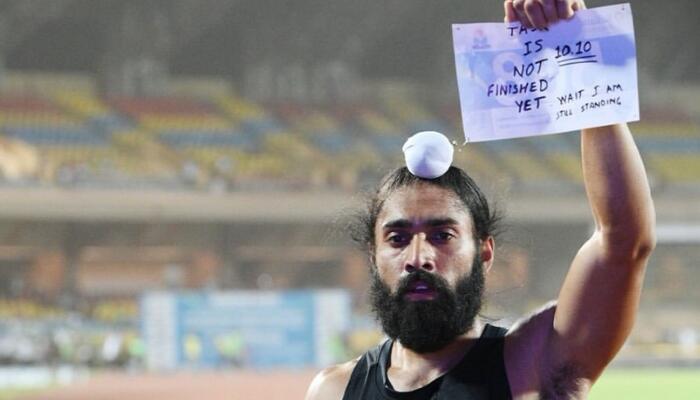
Moments after crossing the finish line, Gurindervir removed his racing bib and pointed it toward the cameras. The gesture drew immediate attention because of what had been written behind it before the race began.
Alongside the underlined target “10.10” was a handwritten message: “Wait, I’m still standing.”
The statement reflected both his personal struggle and the rise of Indian sprinting itself.
From Punjab’s tracks to national history
After initially training under coach Sarwan Singh, Gurindervir later moved to Jalandhar following Class 9. There, he began working with coach Sarabjit Singh Happy. That phase is widely regarded as the turning point in his career. Under structured coaching, he steadily evolved into one of India’s finest sprinters.
Following the race, Gurindervir credited his family, coaches, trainers and support staff for standing by him throughout his journey. He especially thanked his parents for their encouragement. He also acknowledged the role played by his trainers and dietician in preparing him physically for elite competition.
The sprinter praised the facilities and support provided by the Reliance Foundation. His achievement also drew praise from several political and sporting figures, including Samrat Choudhary, who described the performance as an inspiration for India’s youth.
Comparisons with the Flying Sikh begin
The historic sprint has already triggered comparisons with legendary Punjab athlete Milkha Singh, famously known as the “Flying Sikh”. Many have begun referring to Gurindervir as India’s potential “second Flying Sikh”, although experts believe his international journey has only just begun.
Globally, the benchmark remains distant. Jamaican sprint legend Usain Bolt still holds the world record at 9.58 seconds. China’s Su Bingtian owns the Asian record at 9.83 seconds, achieved during the Tokyo Olympics in 2021.
Yet for Indian athletics, Gurindervir Singh’s 10.09-second sprint may ultimately be remembered as the race that shattered a barrier Indian sprinting had carried for generations.