







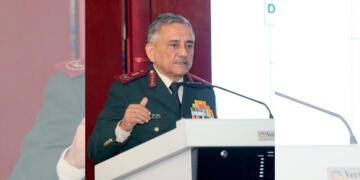










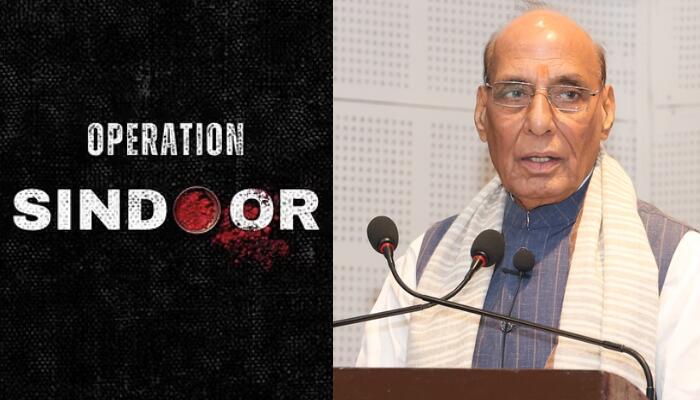
Defence Minister Rajnath Singh said, “India halted Operation Sindoor by choice, not compulsion”. Speaking at the National Security Summit 2.0, he asserted that India stood fully prepared for a prolonged conflict with Pakistan. Yet, it chose to stop on its own terms.
He rejected any suggestion of operational or diplomatic strain. Instead, India retained full military capability throughout the operation. Singh highlighted the country’s “surge capacity”, its ability to scale up force at short notice. Moreover, he noted that this capacity has only strengthened since then.
A decisive break from the past
Singh described Operation Sindoor as a turning point in India’s security approach. Now, instead of limiting itself to diplomatic responses, India acts directly against those responsible for attacks.
During the operation, Indian forces carried out precise strikes and hit intended targets. Even as Pakistan issued nuclear threats, New Delhi refused to be intimidated. Singh dismissed those warnings as a bluff and maintained that every decision remained guided by national interest.
At the same time, he drew a clear policy line. India, he said, will no longer distinguish between terrorists and those who shelter them. This marks a sharper and more assertive doctrine.
Pakistan in focus
Singh did not hold back in his assessment of Pakistan. He described it as the “epicentre of International Terrorism” while contrasting it with India’s global reputation in Information Technology.
Furthermore, he explained that terrorism operates across three dimensions: operational, ideological, and political. Addressing only the visible layer, he warned, will not eliminate the threat. The deeper ideological and political roots must also be dismantled.
To drive the point home, Singh used a striking analogy. He compared these roots to the source of Ravana’s strength, arguing that unless this core is destroyed, terrorism will continue to regenerate.
Operation Sindoor and escalation
India launched Operation Sindoor on May 7, 2025, after the Pahalgam terror attack that killed 26 civilians. In response, Indian armed forces struck targets across Pakistan and Pakistan-occupied (POK) Jammu and Kashmir. They destroyed nine major terror infrastructures linked to Lashkar-e-Taiba, Jaish-e-Mohammed, and Hizbul Mujahideen, killing more than 100 terrorists.
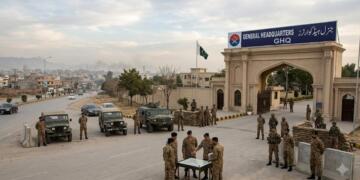
Pakistan responded with drone attacks and shelling, which triggered a four-day military confrontation. In turn, India retaliated with strikes on radar installations in Lahore and near Gujranwala, demonstrating both reach and readiness.
Eventually, the situation eased after Pakistan’s Director General of Military Operations contacted his Indian counterpart. Both sides agreed to a ceasefire on May 10.
A year later, a clear signal
Nearly a year on, Singh described Operation Sindoor as a symbol of a changing strategic order. He credited Prime Minister Narendra Modi’s leadership and the government’s zero-tolerance policy for shaping this shift.
The message is unambiguous. India will decide when to act, how far to go, and when to stop. It will do so on its own terms.