

















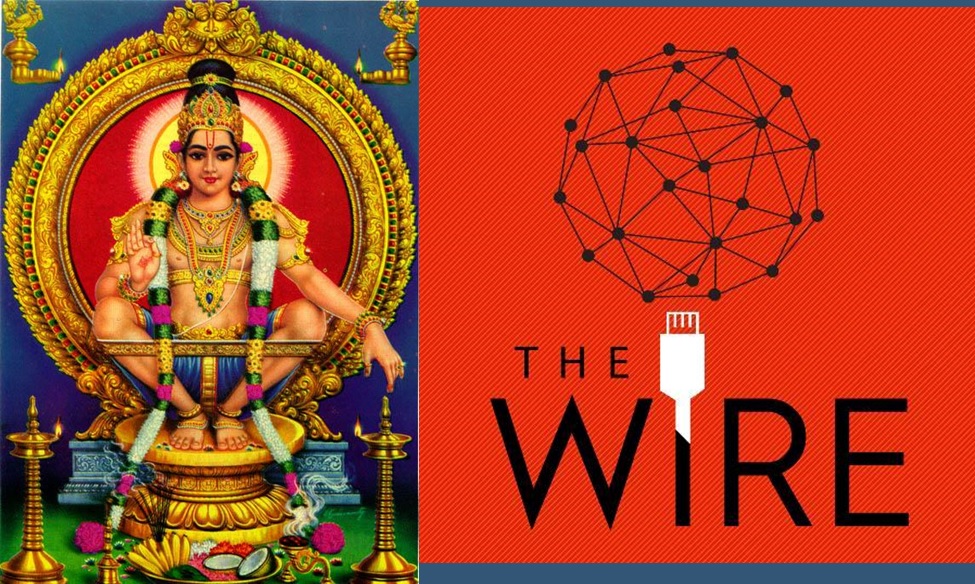
Recently, The Wire published an article titled ‘Appropriation of Ayyappa Cult: The History and Hinduisation of Sabarimala Temple’. A typical hit-job from what should be named “The Garrote” and not “The Wire”, scholarly smear job of half-truths, speculations and outright nonsense.
Yet in the narrative conflict, it must be responded to.
The article starts with tracing the heterogeneous history of the Ayyappan cult. The word ‘cult’ itself is a disparaging term. But let us look at the points,
• The scholar Radhika Sekar in her book, The Sabarimala Pilgrimage and Ayyappan Cultus, says the myth and legends of Ayyappa are not found in any of the major Puranic texts.
Response: How is that relevant? Hindu Dharma is not limited to a book or books. The divinity constantly graces us in new avatars, and new vyuhas, new temples and new methods of praxis are constantly evolved. And they are incorporated into texts and new puranas are formed. In the case of Ayyappa, it is the Boothanatha Upakhyanam of Brahmanda Puranam. Now whose arbitrary decision is it that it is not major and only major Puranas are to be the basis, for deciding whether something is Hindu or not?
If looking at Shruti/Smriti literature before Mahabharatha and Bhagavatha, there would be no worship of Krishna. Does that mean worship of Krishna should have no legitimacy? How about Santoshi Matha?
And on the flip side, deities mentioned in the Vedas like Sinivali or Dyaush Pitr are no more worshipped.
• The cult is traditionally not found in the northern parts of India. “Ayyappa worship is not known further north than mid-Karnataka, where it was probably introduced from Kerala”, observes M.N. Srinivas in the book Religion and Society among the Coorgs of South India.
Response: Another irrelevant point. Every region in India has its own unique deities and worships, they all are related to the underlying Dharmic substrate, but are not restricted by it. There are many such examples- Manasa Devi is regional to Bengal, yet is linked to Shakthi. Khatu Shyamji is regional to Rajasthan/Gujarat, is associated with Krishna.
• Due to the significant non-presence of Bhagwan Ayyappa in the conventional Ithihasa-Purana texts, it becomes difficult to categorise the cult as strictly belonging to Hindu tantric modality.
Response: ‘Difficult’ to categorize, if seen with the Abrahamic view. In fact, the need to ‘categorize’ is pre-assumed shoeboxes itself is untenable to Dharmic worldview. They don’t lose legitimacy because people find it difficult to categories, instead it becomes a ‘category’ by itself.
• It is after eighth century AD, with the coming of Brahmin migrants, that the Hindu temples of Ithihasa-Purana tradition started to be built in Kerala. Most of the temples were in the wetland areas.
Response: Multiple pieces of dubious half-truths here. The Hindu temples as seen today with Garbha Griha, Maha Mandapa, Dwijastamba did not happen overnight, they happened over a period, and different regions had different timelines suited to their geography and society. That is hardly any basis. Even today, some vermilion daubed on a tree or a spear stuck in sacred space, is a temple for many Hindus. And as mentioned in the earlier point, not all need to be based on Ithihasa-Purana traditions. Lot of temples in the South follow the Agamas, in the North, don’t – does not mean either is more Hindu than the other.
Eight Century A.D as the date of Brahmin immigrants bringing Ithihasas and Puranas are another ridiculous theory. Of course immigrations were constant in India. Rig Veda the oldest extent literature, was composed in the vicinity of Sindhu-Saraswati, can be considered the epi-center of this civilization, from there people and therefore with them customs would have emigrated. Parashurama might have brought them with him to Kerala, but in any case, it is nonsense to say that Keralaputras were unaware of the mainstream legends of Sanatana Dharma as late as 800 CE.
(1) Kulasekhara Perumal, the Chera king dated in 8th Century CE, was already composing the mellifluous ‘Mukunda Mala’ in Samskritam and Perumal Tirumozhi, part of the Tamil Divyaprabhandam.
(2) Cheraman Perumal, contemporary to Sundarar is approximately dated 700 CE. Again was well versed in Shaiva puranas and agamas.
(3) Even if the above 2 has some ambiguity, they were not the first set of Cheras. There was Sangam before. Even at the outside date of 6th century CE, Silappadikaram written by Ilango Adikkal, the brother of Chera King Senguttavan, is a wealth of poetic depictions the society in Chera, Chola, Pandiya kingdoms of that period, includes Aaychiyar (Cattle Herdswomen) singing Kuravai about the deeds of Krishna and his elder brother ‘Vraja’.
Besides, the Christians have a myth that St.Thomas visited the South of India. And in that concoction, not accepted by any Christian other than Christian South Indians, Thomas convinces a bunch of Brahmins in Palayoor to convert to Christianity by suspending some water in mid-air.
Since Thomas was a contemporary of Jesus, this should have happened in 1st century CE. Now where did these ‘Brahmins’ magically appear in Kerala in 1st Century?
Is that tale alone fiction, is the visit of Thomas to South India a fiction or is Jesus himself a fiction?
In any case, if literature alone is the basis, that Chera country had the Ithihaasas as intrinsic to culture far before 800 CE is well evidenced.
- One of the most notable things is that the Sabarimala Ayyappa temple does not find much mention in historical records of ancient Kerala, as Thikkurissi Ganghadaran says in his chapter of the book Kerala Samskara Padanangal.
Response: This is misdirection. Of course the Sabarimala Ayyappa temple is relatively new. The Pandalam Pandyas lineage arising from the dispersal of the Pandyas after the attack of Malik Kafur on Madurai (1311 CE). Many descendant kingdoms were established in Thenkasi etc, in the region, And Ayyappa was a foster child of the Pandalam Royal family.
But the historical mention that should be sought is the mention of worship of Ayyanaar, Shastha, Dharma Shastha etc. This is like saying there is no mention of Rama or Krishna in Vedas. Ayyappa is an avatara of Shastha. He is to Shastha, what Rama is to Vishnu.
Thankfully that aspect at least is mentioned in that article. Ayyanar worship. But there is also the narrative of being non-brahmanical is highlighted. And again how is it even relevant? How many gods of Hinduism are actually Brahmanical. Rama – Kshatriya, Krishna – Yadava, Shiva – only he knows, Parvati – Scheduled Tribe?
At no point was Hinduism the elusive domain of Brahmins, had it been, it would not have survived. More often than not, it is the other communities which built the traditions and temples and then deputed Brahmins to follow an austere lifestyle and conduct worship. In fact Archana/Seva in temples is not even among six primary duties prescribed for the Brahmins.
This is the ploy peddled in Tamil Nadu sponsored by Christian Evangelists to split the Hindu framework into silos of “Small god worship” and “Big god worship”, as though divinity can be measured in any manner?
On the whole, these arguments are totally based on the Christian/Islamic ‘set in stone’ definitions and ignorant of the syncretic nature of how Hindu Dharma evolves. This is beautifully detailed in this article by the writer Jeyamohan.
An arbitrary definition of religion cannot be applied, both on an all expansive, constantly evolving and inclusive one like Hinduism and on ones based on the exclusionary dogmas set in book. The ‘cults’ within Hindu framework, are characterized by their practices and beliefs which, are unique to them and are often considered odd and eccentric, for the outsider perspective, yet belong the larger substrate
This uniqueness is well defined in the case of Dharma Shastha, and more particularly with Sabarimala, with its eighteen steps, Erumudi, Magara Vilakku and mandala Vrata among other things. Yet Ayyappa is associated with Shastha, Hari, Hara and Shakthi – via Mahishi-Mahishasura.
The Buddhist attribution theory-
Then the article pitches the oft repeated ho hum theory of attributing the tradition to Buddhism and how then it was taken over. One would wonder as to where does this idea stem from when it is well known that Buddhists are not known to build temples. This Buddhist takeover theory has been disproved once too often but then one must remember the propaganda machinery’s time tested weapon- if lies are repeated often enough, it will create the illusion of truth one day.
There must exist some “Secret book for Secularists” somewhere, with a rule
‘When secularism fails to fool Hindus, from giving up on a tradition, assign the tradition to Buddhism and try again!’
First of, the problem arises with seeing Buddhism as a separate religion in confrontation with Hinduism or rather as the Hinduphobic term it “Brahmanism”, instead of seeing it as a separate school like Mimamsa, Vedanta or Nyaya. But this viewpoint is a later day machination by our ‘friendly’ visitors from the West.
By the way, Buddha had his own views, that only Kshatriyas and Brahmanas would make the cut to be an Arhat, had lofty opinions about the Brahmans as well.
If those are pointed out, suddenly they will say that those information was added after Buddha’s death. Interesting isn’t it, those which are divergences from Vedic view, Buddha said so, but those aligned were added later. Convenient to anti-Hindu agendas.
(1) Buddha takes from the extant Vedas and Shastras generously and then refutes some core concepts. That establishes that the Vedic pre-existed Buddha. Then all the things Buddha took from Brahmanism, means that it is Buddhism that appropriated from Hindu.
(2) Buddhism was indeed well spread all over the country for few centuries after Ashoka. Then with the advent of Kalabhras from Karnataka, the southern countries as well were politically to great extent and culturally, religiously occupied by Buddhist and Jains. But again, unlike the existential conflicts waged by Christianity and Islam, these schools for Dharma, mostly co-existed. The competition was often for the patronage of the kings and wealthy, rarely violent and occupying other spaces. This is often forgotten when comparing the causes of war. This is elaborated in this article.
(3) Then comes the takeover of religious places. Hindus are probably the only people who vest a place, an object with sacredness. Until the past century, no random location can become a temple. Only a location identified as a place associated with a divine event or with a Sadhu, Mahatma will be worshipped at, as a temple. So it would be extremely unlike of Hindus to forcibly occupy anybody’s place of worship. No Babar Masjids, No San Thome Cathedrals. So what ‘Buddhist’ holy spot can Hindus take over, not even Bodh Gaya.
(4) And did Buddhists have sacred places where gods were worshipped? They did not, they had monasteries – viharas, chaityas, stupas. In the south they lived mostly in caves in hills outside the city. They did make beautiful art in the places they lived. But from Ajanta to Angkor Wat, one thing is very evident. When the patronage and popularity changed between Hindus to Buddhists or Buddhists to Hindus, one did not destroy the others, but simply added icons of their own to the existing ones.
(5) Buddhism and Jainism receded from the South when the Bhakthi of Azhwars and Nayanmaars won the Kings and the people over. And some of the caverns used by Buddhists were indeed taken over for worship by Hindus, but as with Ajanta, Ellora never did they destroy any existing murthis. So if Sabarimala speculatively so, then is there any evidence of uniquely Buddhist art or architecture there? None.
(6) All they got is the vrata – “Ayyappa devotees strictly follow non-violence, vegetarianism and abstention from sex during the two months before the pilgrimage. It resembles the Ahimsa principles practiced by Buddhists”. When did these become the monopoly of Buddhists – Ahimsa, Saatvik Bhojana and Brahmacharya.
(7) Then there is the similarity of posture “For some scholars, Ayyappa is Nilakantha Avalokiteswara depicted in the Buddhist Puranas. “It has been mentioned in the Buddhist Puranas that the temple of Nilakantha Avalokiteswara was erected somewhere in the Sahya mountains,” M. Sreekala Nair writes in her chapter of Introduction to Kerala Studies. The posture of Ayyappa closely resembles the meditating stature of Buddha.”
Nilakantha – wait isn’t that the attribute of Shiva Mahadeva and who does Eswara do not?
First declare that Yoga is not Hindu, then anybody sitting in a yogic posture is therefore automatically Buddhist?
Such is the quality of the evidences to prove that Sabarimala is similar to some Hindu sounding Buddhist deity ‘somewhere’ in the Sahaya mountains.
Rest:
The rest of the article is a sordid story of the attempts by Muslims and Christians to either invalidate the great influence Shashta of Sabari wields among the people of that region or to associate Christianity and Islamic tales to take advantage of the popularity.
Their attempts included setting the shrine on fire, magically finding 2000 year old stone crosses and other such charlatan work. And the secular state keeps accommodating them. Thanks to the activism of Hindu organizations and dharmic people left in Kerala, the communist proxies of the church have not completely destroyed the Nilakkal Mahadeva temple and the Sabari Shrine. That activism is what the columnist mourns as ‘Hinduisation and mobilization.’ And this apparently causes ‘communal confrontation.’
Other such attempts are of course the entire fabricated nonsense, about Thomas in South India, and established 7and ½ churches in Kerala. Guess where J.K.Rowling got the idea for Platform. 9 and ¾ from?
To debunk that will be an article for another day. But thankfully now some Christian voices themselves are disowning.
And that Cheraman Perumal became Tajudeen and went to Mecca, another piece of rubbish. This unfortunately PM Narendra Modi gave credence to, when he visited Saudi Arabia. (The Shaiva tradition holds that Cheraman Perumal ascended to Kailasha simply by chanting Namah Shivaya in the ears of his steed. Yet PM Modi chose to highlight the Muslim myth over the Shaiva belief. Disappointing.
The logic implied is simple, since Hindus ‘supposedly’ appropriated a Buddhist Shrine, now they should just shut up and stand by, as Christians take over Hindu Shrines.
So the answer should be,
(1) No appropriation: There is no evidence that Hindus appropriated a specifically Buddhist Shrine
(2) Buddhism is not an ‘Other’: Buddhism is a fake religion made up by the colonials, Buddha is part of the larger framework of Sanatana Dharma. Like the distributaries of the mother river, it diverges from Hindu dharma, yet it is no alien aggressor and is a part of our heritage. So there is no question of appropriation from ‘other’.
(3) Adoption is different from appropriation: Appropriation is an issue only if there is an alienation and abuse of the original. It is not an issue if Christians adopt Hindu arts and architecture, but it is an issue if they do and then deny the divinity of Hindu gods and call them Satans. Is there any Hindu, who routinely abuses Buddha as a demon etc.? For example
Other points:
A note on the Vavar (Babar), the article calls it ‘Muslim Deity’, guess no Muslim ever reads such articles, else the author might be in trouble for calling a deity as Muslim. That apart, I wonder if the Supreme Court explored whether women would be allowed into the Masjid of Vavar the ‘Muslim Deity’.
The temple definitely has undergone some changes, and some of them are not good. With popularity, there is a tendency for Hindu regional customs to become more mainstreamed, but that should not take away the roles of the traditional communities being involved in the activities of the temple. For example the tribals of the Sabarimala region. But, as with most forest rights, that is caused more by the interference of the government, than any Hindu activism.
While incorporation of the enchanting ‘Harivarasanam’ is a good addition.
Mentioning that Makara Vilakku is man-made is a cheap shot. So what, the Thiruvannamalai Deepam during Karthika is also man-made, yet it kindles the belief of lakhs of devotees. The fire anyway is a compliment to the Makara Nakshatra appearing in the sky. Yatris aware of the temples tradition know it well.
In any case, the miracle is in the belief and the mischief is in abusing it.
The report regarding the Maharani of Travancore visiting the temple,
(1) The current royal in her interview, makes no mention of it and supports the prohibition of women capable of reproduction into the temple
(2) Even if it has happened, what are the chances that it was the typical ‘VIP’ treatment where the traditions of the temple are ‘adjusted’ to accommodate the VIP, that is an aberration that ought not to happen. They are not justification.
Yatra – what an innovative idea?
Finally, the author discovers the concept of ‘communitas’ in the work of eminent anthropologist Victor Turner and figures out Sabarimala Yatra is thus. Brilliant, nobody ever thought of that. Hindus have been doing Yatras for many millennia, completely with no idea of its benefits as a community activity, but just be superstition.
That is correct, unless a western eminence certifies and finds a benefit in a Hindu activity like Yatras, Yoga, Vrata – those are just superstition. Once certified, that aspect of Hinduism should be secularized or Buddhi-fied.
Summary:
There are 2 kinds of narratives at work here,
• The Supreme Court uses the definition of a denomination, decides that Ayyappa worship at Sabarimala, is not a separate denomination of Hinduism, and therefore can’t have the constitutional protections.
• The left-liberal media, like this article, declares the Ayyappa worship is not mainstream Hinduism, but is a cult of Buddhist origins that was later appropriated by Brahmanical Hinduism.
Both these applying the Abrahamic definition of religions and cults, fail Hindus in a damaging ways.
The Court can’t see the tree for the forest, it does not realize that while Hinduism is truly a forest, each tree in it, has its own unique attributes and worthy of being nurtured in that uniqueness.
And the left-liberals can’t see the forest for the trees, they slice and dice every aspect of Hinduism in all ways possible – Brahmanical, Buddhist, Tribal, Dalitists etc.
Both who can’t think of belief systems beyond the model of Abrahamic religions – a uniformed rows of allelopathic trees, like Eucalyptus, which do not allow for other varieties, one size fits all.
Hindus are now caught between the institutional power and the social narrative, both of which seek to impose upon them with no empathy or understanding of its diversity of practice with the underlying unity of philosophies. This has to stop. And we all pray to Lord Ayyappa to give them sad-budhhi.
Swamiye Sharanam Ayyapaa.