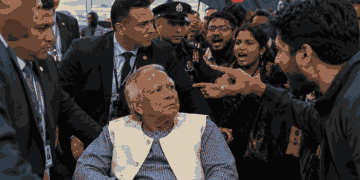




















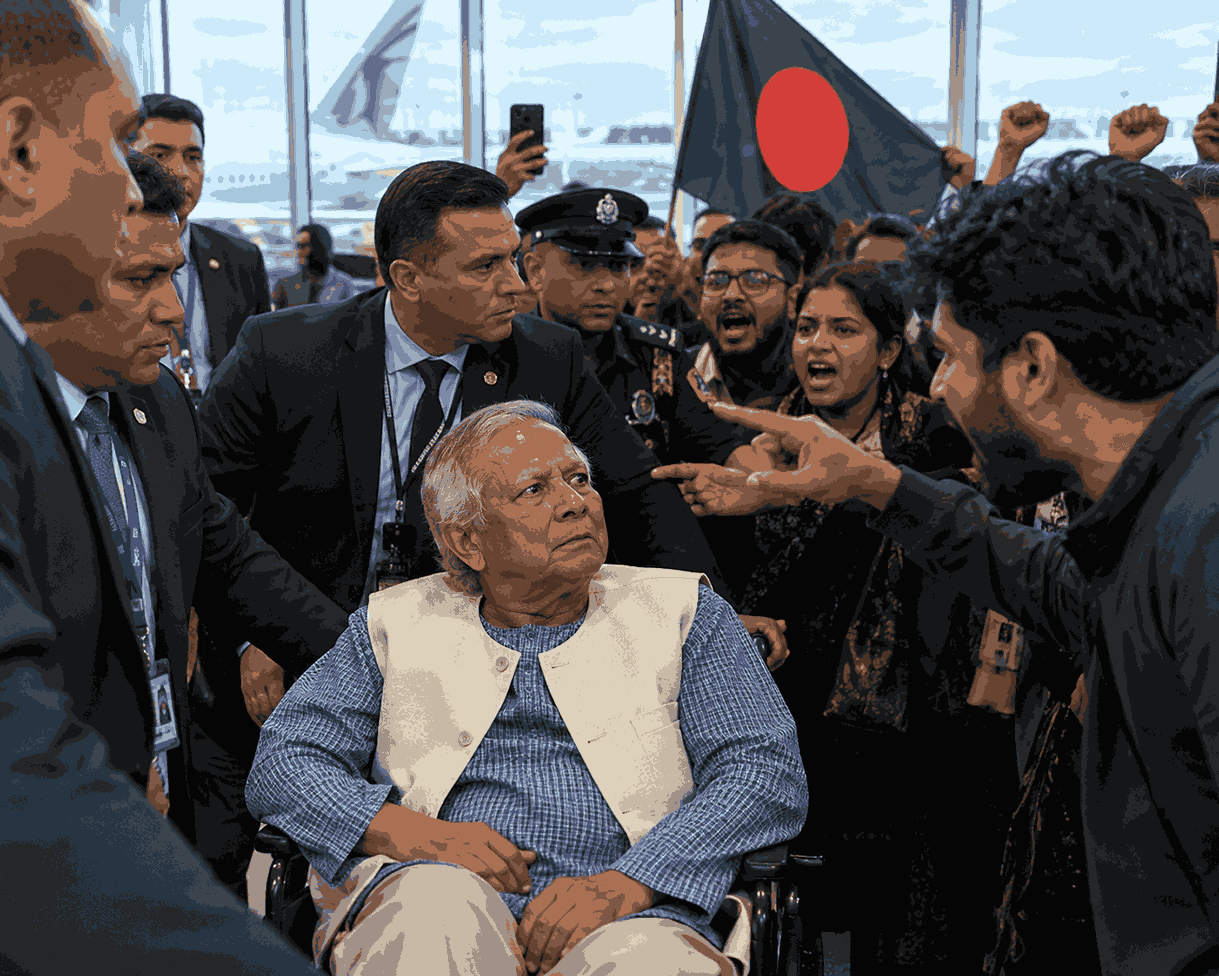
Former Bangladesh interim government chief adviser Muhammad Yunus faced an angry confrontation with Bangladeshi protesters at New York’s John F. Kennedy International Airport on October 12, 2026, with demonstrators calling him a “terrorist” and accusing him of undermining democracy. Video footage circulating on social media showed the Nobel Peace Prize laureate being confronted while seated in a wheelchair, as security personnel and associates attempted to move him away from the shouting crowd.
The incident unfolded as Muhammad Yunus arrived at JFK Airport on a Qatar Airways flight from Doha. According to reports, the aircraft landed at approximately 3:45 p.m. local time, and the confrontation occurred shortly afterwards in Terminal 8. Protesters demanded to know why he had come to the United States and levelled accusations concerning political violence, arrests and the deaths of police personnel in Bangladesh.
“You are a terrorist. You have killed people in Bangladesh. Why have you come here?” one man was heard shouting in a widely circulated video. Other demonstrators accused the former interim leader of destroying democracy and questioned his administration’s record. The allegations were made by protesters and have not been independently established by the footage itself.
Reports suggested that the protesters were associated with Bangladesh’s Awami League, the political party led by former prime minister Sheikh Hasina. However, the identities and affiliations of all those involved were not independently confirmed. The confrontation appeared to reflect the continuing bitterness surrounding the political upheaval that brought down Hasina’s government in August 2024.
Muhammad Yunus assumed leadership of Bangladesh’s interim administration on August 8, 2024, following a mass uprising that forced Hasina from power. His appointment was widely viewed as an attempt to stabilise the country and oversee a transition towards an elected government. Yet his tenure also became the subject of intense political disputes, with critics questioning the administration’s handling of law and order, political opponents and allegations of violence.
The airport confrontation brought these unresolved grievances into public view. Protesters reportedly accused the former adviser of responsibility for the deaths of thousands and alleged that large numbers of people had been arrested during his administration. Such claims must be distinguished from verified findings, and the figures cited by demonstrators could not be independently confirmed from the available footage and reporting.
The episode also prompted a response from Bangladesh’s current government. Zahed Ur Rahman, an adviser to Prime Minister Tarique Rahman, condemned the harassment and warned that legal proceedings would be initiated against those responsible. The government described the incident as unacceptable, signalling that political disagreements should not become an excuse for intimidation or harassment abroad.
The response highlighted a difficult question for Bangladesh’s political leadership: how should authorities respond when supporters and opponents of rival parties carry their domestic political battles onto foreign soil? While peaceful protest and criticism are fundamental democratic freedoms, threatening or harassing individuals raises separate questions of public safety and accountability.
For Muhammad Yunus, the episode represents another reminder that his time at the helm of Bangladesh’s interim administration remains deeply contested. His supporters may regard the confrontation as an attempt to intimidate a prominent public figure, while his critics see the anger as an expression of unresolved grievances over the country’s turbulent political transition. Neither interpretation, by itself, settles the substantive allegations surrounding his tenure.
The controversy also underscores the wider difficulties Bangladesh faces in moving beyond the upheaval of 2024. The removal of a long-serving government did not automatically resolve divisions over political accountability, state institutions, civil liberties or the treatment of opponents. Instead, competing narratives about responsibility for violence and democratic governance have continued to shape political debate, including among Bangladeshis living overseas.
The footage from JFK Airport has therefore become more than a brief confrontation involving an internationally recognised figure. It has exposed the depth of political hostility that persists beyond Bangladesh’s borders. Whether the incident leads to legal action, further diplomatic discussion or renewed political exchanges remains to be seen.
Ultimately, the accusations shouted at the airport should not be treated as proof of wrongdoing. They do, however, illustrate the strength of public anger among some opponents of the former interim administration. For Bangladesh, the larger challenge is to ensure that allegations of political violence are examined through credible evidence and due process, rather than settled through intimidation, slogans or partisan confrontation.