



















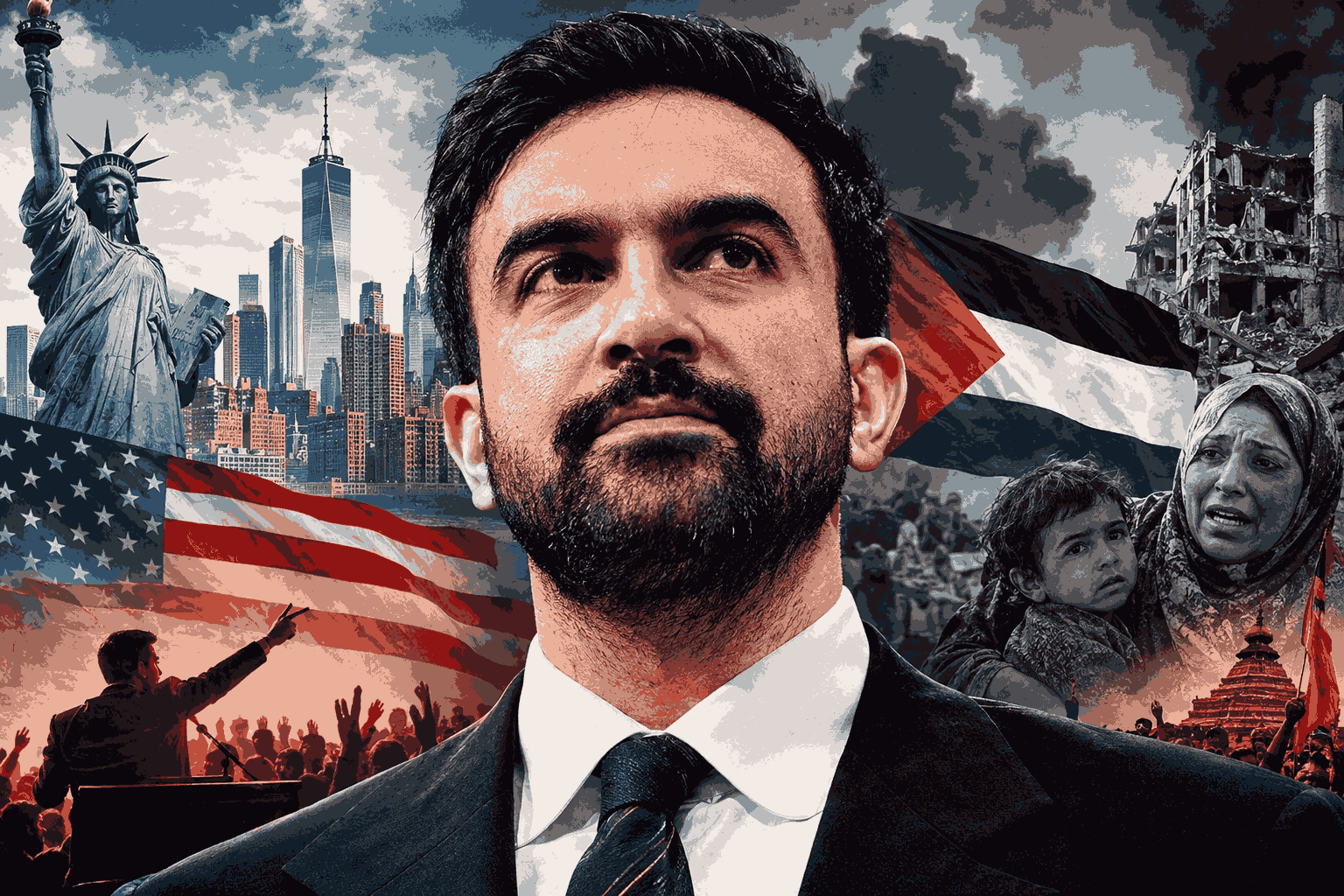
Zohran Mamdani has emerged as one of the most polarising political figures in New York, attracting fierce criticism over his positions on Israel, Palestine, nationalism and religion. His supporters portray him as a progressive champion of minority rights, but his opponents accuse him of applying a deeply partisan double standard to some of the world’s most contentious political conflicts. The resulting controversy has transformed his political rise into a national debate over ideology, identity and the limits of political activism.
At the centre of the storm is Mamdani’s uncompromising criticism of Israel and his vocal advocacy for Palestinian causes. While supporters insist that such criticism is legitimate and necessary, opponents argue that his rhetoric frequently appears far more sympathetic to the Palestinian cause than to Israeli security concerns. For his critics, this imbalance raises uncomfortable questions about whether his foreign-policy activism is driven by a consistent principle or by ideological alignment.
Zohran Mamdani has also faced sustained attacks over his views on nationalism and religious politics. His opposition to Hindu nationalist organisations and criticism of an event associated with RSS leader Mohan Bhagwat triggered accusations that he was hostile toward Hindu political movements. Mamdani has rejected that interpretation, arguing that his objection is directed at Hindu nationalism rather than Hinduism itself. Nevertheless, the episode exposed the widening cultural fault lines surrounding his politics.
The most explosive accusations involve terrorism. Political opponents and commentators have repeatedly attempted to associate Mamdani with extremist causes because of his positions on Israel and Palestine. Such accusations are extraordinarily serious and should not be treated as established facts without evidence. Political sympathy for a cause, however controversial, is not the same as supporting a terrorist organisation. That distinction is crucial in judging Mamdani’s record fairly.
Zohran Mamdani’s critics nevertheless argue that his political language has sometimes been unnecessarily provocative. They contend that his willingness to embrace sharply anti-establishment rhetoric has helped him mobilise supporters while simultaneously alienating opponents. In an increasingly polarised city, that strategy can turn political disagreement into an ideological confrontation in which compromise becomes almost impossible.
His Muslim identity has added another dimension to the controversy. Mamdani has faced attacks that critics say cross the line from political opposition into Islamophobia. That reality should not be ignored. At the same time, criticism of a Muslim politician’s policies cannot automatically be dismissed as prejudice. The challenge is to distinguish legitimate scrutiny of political positions from attacks based on religion or ethnicity.
Zohran Mamdani has therefore become a lightning rod for arguments far beyond New York City. To supporters, his rise represents a challenge to established political power and a demand for greater representation. To opponents, it represents the growing influence of an ideological politics they believe is hostile to traditional American positions on Israel, nationalism and foreign policy.
The controversy became even more combustible when an alleged ISIS-inspired attack involving explosive devices was investigated during an anti-Muslim protest outside Mamdani’s home. Mamdani condemned extremism and violence. The incident demonstrated how quickly political hostility can spill into a dangerous environment in which identity becomes a weapon and legitimate debate is drowned out by threats.
Zohran Mamdani’s political future will depend partly on whether he can turn his activist reputation into effective governance. Campaign rhetoric can energise supporters, but governing New York demands difficult compromises involving public safety, housing, taxation, policing and economic policy. The same uncompromising style that helped build his political movement could become a liability if voters conclude that confrontation matters more to him than practical results.
Ultimately, Mamdani deserves scrutiny precisely because his politics are consequential. But scrutiny should be based on his actual statements, policies and record—not exaggerated accusations or guilt by association. His supporters should be prepared to defend controversial positions rather than dismiss every criticism as prejudice, while his opponents should provide evidence rather than relying on inflammatory labels.
Zohran Mamdani has already succeeded in doing something few politicians accomplish: he has forced New York and the wider United States to confront difficult questions about identity, ideology, religion and foreign policy. Whether his politics ultimately prove visionary or divisive will be determined not by the intensity of the controversy surrounding him, but by the record he builds in office.