





















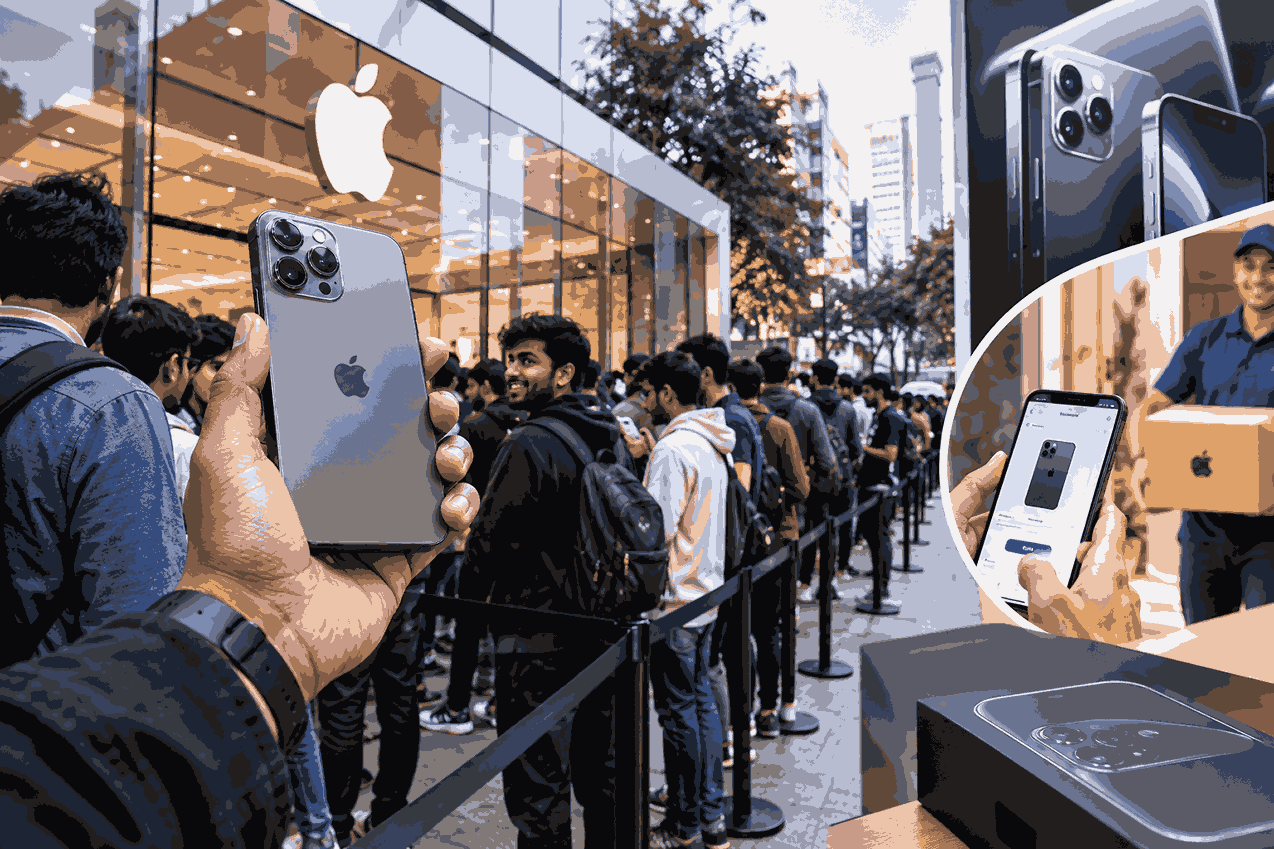
The iPhone 18 Pro frenzy has taken over several Indian cities as customers turned up in large numbers outside Apple Stores on September 18, with some reportedly waiting through the night to purchase Apple’s latest flagship smartphones. The scenes were particularly striking because the same devices are available through online channels, while quick-commerce services have also made rapid delivery possible in several cities.
Long queues were reported outside Apple Stores in Delhi, Noida, Mumbai, Bengaluru and other major cities as the iPhone 18 Pro and iPhone 18 Pro Max went on sale. The phones officially became available in India at 8 am, but enthusiastic buyers began arriving hours earlier. Some customers described the annual launch as something resembling a festival rather than an ordinary retail event.
The price makes the spectacle even more notable. The iPhone 18 Pro starts at ₹1,64,900 in India for the 256GB model, while the Pro Max begins at ₹1,79,900. Higher-storage versions cost considerably more, with the top-end Pro Max reaching ₹3,29,900.
Yet price alone does not explain the queues. The iPhone 18 Pro frenzy is also about the experience of being among the first owners. For many enthusiasts, walking into an Apple Store on launch morning, collecting the device and immediately sharing photographs or videos is part of the attraction.
That distinction matters because purchasing a smartphone is no longer purely a question of convenience. A consumer can order a device online, complete the payment and wait for delivery without leaving home. Apple itself provides online purchasing, while reports have highlighted the availability of rapid delivery options for the latest iPhones in selected Indian cities.
For some buyers, however, the physical experience is valuable. The queue creates a sense of occasion. It allows customers to meet fellow enthusiasts, discuss specifications and share the anticipation surrounding the launch. One Bengaluru buyer told NDTV that he regarded the annual iPhone launch almost like a festival and had been purchasing iPhones since the iPhone 7.
The iPhone 18 Pro frenzy also illustrates how strongly smartphones have become intertwined with identity and status. An expensive smartphone is highly visible. Unlike a household appliance hidden inside a home, a phone travels everywhere with its owner. It appears during meetings, dinners, travel, photographs and social-media posts.
That visibility gives premium smartphones a symbolic value beyond their technical specifications. For consumers who can comfortably afford them, buying the latest model may simply be a personal preference. For others, however, the appeal can involve the desire to demonstrate technological sophistication, financial success or membership of an aspirational social group.
This is where the phenomenon of conspicuous consumption becomes relevant. People do not always purchase products solely because of what those products do. Sometimes the brand, design and social meaning attached to an object form part of its appeal.
The latest iPhone also creates a powerful sense of novelty. Every annual launch generates comparisons between the previous generation and the new model. Features such as Apple’s A20 Pro chip, upgraded camera technology and other hardware changes provide genuine reasons for some existing users to upgrade.
But not every buyer is replacing an old or malfunctioning phone. Some are moving from relatively recent flagship models. For those consumers, the decision can be less about solving a technological problem and more about wanting the newest available product.
That is where FOMO, or the fear of missing out, can enter the equation. Seeing friends, influencers or celebrities display a new device can make consumers feel that they are falling behind even when their existing phone remains perfectly functional.
The iPhone 18 Pro frenzy is therefore amplified by social media. A photograph of an ordinary online delivery may attract little attention. A photograph of hundreds of people waiting outside an Apple Store creates a spectacle. Videos of queues can themselves generate additional interest, reinforcing the impression that the product is exceptionally desirable.
There is also a powerful element of social proof. When large numbers of people visibly choose the same product, others may interpret that behaviour as evidence of the product’s importance or desirability. The resulting cycle can turn a product launch into a cultural event.
Celebrity involvement adds another layer. Indian media reports have highlighted appearances by celebrities around the launch, while social-media content has further increased the visibility of the new models. Celebrity association does not necessarily establish a paid promotional relationship in any particular case, but it contributes to the aspirational environment surrounding premium products.
The iPhone 18 Pro frenzy also demonstrates how Apple has transformed product launches into experiences. The store becomes a meeting point, the queue becomes part of the story, the purchase becomes content and the unboxing becomes a social-media event.
That does not mean everyone standing in line is making an irrational purchase. A wealthy consumer may simply enjoy Apple’s products and want to experience launch day in person. Another buyer may be upgrading from an older device and consider the new features worthwhile.
The more interesting question concerns consumers for whom the purchase represents a significant financial burden. A ₹1.65 lakh smartphone is a substantial discretionary expense. If purchasing it requires sacrificing essential savings or taking on uncomfortable debt merely to project an image of wealth, the financial calculation becomes very different.
Ultimately, the iPhone 18 Pro frenzy is less about a single smartphone than about modern consumer behaviour. Technology, branding, social identity and entertainment have increasingly merged into one marketplace.
For some Indians, the latest iPhone is simply a powerful new device. For others, it is a status symbol, a yearly ritual or an experience worth travelling for.
And that explains why, even in an era when smartphones can be ordered from a sofa and delivered rapidly to the doorstep, thousands of consumers are still willing to stand outside a store and wait for the doors to open.
The phone may be delivered in minutes. The excitement surrounding its arrival, for many buyers, is something they want to experience in person.