
























In the past few days, social media timelines have been dominated by yet another viral clip allegedly showing a woman caught shoplifting at a retail store in the United States. The video, widely circulated on X and YouTube, triggered instant outrage and ridicule directed at India, Indians in abroad particularly Gujaratis. Many assumed that the accused was Indian and even from Gujarat, linking it to an earlier unrelated case. But despite the viral claims, there has been no official confirmation from any U.S. law enforcement agency or credible media outlet about the woman’s nationality.
Almost all the Major Indian outlets that ran the story also admitted they had not independently verified the content, basing their reports purely on social media chatter.
Yet that didn’t stop India’s commentariat from weaponizing an unverified incident to attack the country’s image. What began as a murky online video quickly spiraled into a cross-continental controversy one revealing not just the dangers of digital misinformation but the ideological bias that thrives on India and Modi bashing at any cost.
Our research of the digital trail behind the so-called “shoplifting incident” shows how an unverified incident is made into a toolkit Just to tarnish India’s image. The earliest version we could trace appeared on a YouTube channel called “RK’s in America” on November 1 2025. The video, titled “One More Indian Woman Caught Stealing”, claimed to show this alleged incident was recorded on July 17 2025. The description redirected us to another channel “Crime Time Cam” as the alleged original source. But upon inspection, no such video exists on that channel.
How the Story Spread: From a YouTube Clip to National Headlines
Despite this missing source, Indian websites, top television channels and digital magazines went ahead with sensational headlines, saying viral video, Indian get caught etc, and some like news 24 even confidently declaring that the woman was “Gujarati”. None offered proof. Not one had spoken about U.S. police departments or verified the footage’s authenticity.
Why such eagerness to attribute nationality without evidence? The answer lies partly in India’s digital ecosystem, where ideology and click-bait often blur journalistic ethics.
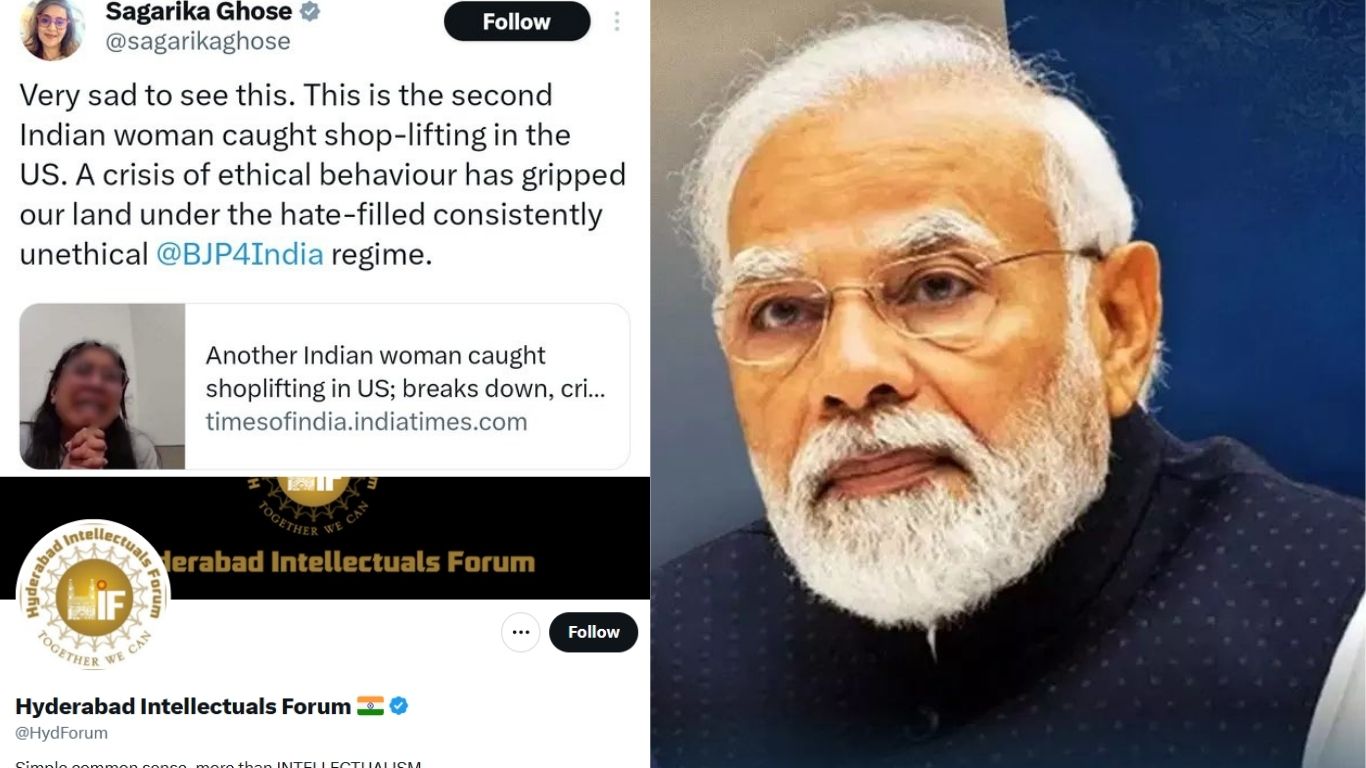
Our research further led us to The Hyderabad Intellectuals Forum, a politically-charged X handle with a record of anti-India posts, played a key role in amplifying the clip. Its posts frequently target the Indian government, question the country’s moral compass, and fan regional divisions. In one tweet exchange, when a user used an expletive linking them to Turkey, the handle replied, “How much hatred, how much depravity. It silently tells us how wretchedly our country has become.” Ironically, the same account tolerated abusive comments against this alleged Indian women under its own shoplifting post. Because want people to abuse India. The agenda is very clear and simple.
And By embedding a tweet from this Hyderabad Intellectuals Forum handle, every Indian news organizations effectively lent legitimacy to a politically motivated account without checking the underlying facts. The end result, a digital echo chamber that painted Indians as unethical, Gujaratis as symbolic villains, and India’s global reputation as collateral damage.
Amid this manufactured outrage, one prominent voice that seized the moment was Trinamool Congress MP Sagarika Ghose. Known for her long-standing criticism of the BJP and Prime Minister Narendra Modi, she quoted the viral clip and declared:
“Very sad to see this. This is the second Indian woman caught shoplifting in the US. A crisis of ethical behavior has gripped our land under the hate-filled, consistently unethical BJP regime.”
The irony could not be starker. Here was a senior journalist-turned-MP connecting an unverified foreign petty-crime video to India’s domestic politics without even confirming if the woman was Indian at all. None of the Indian outlets she cited had verified the facts either. Yet the comment fit neatly into a pattern that has come to define parts of India’s liberal ecosystem using any incident, however distant, to reinforce an anti-Modi narrative.
This is the same mindset that saw sections of the commentariat justify the Emergency, dismiss terror attacks as “politicized events,” or rationalize anti-Hindu violence as “contextual.” The ideology remains constant attack the current government even if that means ridiculing the nation itself.
What makes the episode more revealing is the consistent attempt to frame Gujarat as the symbolic punching bag. When these X handles declared that the alleged woman was “Gujarati”, it provided zero verification. The subtext was clear, because it’s the home state of Indian PM Modi. The state that gave India Gandhi and Patel
This selective targeting is not accidental. For years, Gujarat has been the epicenter of ideological battles, portrayed alternately as the land of progress or prejudice depending on one’s politics. The shoplifting story offered another opportunity to invoke that imagery. In the absence of real facts, insinuation sufficed.
At its heart, this controversy exposes the symbiosis between agenda-driven influencers and profit-driven digital newsrooms. The first provides outrage; the second monetizes it. Media houses embedded viral tweets without verification, repeated unconfirmed claims, and turned social media speculation into “Breaking News.” Some even blurred ethical lines further by inserting communal or regional overtones.
What none of them did was basic journalism, verify the footage, trace its origin, or contact U.S. authorities. Our investigation shows that the supposed “original” video remains missing. Even the metadata from the known uploads suggests re-editing and re-posting by multiple unknown accounts making the authenticity dubious at best. Yet the moral panic travelled faster than facts ever could.
Equally revealing was the selective outrage displayed by accounts like Hyderabad Intellectuals Forum their double standards expose that the goal was never moral concern but political messaging, to depict Indians, especially those from Modi’s home state, as ethically compromised.
The viral shoplifting saga is less a story about a petty crime and more a case study in how agenda replaces accuracy in today’s information wars
It raises a straightforward question, When facts are uncertain, why drag India, Modi, or Gujarat into it at all? The answer may lie in the compulsive need of some to keep India divided, its achievements undermined, and its image perpetually questioned.