
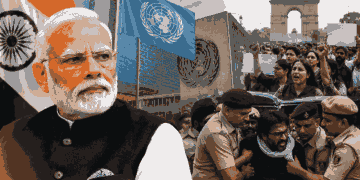




















New Delhi: For two weeks, India’s Monsoon Session has produced more adjournments than legislation. The trigger was police action against student protesters in Jharkhand and Delhi, and the demand from the Opposition was simple: get the Union home minister, Amit Shah, to answer for it on the floor of the House. On Monday, the government said yes.
The parliamentary affairs minister, Kiren Rijiju, told a Lok Sabha Business Advisory Committee meeting, chaired by the Speaker, Om Birla, that the government was ready for “a full-fledged discussion on the student and youth agitations that have been going on in different parts of the country as well as police action.” Shah, he said, would give a “point-by-point reply” on behalf of the government. The Opposition, however, rejected it within hours.
A demand met, then moved
The Congress and the Samajwadi Party said the offer wasn’t enough. They want a second, separate debate on alleged irregularities in donations to the Ram Temple trust in Ayodhya treated as a standalone discussion, not folded into the same session as the students’ issue.
The Leader of the Opposition in the Lok Sabha, Rahul Gandhi, has previously called Shah’s presence in the House “non-negotiable.” Congress leaders Gaurav Gogoi and K Suresh have said the Opposition wants both issues discussed, not one substituted for the other.
Rijiju’s response points at something simpler: cooperation. “My only point made to the Opposition is that while the discussion and a reply are being made, the Opposition should not create disturbances to prevent the statement of the Home Minister,” he said. “They must listen to the reply of the Home Minister and the government.”
What sparked it
The unrest began with a protest march on July 20, followed by allegations of police lathi charges and the use of water cannon on demonstrators in Jharkhand—a state governed by a coalition of the Jharkhand Mukti Morcha, the Congress and the Rashtriya Janata Dal. Similar clashes have played out in Delhi. Opposition MPs, including the Samajwadi Party’s Akhilesh Yadav and the CPI(M)’s John Brittas, have raised the issue repeatedly in the House, alongside objections to the FCRA Amendment Bill.
The cost has been visible in the legislative record. Six of the eight bills passed by the Lok Sabha this session went through without any debate at all, as the standoff over Shah’s appearance ate into the time available for scrutiny.
The optics problem
Here is where the arithmetic gets awkward for the Opposition. The government’s offer, on its face, addresses exactly what was being demanded: Shah, in the House, answering questions on the record. Rijiju has framed the ask back to the Opposition as one of basic parliamentary conduct—let the minister speak, and challenge him afterwards.
By adding a second condition, a separate Ram Temple debate, before it will accept the offer, the Opposition risks a familiar accusation: that disruption, not accountability, is the actual objective. If the demand was always simply for Shah to answer on students’ safety and police conduct, that demand is now on the table. Refusing to proceed until an unrelated issue is bundled in makes it harder to argue the paralysis rests solely with the treasury benches.
The Monsoon Session is scheduled to end on August 13, 2026, leaving both sides very little time to resolve the impasse or very little time left to spend not resolving it.