























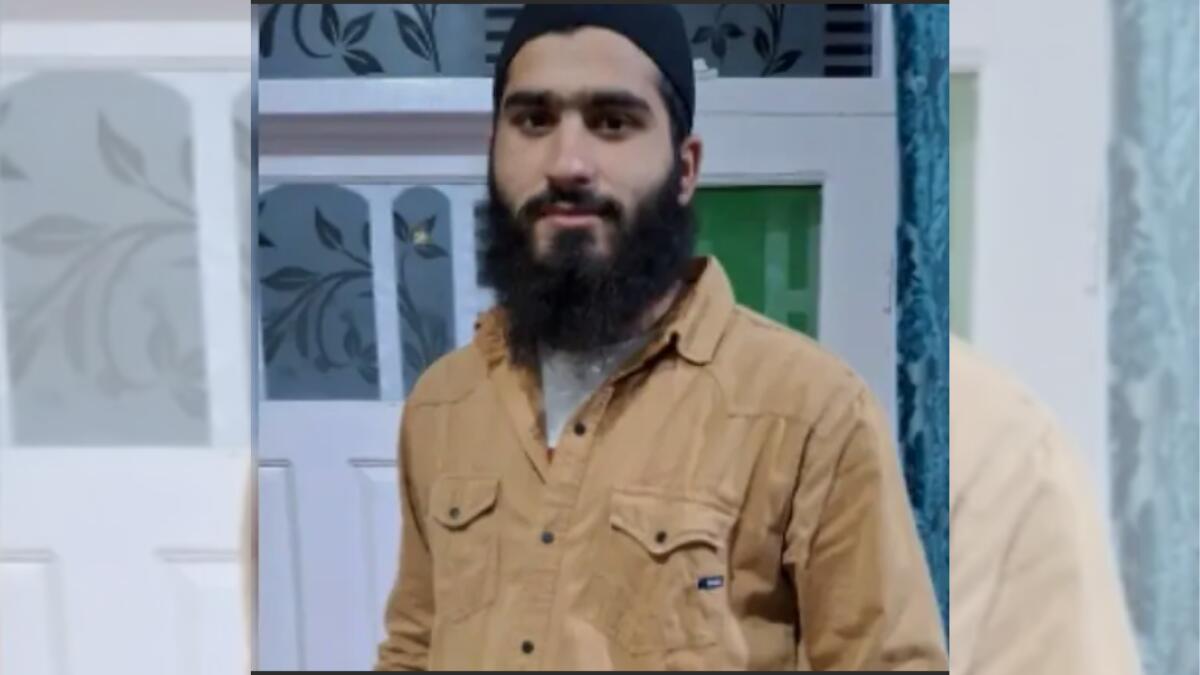
The killing of Lashkar-e-Taiba (LeT) commander Mohammad Lateef Bhat in Jammu & Kashmir’s Kulgam district has highlighted two contrasting aspects of the fight against terrorism: the dangers of radicalization and the importance of restraint by security forces during counter-terrorism operations.
Bhat was killed on Wednesday after a prolonged encounter in Zangalpora village. He had taken shelter inside a mosque after security forces surrounded the area following intelligence inputs about his presence.
What made the operation particularly sensitive was the presence of 25 girls and two teachers inside a Darul Uloom, an Islamic educational institution adjoining the mosque. Security forces had to neutralize the threat while ensuring that civilians were not caught in the crossfire and that the religious structure suffered minimal damage.
Refusal to surrender raises questions about radicalization
According to reports quoting police officials, security forces made repeated attempts to persuade Bhat to surrender. Kulgam senior superintendent of police, Anayat Ali and the commanding officer of the Army’s 9 Rashtriya Rifles also tried to convince him through a video call.
An officer reportedly told him, “Hum tumhare saath hain” (We are with you), urging him to lay down his weapons and return alive. However, Bhat refused.
During the conversation, he reportedly said that he wanted to meet Allah and was happy, indicating that he did not intend to surrender. He subsequently opened fire from inside the mosque.
His response reflects the disturbing mindset that can emerge from deep radicalization: the belief that violence can be justified in the name of faith and that taking innocent lives or putting others at risk can somehow be reconciled with religious belief.
There is a fundamental contradiction in using religion to justify killing, intimidation and armed violence. No religious place should be turned into a refuge for terrorism, and no individual can claim religious justification for endangering innocent people.
The episode also raises an important question: what makes a radicalized individual reject repeated opportunities to surrender, even when security forces assure him that his life can be spared?
How security forces prioritises civilian safety
The rescue of the 27 civilians became one of the most significant aspects of the operation.
According to officials quoted by the Press Trust of India (PTI), an officer from the Army’s 9 Rashtriya Rifles volunteered to enter the adjoining seminary with another soldier despite heavy firing from the mosque. They successfully evacuated all 25 girls and two teachers.
Only after the civilians had been moved to safety did security forces proceed with the final phase of the operation.
Troops from the Army’s 9 Rashtriya Rifles and the Jammu & Kashmir police’s Special Operations Group (SOG) fired tear gas shells into the mosque to force Bhat out. They maintained a tight cordon and exercised restraint to prevent damage to the religious structure.
Bhat eventually emerged from the mosque and was shot dead as he attempted to run, according to reports quoting officials.
Why the operation matters
The encounter followed the November 11 attack on a Central Reserve Police Force (CRPF) checkpoint in Akhran village near Mir Bazaar, in which three personnel were injured. Police and security officials suspected Bhat and his associate Umar Nisar Dar of involvement in the attack. Dar was killed in a separate encounter earlier in the week.
The operation was the culmination of a sustained search for Bhat, who had evaded security forces during an earlier encounter. His killing marked a significant outcome for the forces involved in the search.
However, the success of the operation cannot be measured only by the elimination of a wanted terrorist. The safe evacuation of 27 civilians, repeated attempts to secure a surrender and efforts to protect the mosque demonstrated the importance of intelligence-led operations and civilian safety.
The operation demonstrated the effectiveness of a coordinated, intelligence-led counter-terrorism effort involving the Army and Jammu & Kashmir police. Security forces successfully tracked down a wanted LeT commander, established a cordon to prevent his escape and made repeated attempts to secure his surrender.
More importantly, they prioritized civilian safety even as the encounter continued. The evacuation of all 27 civilians, the use of tear gas to bring Bhat out and the restraint exercised to protect the mosque reflected a measured approach to a sensitive operation. With no civilian casualties reported, security forces achieved their primary objectives: neutralizing the wanted terrorist while protecting innocent lives and preventing damage to the religious structure.