





















Every great economic power in the modern era arrived at that status by water, not by accident. Britain built an empire on shipping lanes before it built one on factories. The United States became the arbiter of global trade only after its navy could guarantee that trade would move. China’s manufacturing rise since the 1990s has been inseparable from its build-out of ports, container fleets and, more recently, a navy large enough to make sure nobody could threaten either. India, aiming to join that company by 2047, has so far treated this as an economic project rather than a maritime one. That is the gap the next two decades need to close.
A Target That Only the Ocean Can Deliver
The government’s Viksit Bharat vision sets out what a “developed” India is supposed to look like by the time the country turns 100: an economy of roughly $30 trillion, up from around $4 trillion today, alongside a per capita income near $18,000 and eight per cent annual growth sustained for two decades. These are extraordinary numbers, and nearly all of them run through a single chokepoint that gets far less attention than the growth targets themselves — the sea. Analysts tracking India’s economic strategy describe the Indian Ocean bluntly as India’s “lifeline to becoming a developed country by 2047,” because maritime trade is not one input into that growth story; for a country that already moves 95 per cent of its trade by volume and 70 per cent by value across water, it is close to the entire story. Ensuring the safety and security of the sea lines carrying that trade is not a peripheral defence concern attached to an economic plan. It is a precondition for the plan working at all.
The Embarrassing Gap Nobody Quite Says Out Loud
Here is the uncomfortable number: despite sitting astride some of the busiest shipping lanes on Earth, with an 11,000-km-plus coastline, India’s share of global shipbuilding output stands at roughly 0.06 per cent — a rounding error next to China, South Korea and Japan, the three countries that build almost everything that carries India’s own trade. India pays out close to ₹6 lakh crore, on the order of $75 billion, every year to foreign shipping companies simply to move its own goods, because it does not own enough of the ships doing the moving. This is the same country whose government has set a target GDP of $30 trillion for 2047. An economy of that size cannot rent its own supply chain from other people’s fleets and still call itself a maritime power.
The government has begun to treat this as the emergency it is. A ₹69,725 crore shipbuilding package announced to replace the expiring 2015 policy framework is explicitly aimed at pushing India into the world’s top five shipbuilding nations by 2047, targeting a five per cent global market share — up from essentially nothing today. A separate roadmap commits to adding 62 vessels and roughly 2.85 million gross tonnes of shipping capacity in a single financial year, backed by over ₹51,000 crore in investment. States are racing to position themselves inside this build-out: Gujarat’s newly launched Shipbuilding and Repair Policy leans on the state’s 2,340-km coastline to court a greenfield cluster in Porbandar worth more than ₹27,000 crore, framed explicitly around Prime Minister Modi’s Atmanirbhar Bharat vision. None of this is naval procurement in the strict sense. It is industrial policy that happens to run on the same yards, the same steel and often the same workforce that build warships — which is precisely why the civilian and military shipbuilding ambitions cannot really be separated from each other.
Carrier Battle Groups as the Anchor of the Whole Edifice
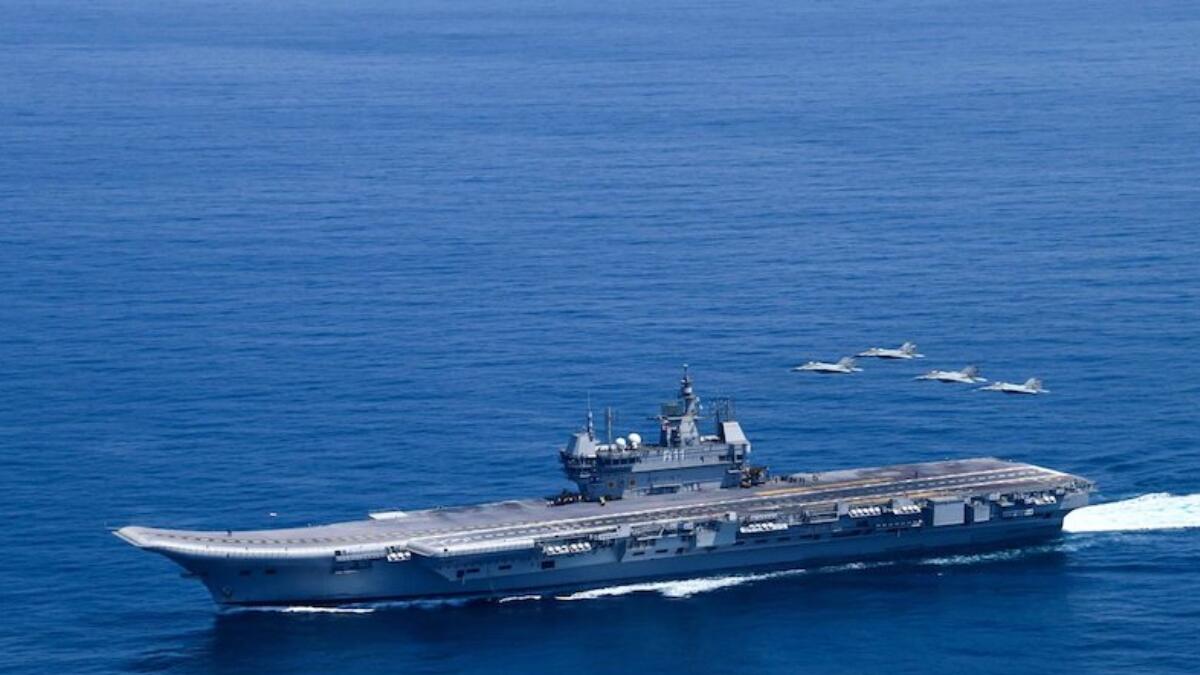
This is where the economic ambition and the naval one converge rather than compete. A shipbuilding industry capable of turning out world-class carriers, destroyers and frigates for the Navy is, by construction, the same industry capable of building the merchant fleet, LNG carriers and container ships India needs to stop paying foreign operators to move its own trade. Every rupee spent on IAC-2, India’s long-delayed second indigenous aircraft carrier, trains welders, engineers and systems integrators who do not forget those skills when they move to a commercial yard the following year. Countries that have successfully built blue-water navies — the United States, Japan, South Korea — did not build them in isolation from a thriving commercial shipbuilding base; the naval and civilian sectors reinforced each other, sharing workforce, capital and political will.
A carrier battle group, in this reading, is not simply a military asset. It is the most visible proof that a country’s shipbuilding base, industrial supply chains and skilled workforce have reached a level of maturity that few nations ever achieve — the same maturity a $30 trillion economy would need anyway to build its own merchant fleet, port infrastructure and offshore energy platforms. India cannot plausibly claim to be a “developed” economy by 2047 while still building only a token fraction of the ships that carry its trade and only a fraction of the warships that would need to protect it. The carrier and the container ship are, in the end, downstream of the same industrial capability.
The Vision for 2047
None of this requires India to out-build China’s navy hull for hull; nobody seriously argues that is the metric that matters. What it requires is a navy — and the shipbuilding ecosystem beneath it — sized to the ambition the country has already set for itself economically. A $30 trillion economy that still cannot reliably move, escort and protect its own trade without borrowed ships and, when it matters, borrowed naval presence, has not actually arrived at the destination its own Viksit Bharat targets describe. The 2047 vision, read carefully, has always been a maritime vision wearing an economic label. India’s task for the next two decades is to stop treating the fleet as an afterthought to the growth story, and start treating it as the machinery that makes the growth story possible in the first place.