


















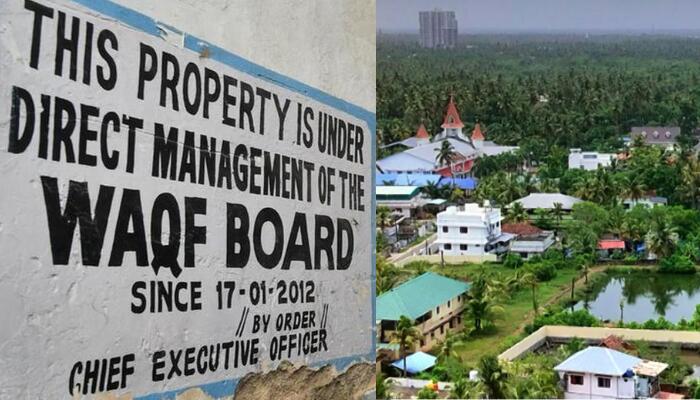
The Munambam land dispute in Kerala has once again exploded into a major political controversy after the Kerala State Waqf Board officially uploaded nearly 404 acres of disputed coastal land on the Centre’s UMEED portal as Waqf property. The development has triggered fresh outrage among hundreds of residents, largely from Christian fishing communities along with Hindu families, who insist they have lived on the land legally for decades.
Located in the Ernakulam district, Munambam has remained at the centre of a bitter ownership battle for years. Residents maintain that they purchased the land through registered deeds, paid taxes to the government and built homes with full legal recognition. However, the Waqf Board has consistently argued that the land belongs to Waqf property records.
The dispute had earlier united Hindu and Christian communities in a rare joint protest movement against what many residents described as the unchecked authority of Waqf institutions. Demonstrations were held in the region, while Church leaders openly backed the agitation. A bishop had even appealed to the Union government to intervene and review the wide-ranging powers enjoyed by Waqf Boards across the country.
Satheesan’s Old Promise Returns to the Centre of the Debate
The controversy has now acquired a sharper political edge because of remarks made by senior Congress leader V D Satheesan before the elections. At the height of the protests, Satheesan, then Leader of Opposition, had publicly stated that if the Congress-led UDF returned to power in Kerala, the Munambam issue could be resolved within “10 minutes”.
That assurance had resonated strongly among protesting families, particularly sections of the Christian community that expected the incoming government to act against the Waqf Board’s claims.
But within days of Satheesan assuming office as Chief Minister with the support of the Indian Union Muslim League, the disputed land was formally notified on the UMEED portal as Waqf property. The timing of the move has intensified allegations from critics who claim that the concerns of Hindu and Christian residents were sidelined without even hearing their position.
The BJP has aggressively targeted the Congress government over the issue, arguing that the controversy reflects the growing influence of the Muslim League within Kerala’s ruling alliance. Political opponents are now openly asking whether the Congress is independently running the state or increasingly operating within the political comfort zone dictated by its alliance compulsions.
Court Observations Had Earlier Raised Questions on Waqf Claim
The dispute had appeared to move towards partial relief for residents after important observations made by the Kerala High Court last year. The court noted that the original 1950 document linked to the land was a gift deed and not a Waqf deed, a distinction that significantly complicated the Waqf Board’s ownership claim.
That observation had strengthened the confidence of residents who believed the decades-long uncertainty surrounding their homes was finally nearing resolution. Yet the Waqf Board has continued to defend its position.
Waqf Board chairman K S Hamza recently stated that the uploading of the property onto the UMEED portal was part of a broader digitisation exercise involving Waqf assets. He also argued that registration on the portal alone would not determine final ownership, which would ultimately be settled through legal proceedings.
More Than a Local Land Dispute
What began as a property dispute in a coastal Kerala settlement has now evolved into a larger political flashpoint involving Waqf authority, coalition politics and religious sensitivities.
For the residents of Munambam, however, the debate is far more personal than political. Many families say they now live with uncertainty despite possessing documents, paying taxes and spending generations on the land. As the legal and political battle intensifies, Munambam is steadily becoming a symbol of a much larger national debate over land rights, Waqf powers and the political calculations surrounding them.