
















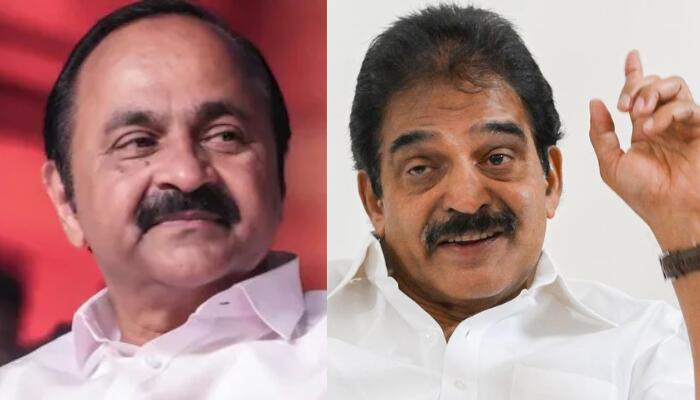
After ten days of sustained negotiations, late-night meetings and high-level consultations between Delhi and Kerala leadership, the Congress-led United Democratic Front has finalised V D Satheesan as the Chief Ministerial face in Kerala. The decision ends a visibly stretched internal process where the party’s early momentum around KC Venugopal gradually weakened under coalition pressure.
What began as a near-consensus inside Congress did not hold through the final phase of talks.
Early Phase: Congress Lines Up Behind Venugopal
In the initial rounds of discussion, KC Venugopal emerged as the strongest internal contender. Party inputs indicate that a majority of Congress MLAs backed his candidature. Rahul Gandhi and Sonia Gandhi were also inclined towards his name during early deliberations, strengthening his position within the organisation.
Venugopal’s control over party structure and his proximity to the central leadership added weight to his claim. Ramesh Chennithala also remained part of the internal consideration set, but the early momentum clearly favoured Venugopal.
At this stage, the internal equation within Congress appeared stable and largely aligned.
Shift Begins as Coalition Arithmetic Enters the Picture
The situation began to change as discussions moved beyond internal party circles into alliance-level negotiations. In Kerala’s coalition framework, the Congress cannot finalise leadership decisions without factoring in partner positions.
According to political inputs, the Indian Union Muslim League emerged as a decisive voice in the final phase of talks. IUML is understood to have strongly backed V D Satheesan, describing him as a more acceptable and politically stable choice for the alliance.
Recent reports also indicate that IUML leadership formally conveyed this preference within the alliance consultation process, adding weight to Satheesan’s candidature.
This intervention significantly altered the internal momentum that had earlier favoured Venugopal.
While Venugopal maintained strong backing among a section of MLAs, sources suggest the final phase of discussions increasingly focused on alliance stability rather than internal numbers alone.
Recent internal assessments have shown a split environment within Congress, with Venugopal leading among MLAs, while Satheesan gained stronger acceptability within the wider UDF ecosystem due to IUML support and perceived electoral optics.
This divergence created a balancing problem for the high command, which had to reconcile internal preference with coalition stability.
Late-Night Negotiations Seal the Outcome
The concluding phase involved multiple rounds of late-night consultations between senior Congress leadership in Delhi and Kerala representatives. The AICC and CLP coordination process worked to align competing positions across stakeholders.
As discussions progressed, the party gradually moved away from its early internal preference and leaned toward a coalition-consensus approach.
By the end of the ten-day exercise, the leadership formally converged on V D Satheesan as the final choice.
The decision reflects a clear shift in decision-making dynamics. What began as an internally driven preference within Congress evolved into a coalition-determined outcome.
Satheesan’s selection is being viewed in political circles as the product of alliance arithmetic, where IUML backing and broader coalition considerations outweighed the party’s initial internal consolidation around Venugopal.
The episode once again highlights a structural reality of Kerala politics: even when a national party appears internally aligned behind a candidate, coalition partners can decisively reshape the final outcome.