


















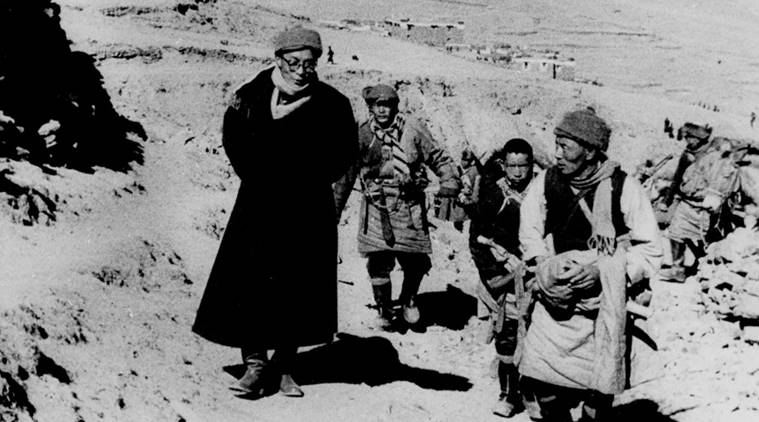
He was 24 years old. He put on a soldier’s uniform, slung a rifle over his shoulder, and stepped out of his palace into a night thick with danger. Somewhere in the darkness, Chinese artillery had been finding its range. His people were gathered around him in desperate numbers, terrified of what was coming. And in that moment, the Dalai Lama made the decision that would define the rest of his life, he walked away, because staying would have meant the end.
For two weeks, he moved through the Himalayas the way a fugitive does — at night, in silence, hugging the cold and the shadows. The passes were brutal. The risk of discovery was constant. But along the way, Tibetan farmers, villagers, and resistance fighters offered what they had — shelter, guidance, their own safety placed second. On 31 March 1959, he stepped onto Indian soil. He was alive. He was free. And he would never see his homeland again.
What happened on 17 March 1959 ?
To understand the night of the 17th, you have to understand what the years before it had felt like for Tibetans. China had marched into Tibet in the early 1950s, carrying with it the language of liberation — a word that, for most Tibetans, quickly proved hollow. Promises of autonomy were made and then quietly shelved. Religious life was interfered with. The occupation tightened, year by year, until the atmosphere in Lhasa had become almost impossible to breathe.
Then, on 10 March 1959, rumour spread through the city that Chinese officials had summoned the Dalai Lama to a military camp — without his bodyguards. Whether the threat was real or imagined barely mattered. In the minds of his people, it felt exactly like a trap. Thousands came out into the streets and encircled Norbulingka, his summer palace, forming a living barrier between their leader and whatever was coming. The Chinese response was to move troops into position and begin shelling the surrounding areas. Two shells landed in the palace gardens on 17 March. The message was clear enough.
China’s crackdown and occupation exposed
Beijing’s account of these events has remained remarkably consistent over the decades. Tibet was liberated. The Dalai Lama was a feudal overlord who instigated an armed rebellion, lost, and fled. End of story.
But that account has a great deal it prefers not to examine too closely. It does not dwell on the decade of broken autonomy pledges that preceded the uprising. It does not linger on the monasteries destroyed, the thousands killed, or the mass arrests that followed the crackdown. And it says very little about the most straightforward explanation for why tens of thousands of ordinary Tibetans surrounded that palace on 10 March — not because they were organised or incited, but because they were scared, and because the person inside those walls represented something they could not afford to lose.
The Dalai Lama did not flee out of cowardice or conspiracy. He fled because the guns made staying impossible. The uprising Beijing branded as reactionary was, stripped of all the political language, an act of fear and love from a people who could see what was being taken from them.
Birth of the Tibetan leadership in exile
India gave him asylum. What he did with it was remarkable. Within weeks of crossing the border, still carrying the weight of everything he had left behind, the Dalai Lama began laying the foundations of a government in exile. It started in Mussoorie, then moved to Dharamshala — a quiet hill town in northern India that few outside the country had ever heard of, and which would gradually become the beating heart of a displaced civilisation.
That institution, the Central Tibetan Administration, functions to this day. It speaks for Tibetans living under Chinese rule, tends to the needs of refugees scattered across South Asia, and works to ensure that Tibetan identity does not simply dissolve under the pressure of occupation and time. China dismisses it as an illegal separatist body. But institutions do not spring up in exile because things are going well at home. The CTA’s existence is itself an argument — one that Beijing has never quite managed to answer.
Why March 17 still matters ?
Anniversaries can lose their edge over time. They become ceremonies, then habits, then barely noticed. But 17 March has not softened in that way, at least not for Tibetans. Each year, wherever they are in the world, they return to this date — not to wallow in what was lost, but to hold onto something that cannot be confiscated or censored: the memory of a choice made in the dark, on a night when the easier thing would have been to surrender.
There is nothing dramatic, on the surface, about what the Dalai Lama did that night. He did not make a speech or fire a shot. He simply put on a disguise and walked. But the meaning of that walk has only grown with time. It said, in the plainest possible terms, that Tibet would not simply accept its own erasure.
China has invested enormously in the counter-narrative — the surveillance, the propaganda, the carefully managed image of a Tibet that is peaceful, prosperous, and perfectly content. But 17 March sits in the middle of all of that like a splinter that cannot be removed. It is a reminder that Tibetans did not choose exile, that they were forced into it by artillery and fear. It is a reminder that history, however heavily it is managed, has a habit of being remembered by the people who actually lived it. And as long as they keep remembering, that chapter remains open.