














Prime Minister Narendra Modi today invoked the historic Dandi March to frame India’s ongoing development journey, telling participants at the NXT Summit in New Delhi that the country is now moving collectively towards the goal of becoming a developed nation under the vision of Viksit Bharat.
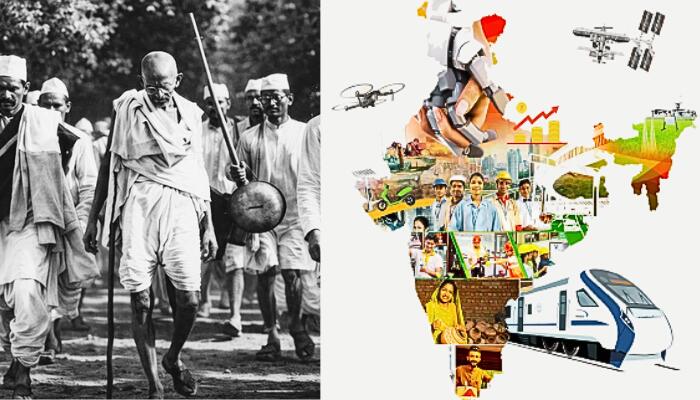
Speaking at the summit, Modi described March 12 as a significant date in India’s history. On this day in 1930, Mahatma Gandhi began the Dandi March from Sabarmati Ashram, a movement that united the country in the struggle against colonial rule. Drawing a parallel with the present, the Prime Minister said India is now undertaking another national journey, this time aimed at transforming the country into a developed nation.
He said discussions and ideas emerging from such platforms play an important role in shaping the direction of India’s development.
India’s Rising Importance in a Changing World
The Prime Minister said the present phase of the 21st century is marked by uncertainty and rapid change. Conflicts, supply chain disruptions and growing questions about the relevance of global institutions have created a challenging international environment.
Despite these developments, Modi said India continues to move forward and has increasingly become central to global discussions about the future. He noted that several world leaders have spoken about India’s rising role in shaping the direction of the global economy and the future of the Global South.
According to him, there is growing curiosity around the world about India’s economic trajectory and development model. He compared this interest to the excitement Indians show during cricket matches, saying people now follow the country’s economic progress with similar enthusiasm.
Reforms and Infrastructure Driving Growth
The Prime Minister said India is moving to what he described as the next level of development, supported by reforms and the rapid expansion of infrastructure.
He pointed to the growth of digital infrastructure and said India has emerged as the fastest-growing hub for real-time digital payments in the world. The country’s expanding digital ecosystem, he said, has strengthened financial inclusion and improved the delivery of services.
Modi also highlighted several policy decisions that he said were once considered difficult but have since been implemented. These include the removal of Article 370 from Jammu and Kashmir, the opening of more than 50 crore bank accounts under the Jan Dhan financial inclusion programme, the abolition of triple talaq, and legislation providing 33 per cent reservation for women in the Lok Sabha and state legislative assemblies.
He also referred to India’s advances in science and technology, including developments in the country’s space programme and new initiatives related to semiconductor manufacturing and quantum technology.
Strengthening Energy Security
A major part of the Prime Minister’s address focused on India’s efforts to strengthen energy security while expanding access to essential services.
He said the number of domestic LPG connections has increased significantly from around 14 crore in 2014 to nearly 33 crore today. Gas bottling capacity has doubled and the number of LPG distribution centres has grown from around 13,000 to more than 25,000.
India’s gas pipeline network has expanded from about 3,500 kilometres in 2014 to around 10,000 kilometres. The number of LNG terminals has also doubled from four during the same period.
Access to piped natural gas has increased from about 25 to 26 lakh households to more than 1.25 crore homes. Meanwhile, the number of vehicles running on compressed natural gas has risen from fewer than 10 lakh to more than 70 lakh as city gas distribution networks expand across more than 600 districts.
Lessons from Global Crises
Modi acknowledged that global developments such as the COVID-19 pandemic and the Russia–Ukraine war have disrupted economies and triggered a global energy crisis. He said such events test a country’s resilience and highlight the need for unity and confidence.
Recalling India’s response during the pandemic, he said the country’s collective effort helped it overcome major challenges. Cooperation among governments, industries, media, youth and civil society will remain essential as India navigates future uncertainties.
Concluding his address, the Prime Minister said India’s development journey cannot be halted. With the aspirations and participation of 140 crore citizens driving progress, he expressed confidence that the country will continue moving steadily towards becoming a developed