

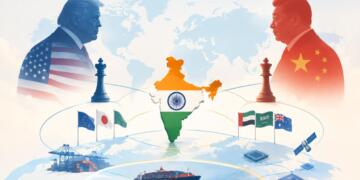

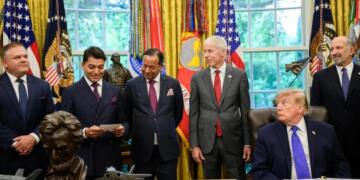





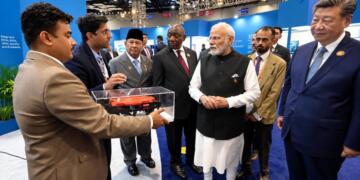











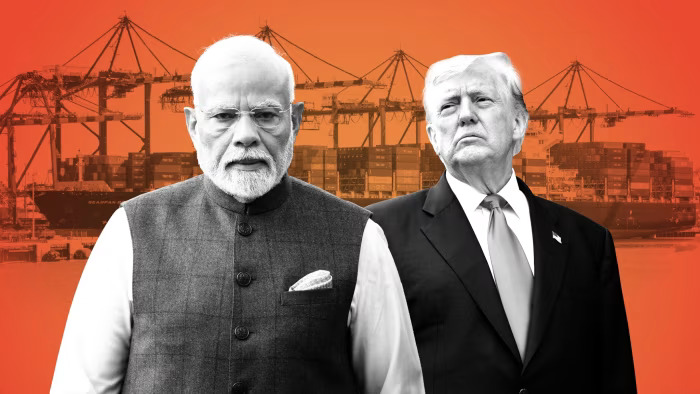
In a striking statement that has stirred diplomatic discussions across global capitals, US President Donald Trump claimed that Prime Minister Narendra Modi has assured him that India will stop buying oil from Russia a claim that has so far not been corroborated by New Delhi. Speaking to ANI, President Trump described the assurance as a “big step” towards economically isolating Moscow amid the continuing Russia-Ukraine conflict. He said, “Modi is a great man… I have watched India for years. It’s an incredible country… He’s assured me there will be no oil purchases from Russia. He’s not buying his oil from Russia. It can’t happen immediately, but the process is going to be over soon.”
Trump’s comments came after a meeting between US ambassador-designate Sergio Gor and Prime Minister Modi, during which the two sides discussed a range of issues, including defence, trade, and technology. According to Gor, the meeting was “incredible,” highlighting strong bilateral engagement at multiple levels. However, India has not issued any official response to Trump’s remarks, prompting observers to recall previous instances when similar claims by Trump were later denied by New Delhi.
Trump’s Tariff War Against India: A Pressure Tactic
The latest statement by US President Trump must be seen in the broader context of his administration’s economic measures targeting India. In August, Trump imposed a massive 50% tariff on Indian goods a direct consequence, according to Washington, of New Delhi’s continued oil purchases from Russia. This came in addition to an earlier 25% duty on other Indian exports, straining trade relations that were otherwise on a growth trajectory.
When questioned by reporters whether he expected progress in trade talks after slapping steep tariffs, Trump bluntly said, “No, not until we get it resolved,” referring to India’s energy ties with Moscow. The message from Washington was unmistakable: stop buying Russian oil or face escalating economic penalties.
India, however, remained steadfast in its position. New Delhi has repeatedly stated that its energy procurement decisions are guided solely by national interest based on affordability, reliability, and security of supply. As an emerging economy with soaring energy needs, India’s approach has been pragmatic and non-aligned, avoiding being drawn into geopolitical contests that serve others’ interests.
While the US has described its tariff strategy as an attempt to weaken Moscow’s finances, India has continued to assert that its oil trade with Russia is entirely legitimate and crucial for domestic stability. Unlike several Western nations, India has maintained a balanced foreign policy, engaging with both Washington and Moscow, and keeping its focus firmly on economic security and development.
India Still Among Top Buyers of Russian Oil: Data Exposes Reality
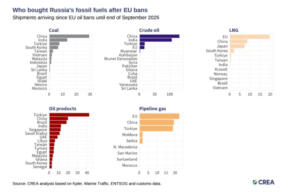
Despite President Trump’s assertions, global data paints a very different picture. According to the Centre for Research on Energy and Clean Air (CREA), India remained the second-largest buyer of Russian fossil fuels in September 2025, second only to China. The CREA report estimated that India imported Russian fossil fuels worth EUR 3.6 billion (₹25,597 crore) during the month with crude oil accounting for 77%, coal for 13%, and oil products for 10%.
The report effectively punctures Trump’s claim that India has halted purchases from Russia. On the contrary, the figures suggest that India has sustained high import volumes to ensure its energy security, even as Western nations have drastically reduced their dependence on Moscow’s energy supplies.
The shift towards Russian oil began in early 2022 when the Ukraine conflict led to Western sanctions on Moscow. As Europe turned away from Russian oil, India seized the opportunity to buy crude at discounts as high as US$18-20 per barrel below global benchmarks. These price advantages have been crucial for keeping inflation under control and ensuring affordable fuel prices domestically.
In September alone, the discount on Russia’s Urals crude increased by 39% month-on-month, averaging US$5.13 per barrel against Brent. For a
developing economy like India, such savings translate into billions in economic relief. Moreover, Russian crude’s composition aligns well with Indian refinery configurations, which are better suited for processing heavier, high-sulfur grades compared to lighter American crude.
According to the global commodities tracker Kpler, India imported over 4.5 million barrels per day (bpd) in September, accounting for 34% of its inbound crude shipments a 70,000 bpd increase from August. Although there was a modest 10% decline in imports over the first eight months of 2025 due to market volatility, India’s commitment to energy diversification remains firm.
India’s Energy Policy: Driven by Sovereignty, Not Pressure
India’s energy decisions are not made to please Washington, Moscow, or any other capital — they are guided by a deep understanding of its developmental needs. Energy security is the foundation of economic stability, and any disruption in affordable oil supply could have serious implications for inflation, manufacturing, and overall growth.
New Delhi has consistently articulated this principle on the world stage. It has clarified that as a sovereign nation, it will buy energy from wherever it gets the best deal — and that this decision will not be dictated by external powers. India’s purchases from Russia, much like its trade with Middle Eastern nations, are rooted in commercial logic rather than political alignment.
Interestingly, while the Trump administration penalized India for its purchases of Russian crude, China which imports far more Russian oil than India — faced no comparable tariffs or restrictions. This inconsistency has not gone unnoticed in diplomatic circles and raises questions about Washington’s selective application of economic pressure.
Moreover, India’s growing partnership with the United States in areas like technology, defense manufacturing, and supply chain resilience shows that New Delhi’s stance on Russian oil has not weakened bilateral ties. Rather, it underlines India’s commitment to strategic autonomy a principle that has guided its foreign policy since independence.
Data Speaks Louder Than Claims
While President Trump’s remarks about Prime Minister Modi’s assurances make for strong headlines, the reality is far more complex. Data from multiple independent agencies clearly shows that India continues to import significant volumes of Russian oil. The reason is simple: India prioritizes its national interest above all else.
Washington may seek to project its tariff-driven diplomacy as a moral crusade, but New Delhi’s position remains pragmatic India will continue to source energy that sustains its growth and protects its people from global price shocks. The latest CREA and Kpler data affirm that India’s strategy is both practical and self-reliant.
Far from being influenced by pressure from any global power, India’s economic policies under Prime Minister Modi are rooted in Atmanirbharta (self-reliance) and guided by the idea of securing the nation’s long-term prosperity. Trump’s claim that India will halt Russian oil purchases may grab attention, but the facts tell a different story one where India stands firm, independent, and strategically sovereign in an increasingly polarized world.
In a firm rebuttal to remarks made by U.S. President Donald Trump, the Indian Ministry of External Affairs (MEA) on Thursday dismissed claims that Prime Minister Narendra Modi had assured Washington of halting India’s purchase of Russian oil. The clarification came hours after Trump publicly asserted that Modi had personally informed him of India’s decision to reduce Russian crude imports — a claim that India categorically denied.
ndia wasted no time in setting the record straight. Addressing the media in New Delhi, MEA spokesperson Randhir Jaiswal clarified:
“As per my information, there was no telephonic conversation between Prime Minister Modi and U.S. President Trump yesterday.”
He further emphasized that India’s energy procurement is guided solely by national interests and the need to ensure stability for Indian consumers amid fluctuating oil prices.
India’s import policies are determined by the energy security and affordability needs of our people. We maintain an independent approach to global energy markets,” Jaiswal added.