












TFIPOST हिन्दी
TFIPOST Global
Tfipost.com
Tfipost.com
No Result
View All Result
  • Premium
  • Politics
    • All
    • Analysis
    • Opinions
    • Trending
    TCS Nashik Scandal: Corporate Silence Amid Horror—Why India’s IT Giant Must Answer Hard Questions

    TCS Nashik Scandal: Corporate Silence Amid Horror—Why India’s IT Giant Must Answer Hard Questions

    When Global Credibility Crumbles: How Reuters Risks Sounding Like the Pakistan Army’s Echo Chamber

    When Global Credibility Crumbles: How Reuters Risks Sounding Like the Pakistan Army’s Echo Chamber

    Promises in spotlight, reality in shadow: Bengal’s women face the job crisis

    Mamata’s Bengal: Women Promised Empowerment, Delivered Unemployment

    Controversy turns costly as backlash erodes market value and dents investor confidence

    Boycott Storm Engulfs Shark Tank Judges: Tilak Row and Namaz Controversy Trigger Public Outrage and Market Losses

    • Analysis
    • Opinions
    • Trending
  • Economy
    • All
    • Business
    • Economy1
    • Finance
    The beginner’s guide to tracking silver rates in India

    The beginner’s guide to tracking silver rates in India

    “I Was Honking”: BJP MLA’s Son Rams Thar Into 5 in MP’s Shivpuri; Victims Allege Threats Following Crash

    “I Was Honking”: BJP MLA’s Son Rams Thar Into 5 in MP’s Shivpuri; Victims Allege Threats Following Crash

    "MoUs on paper, no industry on ground” - Devendra Fadnavis sharpens attack on Trinamool Congress Ahead of Polls

    West Bengal’s Economic Graph Under Fire: Fadnavis Targets TMC, Flags Debt Crisis Ahead of 2026 Polls

    The Great Himalayan Handshake: India’s Most Critical Strategic Corridor Zoji La Tunnel Nears Historic Breakthrough

    The Great Himalayan Handshake: India’s Most Critical Strategic Corridor Zoji La Tunnel Nears Historic Breakthrough

    • Business
    • Finance
  • Defense
    • All
    • Defence
    • Strategy
    • Weaponry
    Precision Strike: Indian Army Approves Procurement of Indigenous MPATGM to Modernise Infantry Wings

    Precision Strike: Indian Army Approves Procurement of Indigenous MPATGM to Modernise Infantry Wings

    Amit Shah on sensitive Gorkha land issue

    Shah Assures Constitutional Path for Gorkha Issue, Intensifies Attack on TMC at Bengal Rally

    Historic Leap for ‘Aatmanirbhar Bharat’ as First India-Made BrahMos Missiles from Lucknow Join Indian Army

    Historic Leap for ‘Aatmanirbhar Bharat’ as First India-Made BrahMos Missiles from Lucknow Join Indian Army

    Historic Leap for ‘Aatmanirbhar Bharat’ as First India-Made BrahMos Missiles from Lucknow Join Indian Army

    The Lion of Ladakh: Kargil War Hero Colonel Sonam Wangchuk and the Brotherhood of Soldiers

    • Defence
    • Strategy
    • Weaponry
  • Geopolitics
    • All
    • Africa
    • Americas
    • Asia Pacific
    • Europe
    • South Asia
    • West Asia
    Modi, Lee Jae Myung hold talks to reset India–South Korea economic ties

    India–South Korea Agree to $50 Billion Trade Target in Major Economic Upgrade

    Doval in Riyadh, reinforcing India’s strategic stakes in West Asia

    Ajit Doval Engages Saudi Leadership in Riyadh as India Strengthens Strategic and Energy Ties

    Umerov In India Talks Dipomacy

    Ukraine Reaches Out to India as War Diplomacy Deepens in New Delhi

    Diplomatic Relations: Xi Jinping and Donald Trump

    Hormuz Reopens, Xi ‘Very Happy’ as Trump Signals Major Shift in US–China Equation

    • Africa
    • Americas
    • Asia Pacific
    • Europe
    • South Asia
    • West Asia
  • Knowledge
    • All
    • Culture
    • Education
    • History
    • Indology
    Sardar Patel and Amit Shah

    Sardar Patel’s 1947 Blueprint on Minority Quotas Resurfaces as Reservation Debate Returns to Centre Stage

    The 1973 Constitution and ‘Bhutto’ the Man Who Made It: What Pakistan Owes and What It Destroyed

    The 1973 Constitution and ‘Bhutto’ the Man Who Made It: What Pakistan Owes and What It Destroyed

    Future-Ready Learning: CBSE Launches AI Curriculum for Classes 3–8 to Boost Digital Readiness in Young Learners

    Future-Ready Learning: CBSE Launches AI Curriculum for Classes 3–8 to Boost Digital Readiness in Young Learners

    From Devotion to Divine Strength: Celebrating Lord Hanuman, Eternal Symbol of Courage, Humility

    From Devotion to Divine Strength: Celebrating Lord Hanuman, Eternal Symbol of Courage, Humility

    • Culture
    • History
    • Indology
  • Law
  • Lounge
    • All
    • Books
    • Cinema
    • Entertainment
    • Food
    • Games
    • Health
    • Lifestyle
    • Satire
    • Sports
    • technology
    • Travel
    AI in healthcare

    AI is Recasting Healthcare, Reshaping How Medicine is Practised

    Delhi-Dehradun Expressway

    Modi Launches ₹12,000-Crore Delhi–Dehradun Expressway, Cutting Journey Time to Around 2.5 Hours

    Asha Bhosle last rites

    India Bids Farewell to Asha Bhosle: State Honours Mark Final Journey of a Musical Legend

    Can Gym-Goers Start Calisthenics Easily? Here’s What to Know

    Can Gym-Goers Start Calisthenics Easily? Here’s What to Know

    • Books
    • Cinema
    • Food
    • Health
    • Sports
    • technology
    • Travel
    • Satire
Tfipost.com
  • Premium
  • Politics
    • All
    • Analysis
    • Opinions
    • Trending
    TCS Nashik Scandal: Corporate Silence Amid Horror—Why India’s IT Giant Must Answer Hard Questions

    TCS Nashik Scandal: Corporate Silence Amid Horror—Why India’s IT Giant Must Answer Hard Questions

    When Global Credibility Crumbles: How Reuters Risks Sounding Like the Pakistan Army’s Echo Chamber

    When Global Credibility Crumbles: How Reuters Risks Sounding Like the Pakistan Army’s Echo Chamber

    Promises in spotlight, reality in shadow: Bengal’s women face the job crisis

    Mamata’s Bengal: Women Promised Empowerment, Delivered Unemployment

    Controversy turns costly as backlash erodes market value and dents investor confidence

    Boycott Storm Engulfs Shark Tank Judges: Tilak Row and Namaz Controversy Trigger Public Outrage and Market Losses

    • Analysis
    • Opinions
    • Trending
  • Economy
    • All
    • Business
    • Economy1
    • Finance
    The beginner’s guide to tracking silver rates in India

    The beginner’s guide to tracking silver rates in India

    “I Was Honking”: BJP MLA’s Son Rams Thar Into 5 in MP’s Shivpuri; Victims Allege Threats Following Crash

    “I Was Honking”: BJP MLA’s Son Rams Thar Into 5 in MP’s Shivpuri; Victims Allege Threats Following Crash

    "MoUs on paper, no industry on ground” - Devendra Fadnavis sharpens attack on Trinamool Congress Ahead of Polls

    West Bengal’s Economic Graph Under Fire: Fadnavis Targets TMC, Flags Debt Crisis Ahead of 2026 Polls

    The Great Himalayan Handshake: India’s Most Critical Strategic Corridor Zoji La Tunnel Nears Historic Breakthrough

    The Great Himalayan Handshake: India’s Most Critical Strategic Corridor Zoji La Tunnel Nears Historic Breakthrough

    • Business
    • Finance
  • Defense
    • All
    • Defence
    • Strategy
    • Weaponry
    Precision Strike: Indian Army Approves Procurement of Indigenous MPATGM to Modernise Infantry Wings

    Precision Strike: Indian Army Approves Procurement of Indigenous MPATGM to Modernise Infantry Wings

    Amit Shah on sensitive Gorkha land issue

    Shah Assures Constitutional Path for Gorkha Issue, Intensifies Attack on TMC at Bengal Rally

    Historic Leap for ‘Aatmanirbhar Bharat’ as First India-Made BrahMos Missiles from Lucknow Join Indian Army

    Historic Leap for ‘Aatmanirbhar Bharat’ as First India-Made BrahMos Missiles from Lucknow Join Indian Army

    Historic Leap for ‘Aatmanirbhar Bharat’ as First India-Made BrahMos Missiles from Lucknow Join Indian Army

    The Lion of Ladakh: Kargil War Hero Colonel Sonam Wangchuk and the Brotherhood of Soldiers

    • Defence
    • Strategy
    • Weaponry
  • Geopolitics
    • All
    • Africa
    • Americas
    • Asia Pacific
    • Europe
    • South Asia
    • West Asia
    Modi, Lee Jae Myung hold talks to reset India–South Korea economic ties

    India–South Korea Agree to $50 Billion Trade Target in Major Economic Upgrade

    Doval in Riyadh, reinforcing India’s strategic stakes in West Asia

    Ajit Doval Engages Saudi Leadership in Riyadh as India Strengthens Strategic and Energy Ties

    Umerov In India Talks Dipomacy

    Ukraine Reaches Out to India as War Diplomacy Deepens in New Delhi

    Diplomatic Relations: Xi Jinping and Donald Trump

    Hormuz Reopens, Xi ‘Very Happy’ as Trump Signals Major Shift in US–China Equation

    • Africa
    • Americas
    • Asia Pacific
    • Europe
    • South Asia
    • West Asia
  • Knowledge
    • All
    • Culture
    • Education
    • History
    • Indology
    Sardar Patel and Amit Shah

    Sardar Patel’s 1947 Blueprint on Minority Quotas Resurfaces as Reservation Debate Returns to Centre Stage

    The 1973 Constitution and ‘Bhutto’ the Man Who Made It: What Pakistan Owes and What It Destroyed

    The 1973 Constitution and ‘Bhutto’ the Man Who Made It: What Pakistan Owes and What It Destroyed

    Future-Ready Learning: CBSE Launches AI Curriculum for Classes 3–8 to Boost Digital Readiness in Young Learners

    Future-Ready Learning: CBSE Launches AI Curriculum for Classes 3–8 to Boost Digital Readiness in Young Learners

    From Devotion to Divine Strength: Celebrating Lord Hanuman, Eternal Symbol of Courage, Humility

    From Devotion to Divine Strength: Celebrating Lord Hanuman, Eternal Symbol of Courage, Humility

    • Culture
    • History
    • Indology
  • Law
  • Lounge
    • All
    • Books
    • Cinema
    • Entertainment
    • Food
    • Games
    • Health
    • Lifestyle
    • Satire
    • Sports
    • technology
    • Travel
    AI in healthcare

    AI is Recasting Healthcare, Reshaping How Medicine is Practised

    Delhi-Dehradun Expressway

    Modi Launches ₹12,000-Crore Delhi–Dehradun Expressway, Cutting Journey Time to Around 2.5 Hours

    Asha Bhosle last rites

    India Bids Farewell to Asha Bhosle: State Honours Mark Final Journey of a Musical Legend

    Can Gym-Goers Start Calisthenics Easily? Here’s What to Know

    Can Gym-Goers Start Calisthenics Easily? Here’s What to Know

    • Books
    • Cinema
    • Food
    • Health
    • Sports
    • technology
    • Travel
    • Satire
No Result
View All Result
Tfipost.com
Tfipost.com
No Result
View All Result
  • Premium
  • Politics
  • Economy
  • Defense
  • Geopolitics
  • Knowledge
  • Law
  • Lounge

This Week in Focus: The Deep State Playbook Part 3 – Economic Coercion

Bull's Eye by Bull's Eye
9 March 2025
in Analysis, Geopolitics, This Week In Focus
This Week in Focus: The Deep State Playbook Part 3 – Economic Coercion

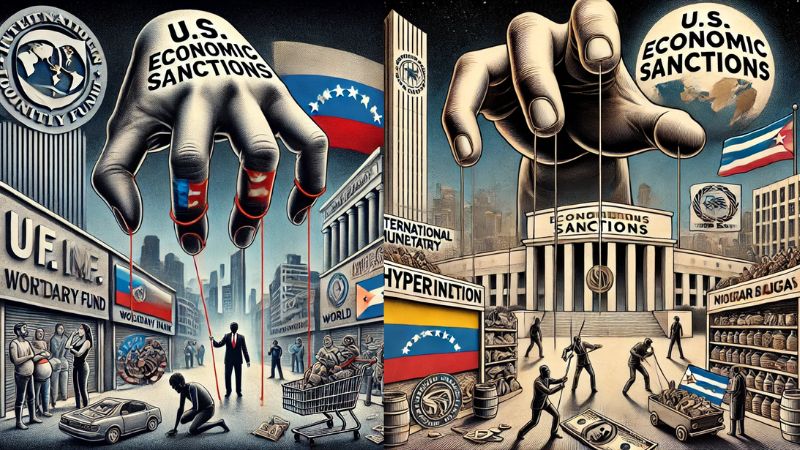
(AI generated Image created by TFI Staff)

Share on FacebookShare on X

USAID funding scandal: In the last part of our series on Deep State, we shed light on key faces associated with USAID. Through notorious agencies like the OCCRP, NED, USAID and others, the Deep State ‘assets’ have been exploiting people’s sympathies and their kinder side to go after Nationalist politicians. This article pieces exposes the economic coercion as part of their modus operandi through which these organisations go after politicians, countries, and nationalistic voices in their target nation.

The US government has used economic pressure as a tool to influence foreign governments. This broad umbrella term includes conditioning (by American as well as U.S.-funded institutions) financial aid on economic reforms, sending inimical countries out of internationally organised economic marketplaces, and using international financial institutions like the IMF and World Bank to pressure countries into adopting policies that align with U.S. interests.

RelatedPosts

India’s Growth Story Holds Firm Despite Global Shocks, World Bank Projects 6.6% Expansion

“Western Pirates”: NATO VS BRICS At Sea? Russia Warns Britain, France & Baltics Over Naval Blockade

IMF Revises India’s Growth Projections Upwards: A Tight Slap to Rahul Gandhi’s “Dead Economy” Rhetoric

Load More

The United States has historically used economic pressure to influence foreign governments, often leading to significant financial turmoil. The impact of these measures can be seen in Venezuela, Iran, Cuba, Nicaragua, Chile, Malawi, and the Democratic Republic of the Congo, where U.S. sanctions, trade restrictions, and aid manipulations have caused hyperinflation, currency collapses, food and medicine shortages, and major declines in GDP, among others. Oil, public services, healthcare, and essential commodities have been the most affected sectors.

In Venezuela, U.S. sanctions had a devastating impact on the country’s oil-dependent economy. Since the imposition of financial restrictions, Venezuela’s GDP has suffered a loss of nearly $700 billion, with the loss of the oil industry—whose contribution to Venezuelan GDP was 95 per cent—alone being approximately $232 billion. Add to that the freezing of $22 billion of Venezuelan assets in international banks, creating a sense of uncertainty for investors looking to pour money into the economy.

The uncertainty caused hyperinflation in the country—so much so that it has a special Wikipedia page dedicated to the phenomenon. Inflation reached an all-time high of 1,30,060 per cent in 2018, followed by 9,586 per cent in 2019 and 2,963 per cent in 2020. The government’s capability for health spending resulted in only 1.8 per cent of its GDP being used for healthcare spending. The corresponding figure was 8.1 per cent in 2008. Apparently, more than 62.5 per cent of healthcare spending in 2017 was done through out-of-pocket expenditure.

Venezuela’s healthcare system collapsed under severe shortages of medical supplies, inadequate infrastructure, and a mass exodus of medical professionals. Towards the late 2010s, hospitals reported up to 95 per cent shortages in medicine, while pharmacies faced 85 per cent shortages. It forced patients to procure their own supplies for surgeries, including basic items like needles and antibiotics.

In a 2016 poll, 76 per cent of public hospitals lacked basic medicines, and Human Rights Watch confirmed that most of the hospitals had none of the WHO’s essential medicines, including antibiotics and cancer treatments. 1,557 patients died due to short supplies between November 2018 and February 2019. The long wait for medicines put 300,000 people at risk in the year 2019.

Infrastructure failures have exacerbated the crisis, with 80 per cent of Barrio Adentro clinics closed by 2017, leaving remaining clinics overwhelmed and understaffed, sometimes serving 6,000 people per doctor. 70 per cent of hospitals suffer due to infrequent water supply as medical staff had to schedule surgeries around water availability.

Hospital bed availability went critically down, with only 16,300 of the 45,000 public hospital beds in use. Even if privately available hospital beds are taken into account, the country of 3 crore people did not have more than 25,000 beds at the peak of American sanctions.

Worse, ICU care got even bleaker as there were only 84 ICU beds available nationwide, and there are no reports of the Covid-induced introduction of 1,200 ICU beds coming to reality. Frequent blackouts have made healthcare even more inaccessible. 79 patients died in hospitals between 2018 and 2019 due to power outages. In one single month of March 2019, hospitals suffered 507 hours of electricity shortages.

High stress, fewer facilities, and intense public scrutiny led to 22,000 doctors leaving Venezuela between 2012 and 2017. A large section of those who remained ran their practices illegally or through fake degrees for wages as low as $4–$10 per month. The unavailability of cheap fuel due to a decline in production made it difficult for willing doctors to reach hospitals.

Like Venezuela, Iran’s economy has also suffered greatly under U.S. sanctions, particularly after the Trump administration withdrew from the nuclear deal in 2018 and reimposed the financial version of Democrats’ cancel culture. The Rial, Iran’s national currency, has suffered constant depreciation, hitting a record low of 892,500 rials per U.S. dollar (in unofficial markets) in February 2025.

Inflation surged as consumer prices for domestic goods rose by 30.23 per cent in 2016, 34.70 per cent in 2019, 40.19 per cent in 2021, and 45.75 per cent in 2022. But Trump only worsened what earlier American Presidents had done to Iran. Even during the Obama era, Iran’s GDP per capita fell by 35 per cent between 2012 and 2014, with the minimum wage plummeting from $275.40 in 2010 to $155 in 2012. The sanctions continue to limit Iran’s access to international markets, keeping inflation high and reducing purchasing power for ordinary citizens.

According to a United Nations General Assembly resolution in October 2024, the U.S. economic embargo has inflicted damages worth $1.499 trillion in losses when measured against the U.S. dollar’s value in gold on Cuba’s economy. Over the last 18 years alone, the island nation has suffered $252 trillion in economic losses due to restrictions on trade, finance, and access to essential resources.

It has significantly hampered Cuba’s ability to import fuel, spare parts, and other critical goods, causing widespread power outages, rationing of food, and disruptions in medical services. From October 18 to 23, 2024, many Cuban families endured long periods without electricity or running water, while hospitals operated under emergency conditions, and educational institutions were forced to suspend classes.

The multilateral agency estimates that the accumulated four-month cost of the blockade was $1.6 billion. This huge sum could have ensured food security for Cuban families for an entire year, while just $12 million—an amount Cuba loses in less than a day due to the embargo—could have funded insulin supplies for all its diabetic patients.

The sanctions have isolated Cuba from global financial systems, leading to downgrading of ratings and obstructing foreign investments and economic reforms that could have improved the lifestyle of an average Cuban citizen. Access to essential medicines and medical equipment is also extremely limited, leading to delays in treatments and surgeries, causing devastation to public health.

The Cuban government describes these measures as “economic warfare” and a “flagrant violation of human rights,” likening the blockade to a military siege under modern international law. Dozens of countries, including Bolivia, Iran, and members of the European Union, have condemned the sanctions as unjust and counterproductive, arguing that they hinder Cuba’s economic progress while failing to achieve their stated political objectives.

Despite these global calls for lifting the blockade—reaffirmed by an overwhelming majority of 187 out of 193 UN member states—the embargo remains in place, prolonging Cuba’s economic struggles and humanitarian challenges.

Also Read: This Week in Focus: The Deep State Playbook Part 2 – Covert operations, propagandists, exploiting ‘victim’ community

For Nicaragua, going with the man Americans did not want in charge was met with severe economic challenges due to U.S. trade restrictions and an economic embargo aimed at weakening the Sandinista government. The embargo, imposed in 1985, along with the funded civil war and internal economic missteps, led to a continuous depreciation in GDP from 1984 to 1990.

While Nicaragua could afford to cut loose on other products, the country needed money for military expenditure. It resorted to printing money to cover deficits, resulting in hyperinflation that soared past 14,000 per cent in 1988. The supply chain was massively disrupted due to widespread shortages of essential goods, mass unemployment reached 25 per cent (a gross underestimation), amidst a 35 per cent drop in real per capita income between 1980 and 1990.

In Chile, during the early 1970s, the USA put economic coercion on China by pressurising it simply because it did not like President Salvador Allende’s socialist government. The Nixon administration—considered quite inert in its policies—curtailed financial aid and influenced international financial institutions to halt loans to Chile. The sanctions, coupled with internal policy challenges of socialist political doctrine, resulted in unchecked government spending, due to which the fiscal deficit reached approximately 23 per cent of GDP by 1973. Available government money with supply-side constraints amidst increasing demand was the reason inflation soared to 1,600 per cent in 1973. The resulting economic turmoil contributed to the military coup in 1973 that brought General Augusto Pinochet to power.

Tags: Deep stateIMFsanctionsUSAIDWorld Bank
ShareTweetSend
Previous Post

HbA1c vs. Blood Glucose Monitoring: Which One Do You Need?

Next Post

Balochistan: Unknown Gunmen knocks off Mufti who kidnapped Kulbhushan Jadhav

Related Posts

Modi, Lee Jae Myung hold talks to reset India–South Korea economic ties
Geopolitics

India–South Korea Agree to $50 Billion Trade Target in Major Economic Upgrade

20 April 2026

India and South Korea set an ambitious target to more than double their bilateral trade to $50 billion by...

Doval in Riyadh, reinforcing India’s strategic stakes in West Asia
Geopolitics

Ajit Doval Engages Saudi Leadership in Riyadh as India Strengthens Strategic and Energy Ties

20 April 2026

National Security Advisor Ajit Doval held a series of high-level meetings today with Saudi Arabia’s senior leadership during his...

Umerov In India Talks Dipomacy
Asia Pacific

Ukraine Reaches Out to India as War Diplomacy Deepens in New Delhi

18 April 2026

Ukraine’s Secretary of the National Security and Defence Council, Rustem Umerov, held significant discussions in New Delhi today with...

Load More

Leave a Reply Cancel reply

Your email address will not be published. Required fields are marked *

I agree to the Terms of use and Privacy Policy.
This site is protected by reCAPTCHA and the Google Privacy Policy and Terms of Service apply.

Currently Playing

From Runways to Warships: India’s Firefighting Warrior Built for Bases & Battles| IAF | VayuShakti

From Runways to Warships: India’s Firefighting Warrior Built for Bases & Battles| IAF | VayuShakti

00:05:40

Ethanol, EVs and Solar- How India’s Energy Game Is Changing | Modi on LPG & Crude Oil | war| Hormuz

00:05:21

Truth of IRIS Dena: 8 Days That Changed Narrative | War zone Reality, Not an Indian Navy Exercise

00:08:02

300 Million Euros for SCALP: Strategic Necessity or Costly Dependency on France300

00:04:06

Tejas Mk1A: 19th aircraft coupled but Not Delivered: What Is Holding Back the IAF Induction?

00:07:21
Facebook Twitter Instagram Youtube
tfipostTfipost.com
Right Wing | News Analysis | Indian Opinion
  • About us
  • Contact Us
  • Careers
  • Brand Partnerships
  • Terms of use
  • Privacy Policy
  • Sitemap

©2026 TFI Media Private Limited

No Result
View All Result
  • Premium
  • Politics
    • Analysis
    • Opinions
    • Trending
  • Economy
    • Business
    • Finance
  • Defense
    • Defence
    • Strategy
    • Weaponry
  • Geopolitics
    • Africa
    • Americas
    • Asia Pacific
    • Europe
    • South Asia
    • West Asia
  • Knowledge
    • Culture
    • History
    • Indology
  • Law
  • Lounge
    • Books
    • Cinema
    • Food
    • Health
    • Sports
    • technology
    • Travel
    • Satire
TFIPOST हिन्दी
TFIPOST Global

©2026 TFI Media Private Limited