
















The clash on the LAC at Galwan valley in Ladakh and the Wuhan virus pandemic preceding it, have firmly put the spotlight on China. There is now a pressing need within India and indeed the rest of the world, to dissect and understand China, and go beyond the superficial models. This is not soon in coming, and indeed it is something that should have happened a long time before, but it may yet not be too late.
To understand China, would mean not only to understand its economy and politics, but most crucially its culture and the history that has shaped it. There is now growing realization that things have come to such a pass because the world bought into its own make believe story about how all countries are basically the same, how various systems are really no different from each other, and all anyone was looking for was free trade and cheap toys.
Intellectuals who had warned about China as far as twenty years back, are now telling the world, I told you so. Political scientist and famed international relations theorist at the University of Chicago John Mearsheimer holds that US has “foolishly” fed the rise of China. He summarizes succinctly, “the US, over the course of the 1990s and the first decade-and-a-half of the 2000s, went to great places to make China more and more economically powerful. We, in fact, have created a potential peer competitor. This is remarkably foolish”
This error of judgement came from a “widespread assumption in the West that, as countries modernize, they also Westernize.” This was called out by British journalist and scholar Martin Jacques as early as 2009 in his seminal book, “When China Rules the World”. In that he correctly points out, “This is an illusion. It’s an assumption that modernity is a product simply of competition, markets and technology. It is not; it is also shaped equally by history and culture. China is not like the West, and it will not become like the West.”
A better model of understanding China is offered by Samir Saran, the president of Observer Research Foundation, one of the most influential think tanks in Asia. He offers the 3M framework, the first M of which is the reemergence of historical identity of Zhōng Guó, or the kingdom at the center (of the world). He says, “You are beginning to see a huge emergence of the Middle Kingdom identity again. They [China] now believe that they are Centre of the world and no rules will restrict their global and domestic behavior.” This “Chinese exceptionalism is aided by two other Ms — Modern tools of engagement and Medieval mindset”. In effect, while China is ready to embrace modern tools, its cultural values are firmly embedded in a very anachronistic mindset.
Han inferiority-superiority complex and deep roots of Chinese racism
At the very basic core then, the key to understanding China is to see what their understanding of the Middle Kingdom is, but before we look at that concept, let us remember that this would not necessarily be the ancient Chinese understanding of the middle kingdom. This would be the Chinese template mixed with the Medieval European mindset (its important to note that medieval China itself was very different). This has happened because of the brutalization of China under the communist regime, starting from Mao. Through the great leap forward and other steps, Mao and the communists not only killed nearly 5 crore people, they also completely destroyed the Chinese cultural base. Mao and his acolytes deeply hated everything that China stood for till then.
As a part of the cultural revolution, a call was given to destroy the sì jiù, or the four old things, those being “Old Customs, Old Culture, Old Habits, and Old Ideas”. Wanton destruction of heritage monuments was carried out, including the cemetery of Confucius. Scholars, artists and painters were persecuted and many of them butchered. The past values were held responsible for the loss of China to Japan and the West; Western things, as embodied by communist values were considered critical going forward. The custodians of old culture such as priests and nobility were systematically exterminated.
The pretension of culture that PRC has today, is essentially a bastardized recreation of what was thought of as Chinese culture in colonial western mindset combined with fragments of broken memories and CPC desire of what the past should be. It is this toxic amalgamation which represents China.
The reimagined country is an absolutist unitary state, one country, one culture, one race, one thought, one voice, one system. There can only be one God Emperor and the rest of the world can only be vassal.
A key part of this ONE CHINA mindset is the Chinese view on race. To quote Martin Jacques again, “The Chinese have a very, very different conception of race to most other countries. Do you know, of the 1.3 billion Chinese, over 90 percent of them think they belong to the same race, the Han. Now this is completely different from the other world’s most populous countries. India, the United States, Indonesia, Brazil — all of them are multiracial. The Chinese don’t feel like that. China is only multiracial really at the margins.”
Historically this one master race has always considered itself superior, but the combination of humiliation that China faced at Japanese and Western hands, coupled with the communist imprint has driven it to crazy heights. It is now a mixture of great arrogance and great insecurity. This dichotomy reflects in a confused contradiction towards others. There is a great adoration for white people, while other races are looked down upon.
While the brutalization of Tibetans in Tibet is legendary and has books of its own to document it, the same is now extending to the Uyghur province. In mainland China itself, racism continues to be endemic, with “No Blacks” notices on restaurants and businesses not considered unusal. There are laws discriminating against ethnic minorities, who are as much as 10% of PRC’s population, and no one thinks about such rank legalized institutional oppression twice. China Central Television recently celebrated the Chinese New Year by hosting a skit mocking Africans through its numerous racist scenes. This is coming from the state-controlled news and public opinion steering agency, acting as an ideology front of Chinese Communist Party. In India this would be if Doordarshan was to mount a public program making fun of Chinese for their slanted eyes, imagine the brickbats it would receive. In China this was not even a news, and the few criticisms that came up, were quickly removed off the Chinese internet, and only a couple of them got out on the world wide web.
The position of Indians in Chinese world view
This version of China, which combines the superiority complex of the old imperial courts and their traditional racial constructs of outsiders when combined with colonial Eurocentric views has Han Chinese thinking of themselves as white and other dark-skinned races as inferior. This world view naturally also becomes a guiding force in their interactions with rest of the world, as well as informing their foreign policy, in addition to domestic systems.
Of particular interest to us then would naturally be what the Han thinks of Indians, racially speaking and how PRC looks at itself vis a vis India as a country. As we have seen, the Chinese worldview is divided neatly into two, either you are the oppressor to the Chinese, or you are inferior to them. However this model breaks down when it comes to Indians, leading to particularly deep anger and hate against us at a visceral level. This is because there are two competing forces at work when Hindustanis are concerned.
At one level being largely brown or dark skinned, people from sub-continent fit in as inferior in the colour driven value identification prevalent in China. A little above the Africans maybe, but certainly below the Uyghurs even, and certainly no where near the Han. An example of typical Chinese views can be seen below, where a blatantly racist guideline was issues to Chinese travelling to London.
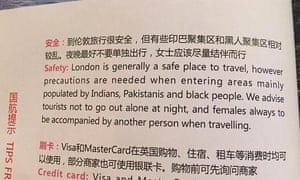
Its important to note that this is hardly a one-off example. This is just a sample of the discourse in the Chinese state and society, and if more of us knew Chinese and could tap into the chatter on their webspace, we wouldn’t be surprised by it.
In case of Hindustan though, there is a very important additional factor shaping the Chinese views. It has to do with how most Chinese came to be aware of Indians first. Something the historically minded Indians don’t understand very well is that the Indian entry into Chinese consciousness is recent, with the memories of older cultural ties, dating back to times of Hiuen Tsang etc. largely washed out during the colonial period and the cultural purges of communist era.
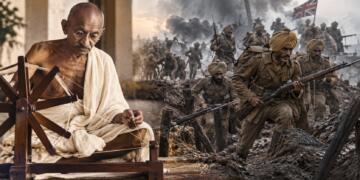
Actually, Indians have come to be known in China through the opium wars. It was the pubaiya soldiers of the East India Company that primarily won the first opium war for the. Post the first Anglo-India war of 1857, the regiments of Indian troops were drawn from other parts of the country, primarily Sikhs and Punjabis. In the era of British occupation of Shanghai, Hong Kong, Guangzhou etc. it was again these Indians who manned the forces controlling the city and countryside. To be defeated by the white devils, was something the Chinese could reconcile with, but to be subjugated by the blackies, was beyond tolerance.
Apart from being called beasts, the Chinese papers of the time wrote abusive articles about them being “slaves without a country” and similar epithets Its again very interesting to note here that such hate was never targeted at the English, despite white soldiers having carried out significantly more barbaric repressions such as burning of imperial palaces. For their effort, the Indians won the nickname of “Ha-taes” or “black bastards”, the hate for Indians only matched by how much they feared the burly turbaned men with heavy beards.
Dr Isabella Jackson who is assistant professor in Chinese history in Trinity college Dublin, talks about Indian depiction in popular Chinese history as following; “Such publications usually include a reference to the slang term by which the Sikhs were known by the Chinese, hongtau asan, which has been translated variously as the ‘red-headed monkeys’, ‘red-headed rascals’ or ‘turbaned number threes’. All reflect their status in Chinese eyes as the vicious lackeys of their British masters.”
Incidentally, the literal meaning of Hongtau Aasan, comes from “red-headed” for the red turbans worn by Sikhs, and Ah-San, or Ah Sir. “Ah Sir” being what the Chinese would need to call the Indian troops when in Shanghai. The etymology of the insults against Indians again highlights the curious mix of obsequious servility towards them when physically present and foul mouthing and behind their backs.
Racism and India-China relationships
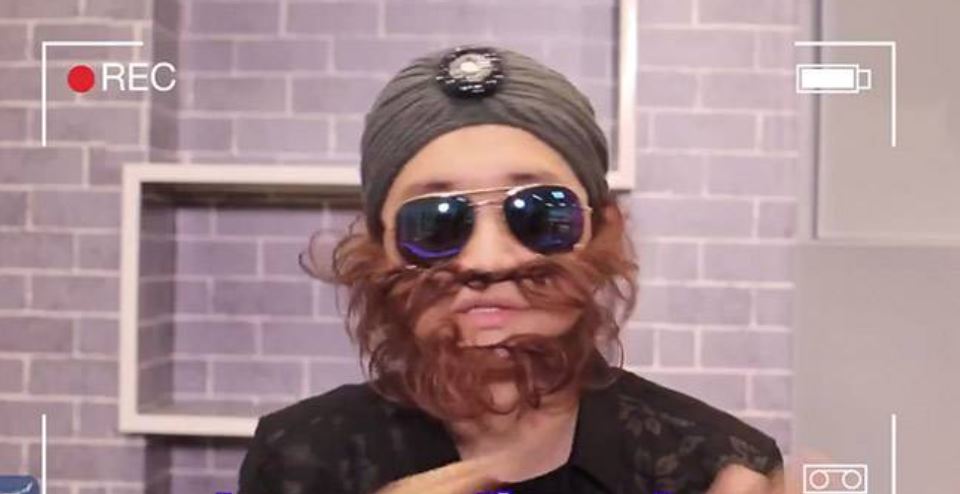
As expected how Chinese see Indians culturally, impacts how PRC deals with India as a country. There are some telling examples, one of them during the India-China standoff at Doklam. After being frustrated by Indian forces in their bid to encroach on Bhutanese territory, towards the end of crisis just before China backed off, it came up with an extremely racist video attacking India. This was a video released by Chinese official media agency Xinhua, so this clearly had sanction at the highest levels.
Just like the caricatures of black Africans in the CCTV skit, the Chinese again put forth a childish drama with Indians being caricatured as, you guessed it, “Hongtau Asan”. The Chinese focused their venom for the Sikh identity and had a turbaned and bearded fool representing India. What the video says, is not really important, as those are the typical Chinese fake claims, but the critical part is the picturization of the video. The immense racist construct of the Chinese world, the blinding hate for India is eloquently captured in the depiction of Indian person.
#TheSpark: 7 Sins of India. It’s time for India to confess its SEVEN SINS. pic.twitter.com/vb9lQ40VPH
— China Xinhua News (@XHNews) August 16, 2017
There is often a tendency amongst many Indians to think that geo-political affairs and cultural aspects of competing countries doesn’t really impact them at personal level. This is a typical Hindu mindset where state conflicts were not held against their citizens. Unfortunately, that is not how the rest of the world works, and China not at all. The deep-seated loathing, they have for Sikhs, continue in their laws as well. Its not only the Uyghurs and Tibetans who would at the receiving end.
Starting 2019, there have been steps systematically humiliate Sikhs, and their religious symbols in terms both the turban and beard being targeted. They are being forced to take off their turbans for official photographs and not being issued permits without it. This despite their passports having their pictures with turbans and the Chinese being informed of the religious significance of the same. Police are stopping Sikhs and telling them that if they wanted to live in China, they must remove their turbans and shave their beards.
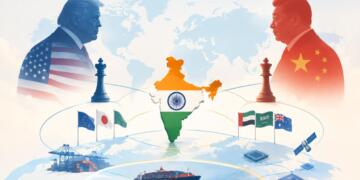
It is clear, that the racist views that Chinese hold of Indians is not merely a theoretical matter, but one which has an impact on every interaction that govern the two people. Indians in general and Government of India in particular, needs to internalize how the Chinese place Indians their scheme of things for us to be able to successfully manage them. The first of which is to relearn that for all their assertions of friendship, they will never think well of us. In fact, Bharat is at the intersection of being feared, despised, hated and coveted for what it has. As China seeks to supplant US in the world order, in civilizational terms India is its biggest bug bear that it must defeat to enable it to take the mantle.
As George Fernandes said in 1999, China is India’s biggest threat, and their views on Indians help us understand why that is so.





The advent in the current age of a plurality of powerful and large nations, information and other new technologies, and the amassing of great wealth has allowed the expression of individual human behavior (both beneficial and malignant) to be collected into a powerful and massive flow, subsequently directed on a grand scale at entire countries and populations. What is new here is not the age-old story of the corruption of greed and power, but the massive scale of the enactment of the story based on the plurality of many nations/ states having sufficient wealth and power to antagonize others on a grand scale. I hope to make three points that may be considered and weighed for value. First, despite a nation’s past relationship with colonialism, one would be wise to not brand current cultural choices on outside forces of the past; this makes one powerless and essentially says that one is still under serfdom. Secondly, China has a very powerful and long history–of making it’s own choices. The notion of fair-skinned exceptionalism is entirely Chinese. In older times, the idea sprang from the fact of wealthy scholars and rulers spending their time in relative luxury and comfortable dwellings, whereas the majority of the population toiled in the fields or in other outdoor professions, where their skin naturally darkened. Fair versus dark skin was a symbol of wealth and power and has a very long standing in Chinese history. It has not been imposed by outside forces. Thirdly, China is the largest and oldest colonial empire on the planet. The land and peoples were conquered through violence and forced into an ever-growing empire. They were subsequently manipulated into identifying with their oppressors to the degree that most have no notion of not actually belonging to the “Han” ethnic group. Many thousands of cultures and ethnic identities have been squashed and erased from the face of the Chinese earth. China is the master of the colonial game.
Interesting. — I contributed some more here, on Chinese racism, and how it underpins the ongoing Chinese genocide against the Uyghurs and other native peoples: https://chinachannel.org/2021/01/22/chinese-racism/