












TFIPOST हिन्दी
TFIPOST Global
Tfipost.com
Tfipost.com
No Result
View All Result
  • Premium
  • Politics
    • All
    • Analysis
    • Opinions
    • Trending
    From pilgrimage to metros, now without the wait

    From Kashi to Mumbai and Ayodhya to Pune: Modi Expands Rail Network with New Amrit Bharat Express Services

    Why is Making a Jet Engine so Hard | The failure of Kaveri

    Why is Making a Jet Engine so Hard | The failure of Kaveri

    Rajnath Singh at SCO, reaffirming India’s zero-tolerance stand on terrorism.

    “No More Double Standards”: Rajnath Singh’s SCO Message Rewrites India’s Terror Response Playbook

    Nepal PM Faces Fresh Controversy as Church Demolition Row Triggers Political Storm

    Nepal PM Faces Fresh Controversy as Church Demolition Row Triggers Political Storm

    • Analysis
    • Opinions
    • Trending
  • Economy
    • All
    • Business
    • Economy1
    • Finance
    India–New Zealand FTA signed in New Delhi, marking a “once in a lifetime” moment in trade ties.

    India, New Zealand Seal Fast-Tracked Trade Pact to Expand Duty-Free Access, Jobs and $5 Billion Trade Target

    Ahmadis in Pakistan: From Faith to Marginalisation Under Law and Society

    Ahmadis in Pakistan: From Faith to Marginalisation Under Law and Society

    Open Demat Account with Zero Annual Maintenance Charges What to Look For

    Open Demat Account with Zero Annual Maintenance Charges What to Look For

    Blood in the Meadows: How the Pahalgam Terror Attack Exposed Calculated Targeting of Civilians in Kashmir

    Blood in the Meadows: How the Pahalgam Terror Attack Exposed Calculated Targeting of Civilians in Kashmir

    • Business
    • Finance
  • Defense
    • All
    • Defence
    • Strategy
    • Weaponry
    Why is Making a Jet Engine so Hard | The failure of Kaveri

    Why is Making a Jet Engine so Hard | The failure of Kaveri

    Rajnath Singh at SCO, reaffirming India’s zero-tolerance stand on terrorism.

    “No More Double Standards”: Rajnath Singh’s SCO Message Rewrites India’s Terror Response Playbook

    Recovered arms and arrests have intensified scrutiny on a suspected cross-border terror network.

    Pakistan’s Proxy War Faces a Setback as Delhi Terror Plot is Crushed, 18 Weapons Seized

    The scars of Pahalgam endure, even as the nation moves forward

    Pahalgam Anniversary: Modi Signals Firm National Stand as India Reasserts Anti-Terror Resolve

    • Defence
    • Strategy
    • Weaponry
  • Geopolitics
    • All
    • Africa
    • Americas
    • Asia Pacific
    • Europe
    • South Asia
    • West Asia
    When law becomes an instrument of exclusion, persecution moves far beyond the courtroom.

    Ahmadis in Pakistan: From Faith to Marginalisation Under Law and Society

    When uranium becomes strategy, India moves first.

    India’s $4 Billion Uranium Coup with Kazakhstan Rewrites the Global Nuclear Balance

    “Fixing the World”: What a Century of Big Ideas Reveals About Us

    “Fixing the World”: What a Century of Big Ideas Reveals About Us

    Pakistan Tried to Bury an NYT Report. It Only Exposed Asim Munir’s Panic

    Pakistan Tried to Bury an NYT Report. It Only Exposed Asim Munir’s Panic

    • Africa
    • Americas
    • Asia Pacific
    • Europe
    • South Asia
    • West Asia
  • Knowledge
    • All
    • Culture
    • Education
    • History
    • Indology
    Chants of ‘Jai Badri Vishal’ Echo as Badrinath Portals Open; All Four Dhams Now Accessible to Pilgrims

    Chants of ‘Jai Badri Vishal’ Echo as Badrinath Portals Open; All Four Dhams Now Accessible to Pilgrims

    Kedarnath Dham Portals Open for Devotees After 181 Days Amid Vedic Chants, Traditional Rituals

    Kedarnath Dham Portals Open for Devotees After 181 Days Amid Vedic Chants, Traditional Rituals

    Sardar Patel and Amit Shah

    Sardar Patel’s 1947 Blueprint on Minority Quotas Resurfaces as Reservation Debate Returns to Centre Stage

    The 1973 Constitution and ‘Bhutto’ the Man Who Made It: What Pakistan Owes and What It Destroyed

    The 1973 Constitution and ‘Bhutto’ the Man Who Made It: What Pakistan Owes and What It Destroyed

    • Culture
    • History
    • Indology
  • Law
  • Lounge
    • All
    • Books
    • Cinema
    • Entertainment
    • Food
    • Games
    • Health
    • Lifestyle
    • Satire
    • Sports
    • technology
    • Travel
    When regulation meets the algorithm

    India Tightens Digital Control as Online Blocking Orders Surge to 24,300 Amid AI Deepfake Trend

    Digital Data Collection In India

    India’s Data Reset Begins: Census 2027 to Become First Fully Digital Population Count

    5 Facilities in Bengaluru Specializing in Mental Health Treatment for Those with Cancer

    5 Facilities in Bengaluru Specializing in Mental Health Treatment for Those with Cancer

    UNESCO World Book Day and Copyright Day

    World Book Day 2026: UNESCO’s Multilingual Push Aligns with India’s Deep Literary Continuum

    • Books
    • Cinema
    • Food
    • Health
    • Sports
    • technology
    • Travel
    • Satire
Tfipost.com
  • Premium
  • Politics
    • All
    • Analysis
    • Opinions
    • Trending
    From pilgrimage to metros, now without the wait

    From Kashi to Mumbai and Ayodhya to Pune: Modi Expands Rail Network with New Amrit Bharat Express Services

    Why is Making a Jet Engine so Hard | The failure of Kaveri

    Why is Making a Jet Engine so Hard | The failure of Kaveri

    Rajnath Singh at SCO, reaffirming India’s zero-tolerance stand on terrorism.

    “No More Double Standards”: Rajnath Singh’s SCO Message Rewrites India’s Terror Response Playbook

    Nepal PM Faces Fresh Controversy as Church Demolition Row Triggers Political Storm

    Nepal PM Faces Fresh Controversy as Church Demolition Row Triggers Political Storm

    • Analysis
    • Opinions
    • Trending
  • Economy
    • All
    • Business
    • Economy1
    • Finance
    India–New Zealand FTA signed in New Delhi, marking a “once in a lifetime” moment in trade ties.

    India, New Zealand Seal Fast-Tracked Trade Pact to Expand Duty-Free Access, Jobs and $5 Billion Trade Target

    Ahmadis in Pakistan: From Faith to Marginalisation Under Law and Society

    Ahmadis in Pakistan: From Faith to Marginalisation Under Law and Society

    Open Demat Account with Zero Annual Maintenance Charges What to Look For

    Open Demat Account with Zero Annual Maintenance Charges What to Look For

    Blood in the Meadows: How the Pahalgam Terror Attack Exposed Calculated Targeting of Civilians in Kashmir

    Blood in the Meadows: How the Pahalgam Terror Attack Exposed Calculated Targeting of Civilians in Kashmir

    • Business
    • Finance
  • Defense
    • All
    • Defence
    • Strategy
    • Weaponry
    Why is Making a Jet Engine so Hard | The failure of Kaveri

    Why is Making a Jet Engine so Hard | The failure of Kaveri

    Rajnath Singh at SCO, reaffirming India’s zero-tolerance stand on terrorism.

    “No More Double Standards”: Rajnath Singh’s SCO Message Rewrites India’s Terror Response Playbook

    Recovered arms and arrests have intensified scrutiny on a suspected cross-border terror network.

    Pakistan’s Proxy War Faces a Setback as Delhi Terror Plot is Crushed, 18 Weapons Seized

    The scars of Pahalgam endure, even as the nation moves forward

    Pahalgam Anniversary: Modi Signals Firm National Stand as India Reasserts Anti-Terror Resolve

    • Defence
    • Strategy
    • Weaponry
  • Geopolitics
    • All
    • Africa
    • Americas
    • Asia Pacific
    • Europe
    • South Asia
    • West Asia
    When law becomes an instrument of exclusion, persecution moves far beyond the courtroom.

    Ahmadis in Pakistan: From Faith to Marginalisation Under Law and Society

    When uranium becomes strategy, India moves first.

    India’s $4 Billion Uranium Coup with Kazakhstan Rewrites the Global Nuclear Balance

    “Fixing the World”: What a Century of Big Ideas Reveals About Us

    “Fixing the World”: What a Century of Big Ideas Reveals About Us

    Pakistan Tried to Bury an NYT Report. It Only Exposed Asim Munir’s Panic

    Pakistan Tried to Bury an NYT Report. It Only Exposed Asim Munir’s Panic

    • Africa
    • Americas
    • Asia Pacific
    • Europe
    • South Asia
    • West Asia
  • Knowledge
    • All
    • Culture
    • Education
    • History
    • Indology
    Chants of ‘Jai Badri Vishal’ Echo as Badrinath Portals Open; All Four Dhams Now Accessible to Pilgrims

    Chants of ‘Jai Badri Vishal’ Echo as Badrinath Portals Open; All Four Dhams Now Accessible to Pilgrims

    Kedarnath Dham Portals Open for Devotees After 181 Days Amid Vedic Chants, Traditional Rituals

    Kedarnath Dham Portals Open for Devotees After 181 Days Amid Vedic Chants, Traditional Rituals

    Sardar Patel and Amit Shah

    Sardar Patel’s 1947 Blueprint on Minority Quotas Resurfaces as Reservation Debate Returns to Centre Stage

    The 1973 Constitution and ‘Bhutto’ the Man Who Made It: What Pakistan Owes and What It Destroyed

    The 1973 Constitution and ‘Bhutto’ the Man Who Made It: What Pakistan Owes and What It Destroyed

    • Culture
    • History
    • Indology
  • Law
  • Lounge
    • All
    • Books
    • Cinema
    • Entertainment
    • Food
    • Games
    • Health
    • Lifestyle
    • Satire
    • Sports
    • technology
    • Travel
    When regulation meets the algorithm

    India Tightens Digital Control as Online Blocking Orders Surge to 24,300 Amid AI Deepfake Trend

    Digital Data Collection In India

    India’s Data Reset Begins: Census 2027 to Become First Fully Digital Population Count

    5 Facilities in Bengaluru Specializing in Mental Health Treatment for Those with Cancer

    5 Facilities in Bengaluru Specializing in Mental Health Treatment for Those with Cancer

    UNESCO World Book Day and Copyright Day

    World Book Day 2026: UNESCO’s Multilingual Push Aligns with India’s Deep Literary Continuum

    • Books
    • Cinema
    • Food
    • Health
    • Sports
    • technology
    • Travel
    • Satire
No Result
View All Result
Tfipost.com
Tfipost.com
No Result
View All Result
  • Premium
  • Politics
  • Economy
  • Defense
  • Geopolitics
  • Knowledge
  • Law
  • Lounge

Unsound and Idiotic Plan, Comprehensive Defeat: This is how an Ex-ISI officer presents the Pakistani side of the Kargil War

Bhushan Agrawal by Bhushan Agrawal
12 June 2017
in History
Unsound and Idiotic Plan, Comprehensive Defeat: This is how an Ex-ISI officer presents the Pakistani side of the Kargil War
Share on FacebookShare on X

We are all aware of the Kargil war and how the Indian Bravehearts fought bravely to re-capture lost ground, mountains, and peaks sacrificing even their lives for the pride of our motherland. More than a decade and a half later let’s collaborate the facts and understand what exactly happened and how, with an perspective from both sides of the border.

Lt Gen (R) Shahid Aziz who was with the ISI Analysis Wing at the time of the Kargil invasion, recounts the Pakistani side of what actually happened during the Kargil war. He very clearly demarcates that the Pakistani invasion in Kargil was an unsound military plan based on invalid assumptions, launched with little preparations and in total disregard to the regional and international environment and was therefore bound to fail. He did not mince words to conclude that it was a total disaster.

RelatedPosts

Pakistan’s Proxy War Faces a Setback as Delhi Terror Plot is Crushed, 18 Weapons Seized

Ahmadis in Pakistan: From Faith to Marginalisation Under Law and Society

Ahmadis in Pakistan: From Faith to Marginalisation Under Law and Society

Load More
Kargil
General (R) Shahid Aziz

But he did raise few pertinent questions about why was Kargil war undertaken? Were there other motives other than those proclaimed, or was it only a blunder or a military adventurism?

It was with certainty that Pakistani participation was never a defensive manoeuvre, since there was never a sign of Indian attack at any given point, even the intelligence ISI confirmed. So basically it was an act of aggression by the Pakistani Military with an intent to cut the supply lines to Siachen and force the Indians to pull out. On the ground they captured almost 800 sq. kms of area by occupying empty spaces along the LOC on the top of ridges and mountains held by the Indians as part of the Shimla agreement and never been breached since 1971.

Lt Gen Aziz recounts the following “The entire planning and execution was done in a cavalier manner, in total disregard of military convention. In justification, to say that our assessment was not wrong, but there was, “unreasonably escalated Indian response” is a sorry excuse for not being able to assess Indian reaction. Assumptions were made that they would not be able to dislodge us and the world would sit back idly. There were no mujahedeen, only taped wireless messages, which fooled no one. Our soldiers were made to occupy barren ridges, with hand held weapons and ammunition. There was no way to dig in, so they were told to make parapets with lose stones and sit behind them, with no overhead protection. The boys were comforted by their commander’s assessment that no serious response would come. But it did — wave after wave, supported by massive air bursting artillery and repeated air attacks. The enemy still couldn’t manage to capture the peaks, and instead filled in the valleys. Cut off and forsaken, our posts started collapsing one after the other, though the general (Musharraf) publicly denied it. The gung-ho mannerism, when there were no pressures, was cowed when lines started shrinking and the international setting became frightening. There was no will to stay the course. Media was hushed to silence, so that pulling out does not become a political issue. We will sing when our songs don’t tie us down. The operation, in any case, didn’t have the capacity to choke Siachen.”

Kargil
PC: http://pakteahouse.net

Technically and militarily the Pakistanis had a show of very poor execution and badly planned task at hand, resulting in deaths of their soldiers whose supply lines instead were disrupted by the Indian forces below the occupied ridges and mountains with heavy artillery shelling on one hand and at the same time these occupied peaks were bombarded by massive air strikes by the Indian air force on the other hand.

These soldiers from the enemy country were now effectively in a lame-duck situation.

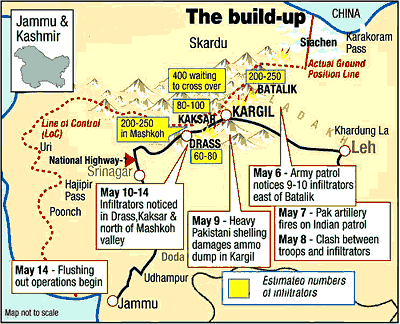
During the winter season, due to extreme cold in the snow-capped mountainous areas of Kashmir, it was a common practice for both the Indian and Pakistan Armies to abandon some forward posts on their respective sides of the LOC and to reduce patrolling of areas that may be avenues of infiltration. When weather conditions became less severe, forward posts would be reoccupied and patrolling resumed. In February 1999, the Pakistan Army not only began to re-occupy the posts it had abandoned on its side of the LOC in the Kargil region, but also sent forces to occupy some posts on the Indian side of the LOC. Troops from the elite Special Services Group as well as four to seven battalions of the Northern Light Infantry covertly and overtly set up bases on the vantage points of the Indian-controlled region.

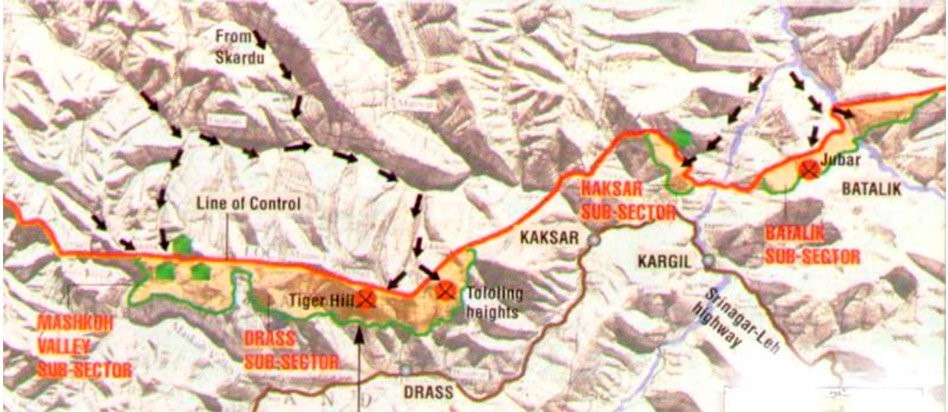
The Indian Army‘s first priority was to recapture peaks that were in the immediate vicinity of NH 1D. This resulted in Indian troops first targeting the Tiger Hill and Tololing complex in Drass, which dominated the Srinagar-Leh route. This was soon followed by the Batalik-Turtok sub-sector which provided access to Siachen Glacier. Some of the peaks that were of vital strategic importance to the Pakistani defensive troops were Point 4590 and Point 5353. While 4590 was the nearest point that had a view of NH 1D, point 5353 was the highest feature in the Drass sector, allowing the Pakistani troops to observe NH 1D. The recapture of Point 4590 by Indian troops on 14 June was significant, notwithstanding the fact that it resulted in the Indian Army suffering the most casualties in a single battle during the conflict.

Kargil
NH1 D | PC: WikiMedia

India regained control of the hills overlooking NH 1D, the Indian Army turned to driving the invading force back across the Line of Control. The Battle for Tiger Hill (Point 5140) was still an ongoing one, Indian troops found well-entrenched Pakistani soldiers at Tiger Hill, both sides suffered heavy casualties. After a final assault on the peak in which ten Pakistani soldiers and five Indian soldiers were killed, Tiger Hill finally fell. A few of the assaults occurred atop hitherto unheard of peaks – most of them unnamed with only Point numbers to differentiate them – which witnessed fierce hand to hand combat.

As the operation was fully underway, about 250 artillery guns were brought in to clear the infiltrators in the posts that were in the line-of-sight. The Bofors FH-77B field howitzer played a vital role.

In many vital points, neither artillery nor air power could dislodge the outposts manned by the Pakistani soldiers, who were out of visible range. The Indian Army mounted some direct frontal ground assaults which were slow and took a heavy toll given the steep ascent that had to be made on peaks as high as 18,000 feet (5,500 m). Since any daylight attack would be suicidal, all the advances had to be made under the cover of darkness, escalating the risk of freezing. Accounting for the wind chill factor, the temperatures were often as low as −15 °C to −11 °C near the mountain tops.

Based on military tactics, much of the costly frontal assaults by the Indians could have been avoided if the Indian Military had chosen to blockade the supply route of the opposing force from all sides, creating a complete siege. Such a move would have involved the Indian troops crossing the LoC as well as initiating aerial attacks on Pakistani soil, a manoeuvre India was not willing to exercise fearing an expansion of the theatre of war and reduced international support for its cause.

Meanwhile with a three pronged strategy and the war escalating further the Indian Navy also stepped in and started preparing the blockade of the Pakistani ports (primarily the Karachi port) to cut off supply routes under “Operation Talwar“. The Indian Navy’s western and eastern fleets joined in the North Arabian Sea and began aggressive patrols and threatened to cut Pakistan’s sea trade. This exploited Pakistan’s dependence on sea based oil and trade flows. Later, then-Prime Minister of Pakistan, Nawaz Sharif disclosed that Pakistan was left with just six days of fuel to sustain itself if a full-scale war had broken out.

Kargil
Indian soldiers after winning a battle during the Kargil War | PC: WikiMedia

Pakistan now being in defensive mode sought help from America in de-escalating, but President Bill Clinton refused to intervene until Pakistan had removed all forces from the Indian side of the Line of Control.

Two months into the conflict, Indian troops had slowly retaken most of the ridges that were encroached by the infiltrators. The Indian army launched its final assault in the last week of July, as soon as the Drass subsector had been cleared of Pakistani forces, the fighting ceased on 26 July.

Internationally Pakistan was humiliated, isolated and criticized by other countries for instigating the Kargil war, as its forces crossed the Line of Control.

G8 nations supported India and condemned the Pakistani violation of the LOC at the Cologne summit. The European Union also opposed Pakistan’s violation of the LOC. China, a long-time ally of Pakistan, insisted on a pullout of forces to the pre-conflict positions along the LOC and settling border issues peacefully. Other organizations like the ASEAN Regional Forum too supported India’s stand on the inviolability of the LOC.

US President Bill Clinton later in his autobiography said “Sharif’s moves were perplexing since the Indian Prime Minister Atal Bihari Vajpayee just few days earlier had travelled to Lahore to promote bilateral talks aimed at resolving the Kashmir problem and by crossing the Line of Control, Pakistan had wrecked the talks. On the other hand, he applauded Indian restraint for not crossing the LoC and escalating the conflict into an all-out war“. KargilKargil
Tags: Indian ArmyKargilPakistan
Share234TweetSend
Previous Post

The Incredibly Strange Journalists Who Stopped Reporting and Became Corrupt Zombies

Next Post

Look at what Congress is doing to farmers in Karnataka, And Try To convince me that Congress is a farmer friendly party

Related Posts

Sardar Patel and Amit Shah
History

Sardar Patel’s 1947 Blueprint on Minority Quotas Resurfaces as Reservation Debate Returns to Centre Stage

17 April 2026

Sardar Vallabhbhai Patel’s 1947 intervention on minority representation in India’s Constituent Assembly has returned to the centre of political...

The 1973 Constitution and ‘Bhutto’ the Man Who Made It: What Pakistan Owes and What It Destroyed
Analysis

The 1973 Constitution and ‘Bhutto’ the Man Who Made It: What Pakistan Owes and What It Destroyed

6 April 2026

Pakistan’s constitutional story is built on a contradiction so stark that it still indicts the state nearly half a...

The Fall of Lhasa: How Nine Days in 1959 Changed Tibet Forever
History

The Fall of Lhasa: How Nine Days in 1959 Changed Tibet Forever

26 March 2026

There is a photograph that has never left the minds of those who have seen it. Lhasa, March 1959,...

Load More

Leave a Reply Cancel reply

Your email address will not be published. Required fields are marked *

I agree to the Terms of use and Privacy Policy.
This site is protected by reCAPTCHA and the Google Privacy Policy and Terms of Service apply.

Currently Playing

From Runways to Warships: India’s Firefighting Warrior Built for Bases & Battles| IAF | VayuShakti

From Runways to Warships: India’s Firefighting Warrior Built for Bases & Battles| IAF | VayuShakti

00:05:40

Ethanol, EVs and Solar- How India’s Energy Game Is Changing | Modi on LPG & Crude Oil | war| Hormuz

00:05:21

Truth of IRIS Dena: 8 Days That Changed Narrative | War zone Reality, Not an Indian Navy Exercise

00:08:02

300 Million Euros for SCALP: Strategic Necessity or Costly Dependency on France300

00:04:06

Tejas Mk1A: 19th aircraft coupled but Not Delivered: What Is Holding Back the IAF Induction?

00:07:21
Facebook Twitter Instagram Youtube
tfipostTfipost.com
Right Wing | News Analysis | Indian Opinion
  • About us
  • Contact Us
  • Careers
  • Brand Partnerships
  • Terms of use
  • Privacy Policy
  • Sitemap

©2026 TFI Media Private Limited

No Result
View All Result
  • Premium
  • Politics
    • Analysis
    • Opinions
    • Trending
  • Economy
    • Business
    • Finance
  • Defense
    • Defence
    • Strategy
    • Weaponry
  • Geopolitics
    • Africa
    • Americas
    • Asia Pacific
    • Europe
    • South Asia
    • West Asia
  • Knowledge
    • Culture
    • History
    • Indology
  • Law
  • Lounge
    • Books
    • Cinema
    • Food
    • Health
    • Sports
    • technology
    • Travel
    • Satire
TFIPOST हिन्दी
TFIPOST Global

©2026 TFI Media Private Limited