













Delhi recorded an Air Quality Index (AQI) reading of 382 on Friday, which falls in the “very poor” category. It is the highest pre-Diwali reading in eight years. Emergency restrictions have been imposed across the National Capital Region (NCR). With Diwali falling on Sunday, the deterioration has exposed a larger problem: the capital’s air is already heavily polluted before firecracker emissions add to the burden.
Central Pollution Control Board (CPCB) data cited by The Indian Express showed PM2.5 concentrations approaching 280 micrograms per cubic metre, the highest comparable pre-festival baseline since 2019. While an AQI of 382 falls in the ‘Very Poor’ category, PM2.5 measures fine particles capable of penetrating deep into the lungs and affecting respiratory and cardiovascular health.
The deterioration extends beyond Delhi, with Noida recording an AQI of 303 and Greater Noida 316. Several Delhi neighbourhoods had already recorded severe pollution earlier in the week.
Why is Delhi’s air already polluted?
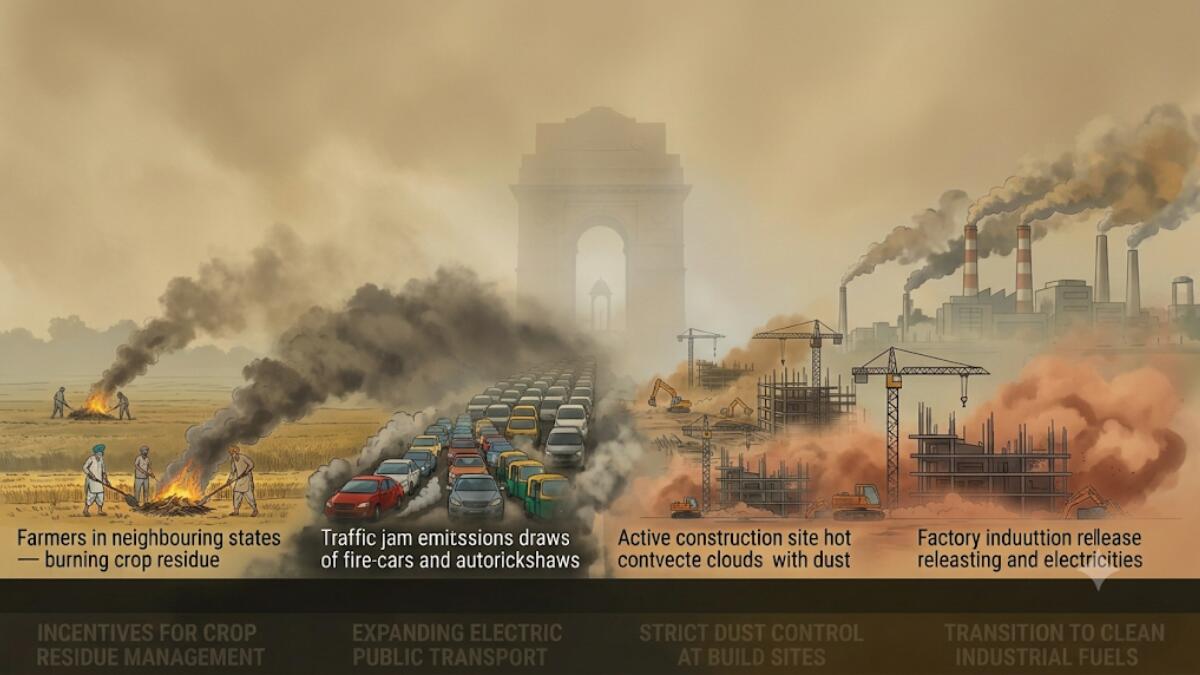
The capital faces substantial year-round emissions from vehicles, industries, construction dust, waste burning and agricultural fires. Winter conditions intensify the problem by preventing pollutants from dispersing.
According to the Indian institute of tropical Meteorology’s decision support system, transport accounted for 17.6% of Delhi’s PM2.5 pollution on November 6, followed by farm fires at 7.9% and neighbouring areas, including Jhajjar, at 6.8%.
These are daily estimates, not fixed annual contributions.
Vehicles and industrial emissions
During Friday’s hearing, chief justice, Surya Kant, questioned why vehicular pollution remained a major problem despite existing restrictions, highlighting bumper-to-bumper traffic and inadequate public transport.
The Supreme Court also raised concerns about monitoring vehicles entering Delhi from neighbouring states.
Vehicles emit exhaust pollutants, while brake and tyre wear produce additional particles. Industrial emissions, power plants and burning activities also release gases that undergo atmospheric reactions, forming secondary particulate matter.
A February 2026 CAQM assessment identified secondary particles as Delhi’s largest winter PM2.5 component at 27%, followed by transport at 23%, biomass burning at 20%, dust at 15% and industry at 9%.
These aggregated estimates from studies conducted between 2015 and 2025 differ from the November 6 daily figures.
Stubble burning and winter weather
Agricultural fires remain an important seasonal contributor, although their impact varies with wind direction and atmospheric conditions.
The Indian Express reported 6,226 farm fires between September 15 and November 6, including 3,144 in Punjab, 1,220 in Madhya Pradesh and 1,097 in Rajasthan. Haryana recorded just 89 incidents, indicating changing geographical patterns.
The Supreme Court advocated economic incentives and assured procurement of crop residue to discourage burning, recognizing farmers’ need for affordable alternatives.
Meanwhile, minimum temperatures forecast around 14-16°C and stagnant winds could worsen pollution through temperature inversion. This occurs when warmer air traps colder, polluted air near the surface, restricting its dispersal.
Weather does not create pollution; it concentrates emissions already present in the atmosphere.
Why emergency measures are not enough
CAQM invoked GRAP Stage III across NCR on November 6, restricting older petrol and diesel vehicles in designated districts, introducing hybrid learning for primary classes and permitting wider work-from-home arrangements.
These measures can temporarily reduce emissions and exposure but cannot eliminate the underlying pollution sources.
What needs to change?
Immediate priorities include stricter vehicle-emission checks, better traffic management, construction-dust controls, industrial compliance and enforcement against open waste burning.
Medium-term reforms require more reliable buses, improved last-mile connectivity, integrated NCR public transport and effective crop-residue collection and processing systems.
Long-term improvements depend on cleaner industries, reduced dependence on private vehicles, scientific waste management and coordinated action across Delhi, Haryana, Punjab, Uttar Pradesh and Rajasthan.
Delhi’s recurring winter crisis cannot be solved by targeting firecrackers or stubble burning alone. Lasting improvement requires year-round emission reductions, regional cooperation and practical alternatives that make cleaner choices economically viable.