























The Trump administration on Thursday suspended processing of permanent labour certifications for eight technology and IT services companies, among them TCS, Infosys, Wipro, HCLTech and Cognizant, in the sharpest action yet against the firms that built India’s outsourcing industry. Announced by Vice President JD Vance and Labor Secretary Keith Sonderling, the move halts the PERM programme for the named employers. The Labor Department will stop accepting new applications and processing pending ones while investigations into alleged fraud and compliance violations continue. Capgemini, Microsoft and Adobe are also on the list.
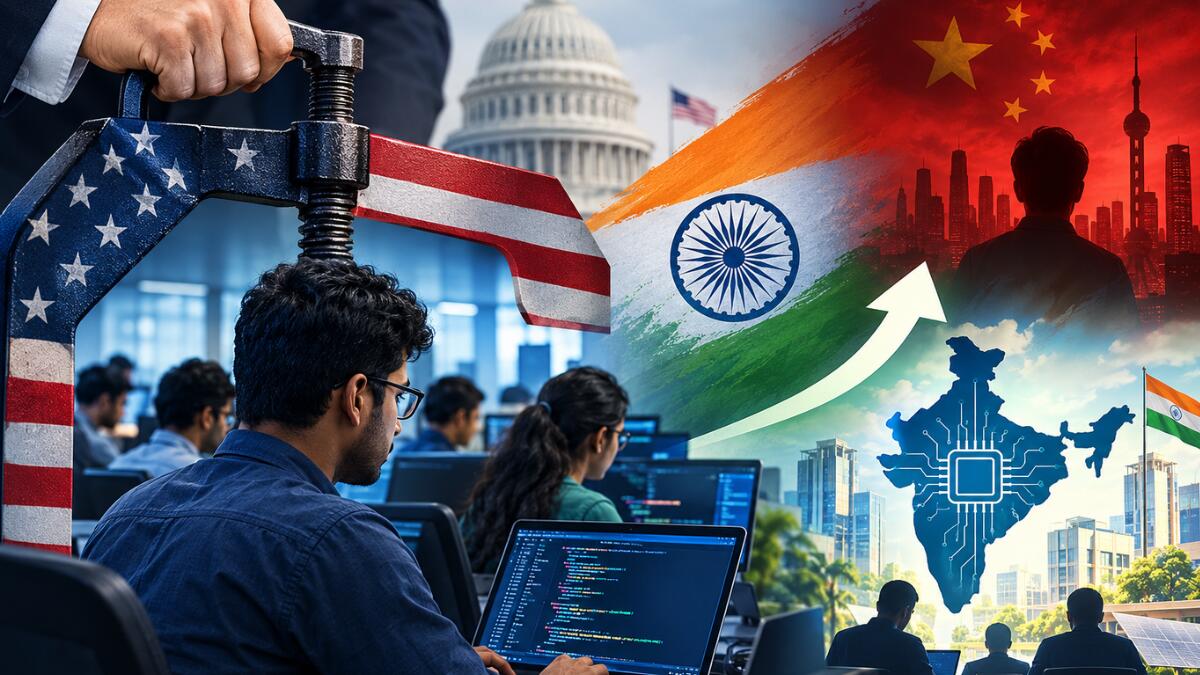
The decision is not a suspension of the H-1B visa, as some early reactions suggested. PERM is the first step toward an employer-sponsored green card, and the same report notes that the suspension does not cancel the H-1B programme or automatically revoke existing H-1B visas. But it lands on top of a year of tightening, and it has revived a question that Indian policymakers and executives have asked before: whether sustained American pressure on skilled migration could force India to build a technology base of its own, much as US restrictions pushed China toward self-reliance.
What the administration says
Vance and Sonderling framed the action as an enforcement matter. They said the companies’ heavy use of employment-based immigration programmes, including large volumes of H-1B and PERM filings alongside workforce reductions, may have cost American workers opportunities. Vance pointed to specific cases the administration believes merit investigation. Immigration firm Envoy Global noted that no final findings were announced, and that the duration of the suspension and the treatment of approved certifications remain unclear.
Who is affected, and how much
The practical damage depends on where a worker sits in the green card queue. Employees who have not begun the process may be unable to start it, and those with pending cases face delays. The most acute risk is for workers nearing the six-year H-1B limit, who rely on a PERM filing to qualify for extensions.
Industry reaction has been measured. Analysts cited by BusinessToday said existing H-1B employment is untouched, so the immediate operational impact may be limited, though a prolonged suspension could raise retention and compliance costs. TCS said its PERM applications were in single digits in each of the last two years and that it plans to hire an additional 15,000 people in the US over the next five years. Nasscom, the industry body, said Indian companies have significantly reduced their dependence on H-1B visas and expanded local US hiring.
A year of pressure
The latest step follows a pattern. In September 2025 the administration imposed a $100,000 annual fee on H-1B visas, with Commerce Secretary Howard Lutnick arguing that cheap visas had encouraged companies to hire foreign workers instead of training Americans. The fee’s legal standing remains contested, and reports conflict. One says a federal court struck it down on 8 June and an appeals court declined to pause that ruling on 24 July. Another says the administration extended the fee despite legal challenges while pursuing a replacement of roughly $103,000 through formal rulemaking.
The effect on corporate behaviour has been large regardless. White House data cited by one outlet claims registrations from big IT and outsourcing firms fell 92 percent, and Wipro’s H-1B approvals reportedly dropped 62 percent year on year in FY 2026. Indian nationals account for roughly 71 percent of all H-1B visas, so no other country carries as much of the burden.
The “China moment” argument
Proponents of the idea point to what happens when a pipeline is rationed. Engineers and founders who cannot get a US visa or green card have three options: stay in India, move to a third country, or serve American clients remotely. If enough choose the first, and if companies that once exported talent build teams at home, India’s domestic technology base deepens. Sparber of Colgate University told Reuters that keeping skilled foreigners out does not protect American workers, because foreign talent will compete with Americans from abroad instead. A founder quoted by CNBC during the fee shock made the optimistic case plainly, saying that India must create opportunities where world-class talent can thrive without leaving home.
Why the comparison strains
The scepticism begins with what China actually had. Its response to US restrictions rested on state-directed industrial policy, vast capital, deep investment in semiconductors and hardware, and a domestic market too large to ignore. India’s technology strength lies in services, a model that depends on access to American clients and, historically, American visas. Restricting that access damages the model before it creates a replacement.
Leaving the US also does not mean returning to India. Stanford’s Ahmet Gulek observed that permanent residency is the main way skilled foreign workers stay in America and that, without it, some will leave and some will not come at all. Many will end up in Canada, Europe or in the global offices of multinationals. The legal uncertainty adds to the doubt: a fee that has been struck down, extended and rebuilt, and an enforcement action without final findings, are not the stable, long-term pressure that drove China’s strategic shift.
The administration’s critics also say the target is wrong. Entrepreneur Vivek Wadhwa argued that the big technology firms are not the main abusers of the system, and that scrutiny should fall on staffing intermediaries that exploit it for profit.
What would turn pressure into transformation
For this to become more than a difficult adjustment, India would need to convert its engineering workforce into product and research capacity, backed by patient risk capital and stronger domestic research funding. Its large employers would need to move up the value chain, with Indian centres doing core design and engineering rather than support work. Both are underway in places, but neither depends on Washington’s decisions, and neither is guaranteed.
The more accurate description is that the US is acting as a catalyst, not a cause. By raising the cost of the old outsourcing model, it strengthens the argument for a new one. Whether India seizes the opening depends on its own investment and policy choices. The signals to watch are how long the PERM suspension lasts, whether the courts or the Department of Homeland Security settle the H-1B fee, and whether Indian firms begin reporting growth in domestic product and research hiring rather than simply more localisation in the United States.