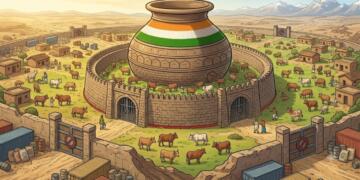

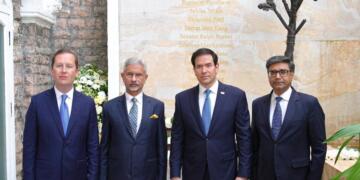



















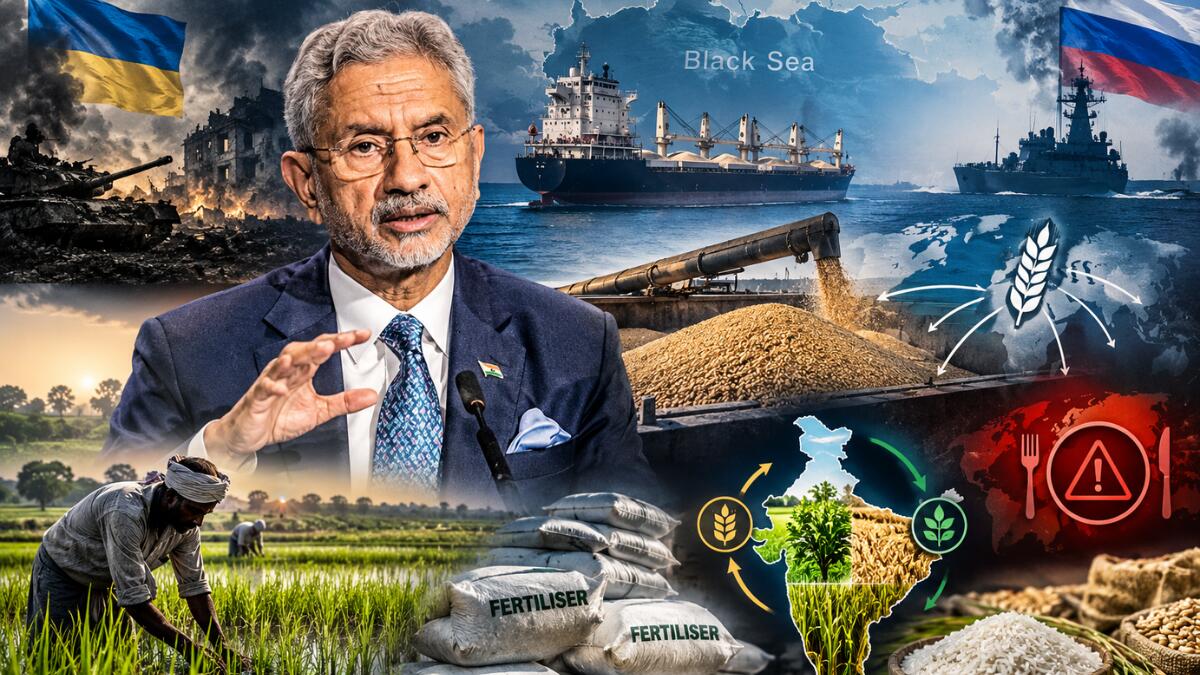
External Affairs Minister S. Jaishankar’s warning of a “major food crisis” in the coming months, delivered at the Asia Society in New York on September 28, is not an abstract diplomatic remark. It describes a chain that runs directly through Indian farms. “We are already looking at major significant fertiliser shortages,” Jaishankar said, adding that major grain exporters would struggle to ship cargoes, particularly through the Black Sea. Understanding why requires looking at two wars, India’s two cropping seasons, and the country’s unusual position as both the world’s largest rice exporter and a nation still dependent on imported fertiliser.
Two seasons, one vulnerability
Indian agriculture runs on two principal cropping cycles: kharif, sown with the monsoon around June and harvested in autumn, which includes rice, cotton, soybean and pulses; and rabi, sown after the monsoon retreats around October-November and harvested in spring, which includes wheat, mustard and gram. Both cycles depend heavily on fertiliser applied at sowing and again during the growing season, particularly urea and di-ammonium phosphate (DAP), which is why a global fertiliser shock hits Indian agriculture twice a year rather than once.
Why fertiliser is India’s weak link
India produces a large share of its own urea, but not enough, and it barely produces phosphate fertiliser at all. Government data shows that in the 2025-26 fiscal year, India imported 103.50 lakh tonnes of urea and 61.94 lakh tonnes of DAP to meet domestic demand, on top of substantial domestic production. According to independent research, natural gas, the key feedstock for urea, and finished DAP itself are both concentrated in a small number of source countries: China, Russia and Jordan together account for about 95 per cent of India’s DAP imports, while urea imports are led by Saudi Arabia, Russia and other Gulf suppliers.
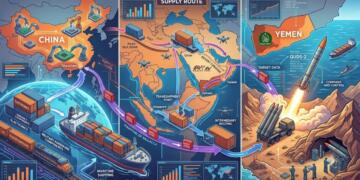
This is precisely the supply chain the wars in Ukraine and West Asia have disrupted. Roughly 45 to 50 per cent of India’s liquefied natural gas, the lifeblood of domestic urea plants, comes from Gulf producers including Qatar, exposing India’s own production to any disruption of the Strait of Hormuz, through which much of that gas transits. International fertiliser prices rose by 46 per cent between December 2025 and April 2026 alone, according to trade analysis, and DAP prices climbed from around $650 a tonne to $750-770 a tonne over the same period. India’s fertiliser subsidy bill for the current fiscal year is projected to run 14 per cent above budget, at roughly ₹1.92 lakh crore, driven by these costlier imports.
India has responded by diversifying suppliers rather than absorbing the shock passively. The share of India’s urea imports sourced from Gulf states fell from 75 per cent in 2024-25 to 38 per cent in 2025-26, as China and Russia’s combined share rose to nearly 40 per cent. Russia in particular has become central to this shift: its share of India’s total fertiliser imports climbed from under 8 per cent in 2017-18 to 27 per cent by 2023-24, and Indian fertiliser companies have since signed agreements to import a further 26.5 lakh tonnes of Russian DAP and NPK fertilisers this year, alongside a separate 31 lakh tonne annual supply agreement with Saudi Arabia. The trade-off is a familiar one in India’s foreign policy since the Ukraine invasion: Russia has offered discounted energy and fertiliser as Western buyers stepped back, and India has taken up much of that discounted supply, mirroring the pattern already seen in its crude oil imports.
India’s role as a rice supplier, and the fragility beneath it
While fertiliser exposes India’s vulnerability, rice shows its market power, and the tension between the two. India is the world’s largest rice exporter, and in 2022, before its own restrictions, it accounted for about 40 per cent of global rice exports of 56 million tonnes. That scale means Indian policy decisions on rice can move world prices more than almost any other country’s can.
That leverage was demonstrated, somewhat unintentionally, in 2023. Citing concerns about domestic food security after uneven monsoon rains and El Niño fears, India banned exports of non-basmati white rice on July 20, 2023, a category that made up roughly a quarter of its total rice exports and was a dominant source of supply for countries such as Madagascar, Benin and Nepal. The impact was immediate and global: India’s rice exports fell 14 per cent within a month, and over the following ten months, total exports were down 34 per cent year-on-year, with non-basmati white rice exports alone down 88 per cent. Global rice prices, according to trade data, rose roughly 15 per cent in the aftermath, and the FAO’s price index for the kind of long-grain rice India typically exports climbed even before the ban, as markets priced in the risk. The countries hit hardest were precisely the food-insecure, import-dependent nations Jaishankar’s remarks were framed around, in Africa and South Asia.
India reversed course as its own supply position eased. The ban on non-basmati white rice was lifted on September 28, 2024, replaced with a minimum export price of $490 a tonne, which was itself removed the following month along with export duties on other rice categories. By the 2024-25 marketing year, exports had recovered to an estimated 18 million tonnes, still below the 20 million tonnes exported in 2022-23 before the restrictions began.
Where the two threads meet
The rice episode and the fertiliser squeeze illustrate the same underlying point from opposite directions. When India restricts exports to protect domestic food security, it can trigger scarcity and price spikes for import-dependent countries elsewhere. When global fertiliser markets tighten because of wars in Ukraine and the Gulf, India itself becomes the import-dependent, price-taking country, exposed to decisions made in Moscow, Riyadh and the shipping lanes of the Strait of Hormuz. Research on India’s fertiliser exposure has also flagged a circular risk: the Middle East supplies India with much of its fertiliser while also importing a significant share of India’s agricultural exports, worth close to $12 billion in 2025, meaning a prolonged disruption could eventually force India to curb the very food exports that Gulf economies rely on, tightening the loop further.
Jaishankar’s warning, then, is less a prediction of a single dramatic shortage than a description of an already-visible mechanism: distant wars raise fertiliser costs and disrupt shipping lanes, which squeezes yields and export capacity in major producing nations, feeding back into global food security in the same Global South economies least able to absorb the shock. For India, sitting simultaneously as a major fertiliser importer and the world’s largest rice exporter, that mechanism runs directly through its own kharif and rabi harvests, twice a year, whether the headlines are about Ukraine or the Gulf.