
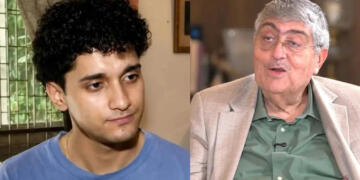



















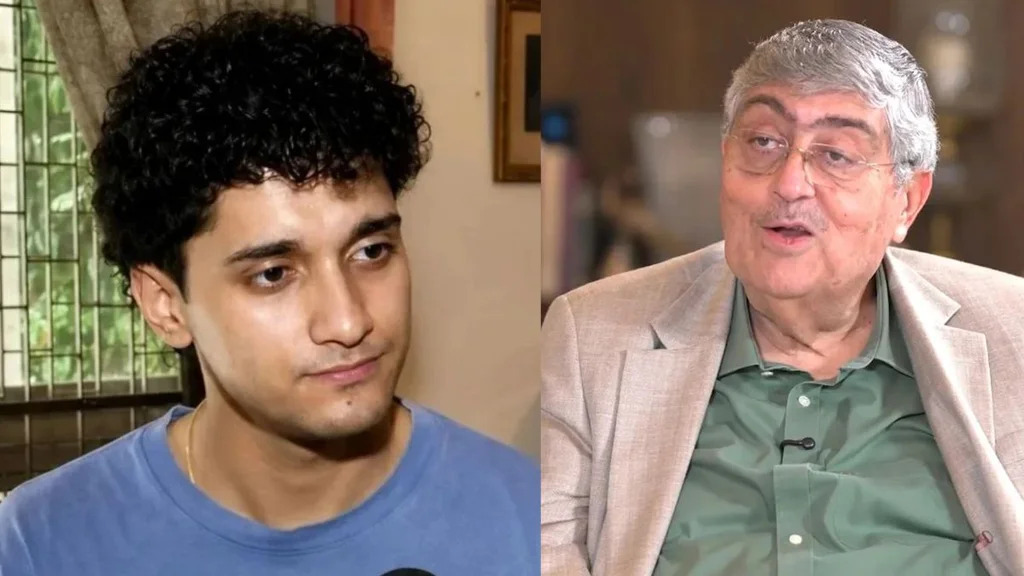
Former Supreme Court judge Justice Sanjay Kishan Kaul has clarified that he was not mentoring Cockroach Janta Party (CJP) co-convenor Saurav Das, following renewed public attention over photographs showing the two together at a Diwali gathering last year. Speaking to ANI, Kishan Kaul said he had met Das only a couple of times when the latter was working as a journalist and described their interaction as brief rather than evidence of a close professional or ideological association.
The controversy gained attention amid scrutiny surrounding CJP leaders following their protest at Jantar Mantar in New Delhi. The resurfacing of the photograph prompted questions about the nature of the relationship between the retired judge and Das, a political activist whose recent activities have attracted public and legal attention.
Responding to questions about the meeting, Kishan Kaul explained that Das had repeatedly invited him to attend a Diwali gathering at his residence. Although he already had other plans, he agreed to make a short appearance. According to the former judge, he intended to stay for approximately ten minutes before leaving for his next engagement.
The former Supreme Court judge emphasised that the meeting had taken place roughly a year earlier, when Das was not receiving the level of public attention he does today. He suggested that the photograph was now being interpreted in a political context that did not reflect the circumstances in which it was originally taken.
A key element of the clarification concerned allegations that the retired judge had mentored Das. Rejecting that suggestion, Kishan Kaul said their interactions had been limited and that he had never undertaken any formal mentoring role. He acknowledged, however, that he had offered advice about the language Das used in public communication.
According to the former judge, he had encouraged Das to moderate his language and adopt a more civil tone. He explained that his generation was accustomed to a different standard of public discourse and that unnecessarily aggressive language could cause offence. He also indicated that he did not want his remarks to be portrayed as an endorsement of Das’s political activities or as evidence that he was advising CJP.
The clarification comes at a politically sensitive moment, as the CJP has faced scrutiny over its protests and the conduct of some of its prominent members. Das was recently released from Tihar Jail after signing a peace bond before a Special Executive Magistrate, undertaking not to engage in activities that could disturb public peace or tranquillity. The circumstances surrounding the protest and subsequent proceedings have contributed to the wider controversy.
The renewed attention has also coincided with a separate debate over judicial independence. Kishan Kaul recently made headlines after discussing former Chief Justice of India DY Chandrachud’s reported approach to judicial appointments. According to his account, he objected to the idea of seeking the government’s views on proposed appointments before the Supreme Court Collegium had formally deliberated on the names.
His remarks generated political debate, with Congress leaders citing the reported disclosures to raise questions about the relationship between the executive and the judiciary. The controversy has brought the former judge’s views on institutional independence into sharper public focus.
However, the Diwali photograph and the former judge’s comments about Das concern a separate issue. A photograph of two people attending the same gathering does not, by itself, establish a political alliance, ideological agreement or mentoring relationship. Equally, the former judge’s explanation does not eliminate legitimate questions about public perceptions of proximity between prominent individuals and political activists.
Kishan Kaul has sought to make his position clear: he met Das briefly, offered advice about language and did not mentor him. His account places the encounter in the context of an ordinary social invitation rather than a sustained professional association.
The episode nevertheless highlights the challenges public figures face when photographs from private gatherings reappear amid changing political circumstances. For a former Supreme Court judge, whose public standing is closely linked to the credibility of judicial institutions, perceptions of political proximity can quickly become a subject of wider debate.
Ultimately, the available account establishes that the former judge acknowledged meeting Das while denying any mentoring role. Whether the controversy will have a lasting political impact remains uncertain, but the episode demonstrates how personal encounters can acquire new significance when the individuals involved become subjects of public scrutiny.