






















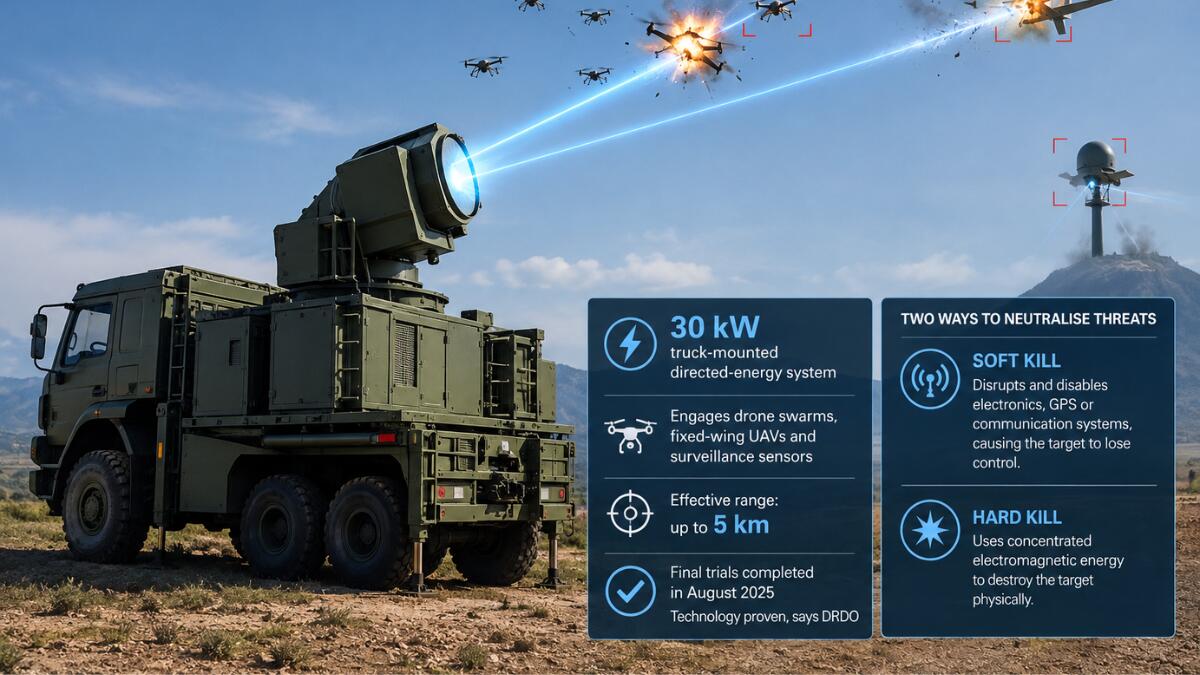
India’s Defence Research and Development Organisation is close to fielding a homegrown laser weapon capable of shooting down swarm drones and UAVs, according to news reports. The first-of-production model of the 30 kW-class directed-energy weapon is expected to be ready within a year, forming a key part of the “Sudarshan Chakra” comprehensive air defence system announced earlier by Prime Minister Narendra Modi, reports said.
BK Das, Director General of DRDO’s Bengaluru-based Electronics and Communication Systems lab, told the Hindu Businessline in an exclusive interaction that having already demonstrated the technology, DRDO will issue an expression of interest within the next six months to select a production partner for the system, according to the report.
The truck-mounted weapon uses electromagnetic energy to destroy targets through either “soft kill” or “hard kill” methods, per the report. Outlook India reported that the 30 kW system can engage drone swarms, fixed-wing UAVs and surveillance sensors at ranges of up to 5 km, and that the move follows the completion of the system’s final trials in August 2025, with DRDO saying the technology has been proven.
GKToday reported that the weapon is being developed under the Integrated Drone Detection and Interdiction System (IDD&IS) Mk-IIA programme, and that the truck-mounted system was demonstrated at the National Open Air Range in Kurnool, Andhra Pradesh, in April 2025, where it engaged fixed-wing drones at long range, countered a multiple-drone attack, and destroyed surveillance sensors and antennae. The outlet added that the technology has received clearance for transfer to Indian industry partners for indigenous production and deployment.
Multiple production partners have reportedly already been lined up for the broader DEW family. According to Outlook India, a 2 kW version of the system is already in production, made by Adani, Astra and Bharat Electronics Limited, while a 10 kW version has cleared the “acceptance of necessity” stage — the first approval in the defence procurement chain — with 10 to 12 units on order and Larsen & Toubro and BEL selected as production partners. DRDO has also selected Bharat Electronics and Adani Defence & Aerospace among the partners for the 30 kW system, per reports.
Reports quoted Das as saying private players sometimes struggle to bring such technologies to market because of order and investment constraints, which is why DRDO is transferring the technology to private firms for a notional fee.
Looking further ahead, reports note that DRDO is also developing 50-100 kW directed-energy weapons and a more powerful, classified 300 kW system reportedly named “Surya,” aimed at engaging faster-moving aerial targets, including missiles. One report projected that Mk-IIA units could be fielded by 2027, with a Mk-III version to follow. Analysts cited in reports describe the shift toward directed-energy weapons as a cost-effective, non-kinetic alternative to missile interceptors, particularly against low-cost, large-scale drone swarm attacks where using expensive munitions would be economically unviable.