























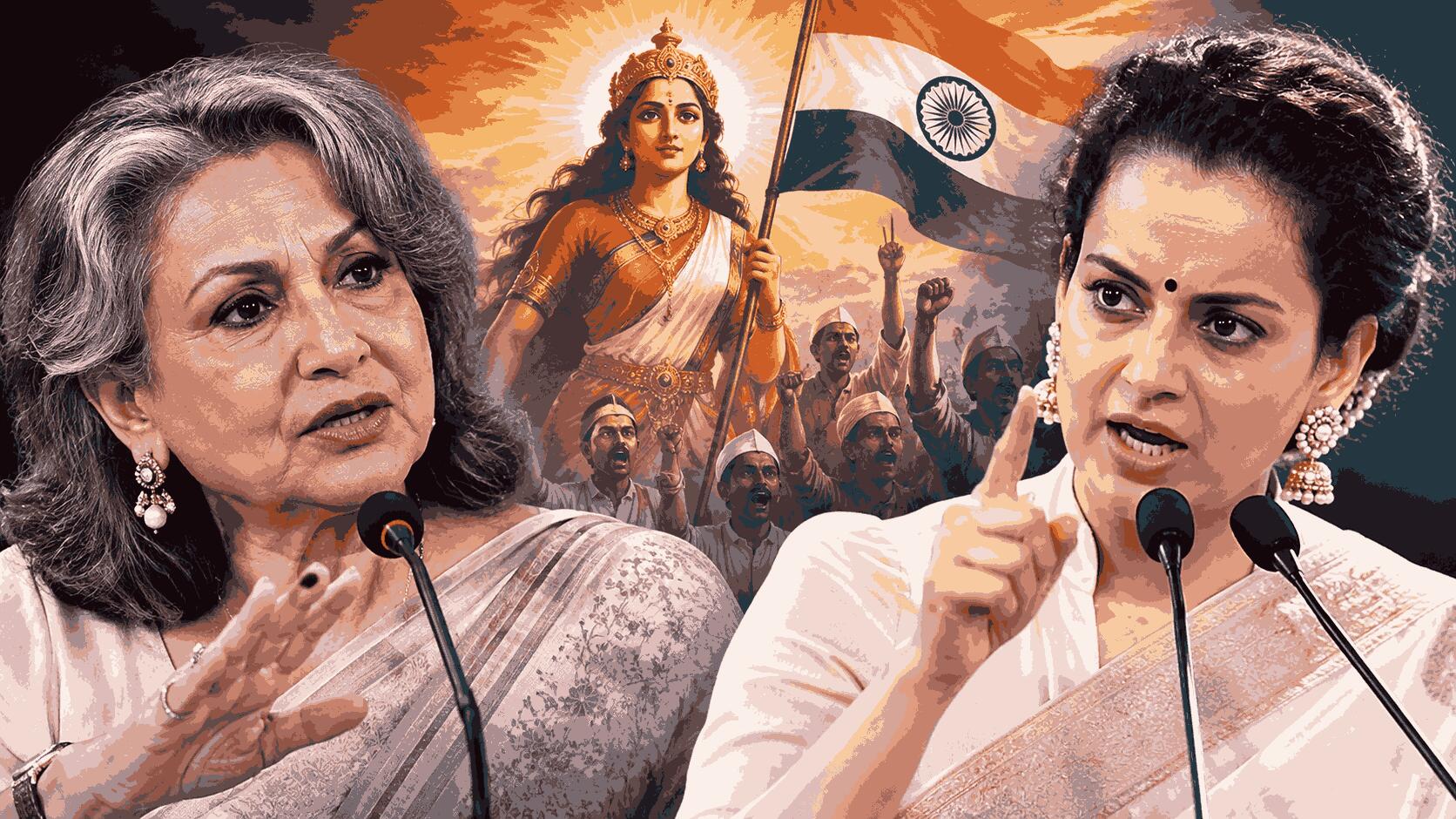
Veteran actor Sharmila Tagore has triggered a fresh political and cultural debate over Vande Mataram after expressing reservations about portions of the national song that invoke Hindu deities, prompting actor and BJP MP Kangana Ranaut to argue that the historic composition should not be viewed solely through a religious lens. The exchange has reopened a long-running discussion about patriotism, artistic expression, religious diversity and the place of Vande Mataram in modern India.
Speaking about the song, Tagore said that people who believe in one God may find some of its later verses difficult to recite because they refer to multiple deities. She indicated that the first two stanzas, which describe and celebrate the motherland, could be more broadly acceptable. Her comments have drawn attention because Vande Mataram occupies a unique position in India’s national life, having served as a powerful rallying cry during the freedom struggle before being accorded the status of the National Song.
Sharmila Tagore‘s remarks were quickly picked up by Kangana Ranaut, who challenged what she described as an overly restrictive interpretation of poetry. Ranaut argued that artistic works frequently use metaphors, imagery and symbolic references to communicate ideas that go beyond their literal meanings. In her view, references to Shakti in Vande Mataram can represent strength, courage and the awakening of a nation rather than being treated exclusively as a statement of religious belief.
The disagreement is particularly significant because Vande Mataram is not merely a literary composition. Written by Bankim Chandra Chattopadhyay, the song became closely associated with India’s anti-colonial struggle and was embraced by generations of freedom fighters. Its opening stanzas celebrate the motherland, while subsequent verses contain explicit references to Hindu goddesses including Durga, Lakshmi and Saraswati. These contrasting elements have periodically generated debate over how the complete composition should be understood and performed in a religiously diverse country.
For Sharmila Tagore, the issue appears to centre on the distinction between appreciating the patriotic character of Vande Mataram and asking whether every part of the original composition can be embraced equally by citizens belonging to different religious traditions. Her argument reflects a concern that national symbols should remain accessible to India’s diverse population. Supporters of this position see the distinction between the first two stanzas and the later verses as a practical way of preserving the song’s national significance while acknowledging differing religious sensibilities.
Ranaut, however, has taken a sharply different approach. Responding on Instagram, she said she was surprised that an artist would interpret poetry so narrowly and argued that words in songs and poems often function metaphorically. Sharmila Tagore was also urged by Ranaut to move beyond what she called a “Hindu-Muslim mindset”. Ranaut’s response framed Vande Mataram primarily as an expression of the spirit of India’s freedom movement and argued that concepts such as Shakti can be understood as universal ideas of power and inner strength.
The controversy comes at a time when Vande Mataram has already become the subject of renewed political discussion. A separate row erupted following an Independence Day programme at the Congress headquarters on August 15, when the BJP accused Sonia Gandhi of objecting to the rendition of the complete song. Congress rejected that interpretation, saying Gandhi had been seeking a chair for party president Mallikarjun Kharge. The competing claims have helped place the national song back at the centre of political debate.
The latest dispute involving Sharmila Tagore therefore extends beyond the comments of two prominent actors. It raises a larger question about whether India’s national symbols should be interpreted primarily through their historical and artistic context or continually reassessed through contemporary religious sensitivities. Vande Mataram’s history demonstrates that it has carried meanings far beyond its literal words, particularly during the freedom struggle, when it became a symbol of resistance to colonial rule. At the same time, concerns about inclusiveness cannot simply be dismissed in a country as religiously diverse as India.
Ultimately, Sharmila Tagore‘s comments and Ranaut’s response represent two contrasting ways of approaching the same cultural symbol. One places greater emphasis on religious accommodation, while the other stresses artistic metaphor, historical memory and national unity. Neither perspective is likely to end the debate. What the controversy demonstrates, however, is that Vande Mataram continues to possess an extraordinary emotional and political resonance nearly eight decades after India became independent.
