
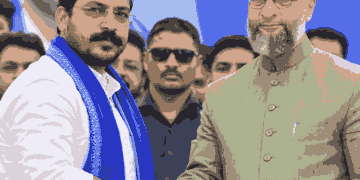




















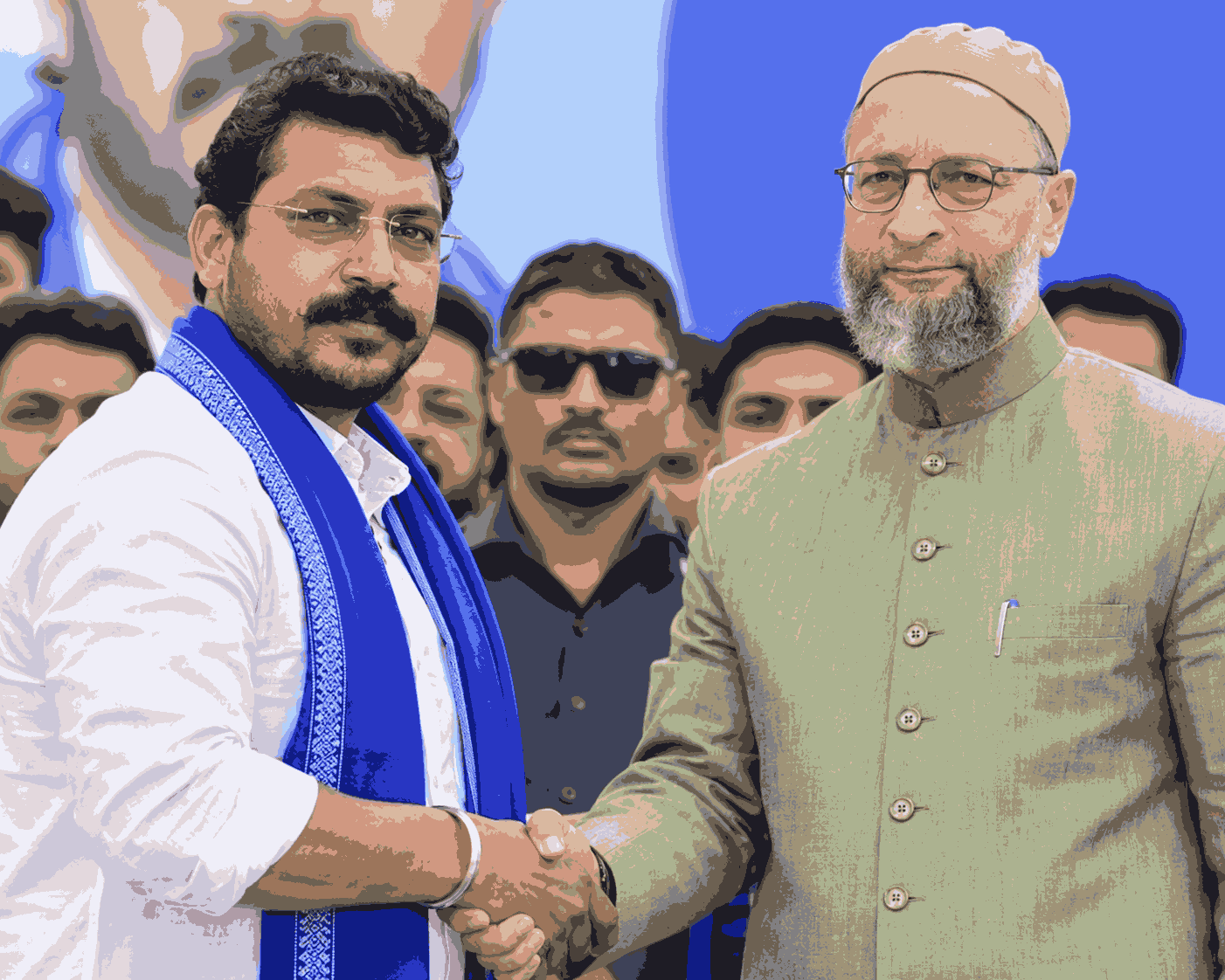
The announcement was made at a joint press conference in Lucknow on Thursday, November 12, 2026. Owaisi announced Chandrashekhar Azad as the alliance’s chief ministerial candidate for the 2027 Uttar Pradesh Assembly elections. The two leaders declared that their parties would contest the elections together, seeking to establish an alternative political force in India’s most politically significant state.
The alliance brings together two political organisations that have attempted to establish themselves through identity-based representation. Azad has built his political identity around the rights and political empowerment of Dalits, particularly younger members of the community. Owaisi, meanwhile, has consistently positioned AIMIM as a platform for Muslim political representation. Their partnership is an attempt to combine these respective support bases into a common electoral force.
The slogan ‘Jai Bheem, Jai Meem’ has become a defining expression of this political arrangement. While ‘Jai Bheem’ invokes Dr BR Ambedkar and the historic struggle against caste discrimination, ‘Jai Meem’ represents Muslim political identity. The Dalit-AIMIM arrangement seeks to present these two constituencies as partners in a broader political movement. However, the slogan also raises questions about whether a shared electoral identity can translate into a common political programme addressing the distinct concerns of both communities.
Azad rejected the description of the new formation as merely a third front. He called it the Samajik Parivartan Morcha and described it as a movement representing marginalised, deprived, oppressed and exploited sections of society. He argued that successive governments had failed to deliver meaningful improvements in the lives of disadvantaged communities despite making repeated promises of social justice and empowerment.
He also indicated that the alliance would remain open to other political parties, including the Congress and the Samajwadi Party, if they were willing to support its objective of preventing the BJP from returning to power in Uttar Pradesh. This statement suggests that the new formation is not necessarily seeking to restrict itself to its two founding parties.
Owaisi, for his part, accused established political parties of treating Dalits and Muslims as vote banks rather than addressing their substantive concerns. He highlighted unemployment, educational shortcomings and farmers’ problems as issues that the alliance intended to raise. He also criticised Samajwadi Party president Akhilesh Yadav, declaring that he would not become the next chief minister of Uttar Pradesh.
The formation of the Dalit-AIMIM alliance follows Owaisi’s unsuccessful attempts to secure an arrangement with the INDIA bloc parties in Uttar Pradesh. Both the Congress and the Samajwadi Party reportedly showed little enthusiasm for accommodating AIMIM in their electoral calculations. The new partnership therefore provides Owaisi with an independent political arrangement while giving Azad an opportunity to expand his influence beyond his existing electoral constituency.
However, the political arithmetic presents considerable challenges. AIMIM has struggled to translate its influence among sections of Muslim voters into substantial electoral victories in Uttar Pradesh. Similarly, Azad’s party has yet to establish a broad statewide electoral organisation. In the 2022 Assembly elections, neither party managed to win a seat. AIMIM contested more than 90 constituencies, while Azad’s party fielded over 100 candidates. Both secured relatively small vote shares.
The Dalit-AIMIM partnership will consequently have to demonstrate that its combined social base can generate actual electoral support rather than remain an arrangement of political symbolism. Uttar Pradesh’s electorate is far more diverse than a simple Dalit-Muslim calculation, and voters also consider governance, local candidates, development, employment, leadership and regional political loyalties.
The Dalit-AIMIM experiment also invites historical comparisons with earlier attempts to build political partnerships around community identities. The experience of Jogendranath Mandal, a prominent Dalit leader who collaborated with the Muslim League before Partition and subsequently served as Pakistan’s first law minister, is often cited in discussions about the opportunities and risks of such political arrangements. However, the historical circumstances of Partition-era politics and contemporary electoral alliances are different and must be assessed in their respective contexts.
Ultimately, the Dalit-AIMIM alliance faces a difficult test in 2027. Whether it can move beyond the politics of slogans and deliver a credible programme of social and economic empowerment will determine its political relevance. For Chandrashekhar Azad and Asaduddin Owaisi, the challenge is to convince voters that their partnership represents a durable political alternative rather than another temporary electoral understanding.