





















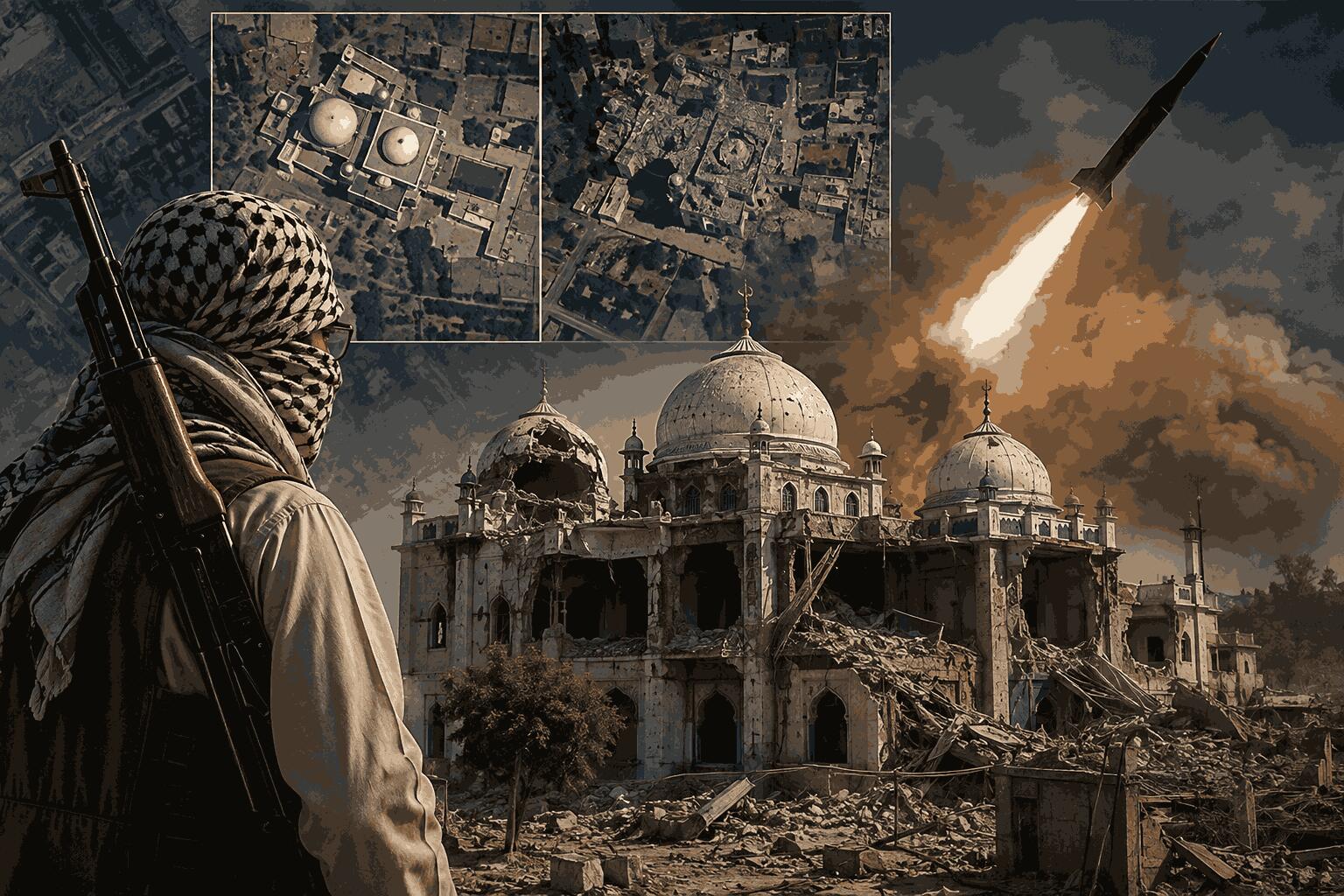
Reports that Jaish-e-Mohammed has begun rebuilding its damaged headquarters at Markaz Subhan Allah in Bahawalpur, Pakistan, roughly 15 months after it was targeted during Operation Sindoor, have renewed questions over the persistence of terrorist infrastructure across the border. Recent imagery reportedly shows construction activity at the complex, including repairs to its prominent domes and the clearing of debris from structures damaged during India’s precision strikes in May 2025.
The Bahawalpur facility, also known as the Jamia Subhan Allah complex, is situated along Pakistan’s N-5 National Highway in southern Punjab. For years, it has been regarded as an important centre associated with the organisation’s ideological, organisational and training activities. Its significance became particularly prominent after India identified the location as one of the targets struck during Operation Sindoor.
The May 2025 operation followed the April 22 Pahalgam terrorist attack in Jammu and Kashmir, in which 26 civilians were killed. India subsequently launched precision strikes against terrorist infrastructure in Pakistan and Pakistan-occupied Jammu and Kashmir on the night of May 6–7. Markaz Subhan Allah in Bahawalpur was among the facilities hit during the operation. Satellite and other high-resolution imagery released after the strikes showed substantial damage to the compound.
The destruction of the Bahawalpur complex was particularly significant because of its association with Masood Azhar, the founder and chief of Jaish-e-Mohammed. Following the strikes, Azhar reportedly claimed that members of his family and associates were killed at the facility. His statement drew renewed attention to the extent to which the compound had become intertwined with the organisation’s leadership and activities.
Azhar has long been one of the most prominent figures in Pakistan-based terrorism directed against India. He was arrested in India in 1994 and was later released in 1999 following the hijacking of Indian Airlines flight IC-814. Over subsequent years, his name became associated with several major attacks, including the 2001 Parliament attack, the 2016 Pathankot attack and the 2019 Pulwama bombing. The United Nations Security Council has designated him a terrorist.
The apparent reconstruction now underway suggests that the damage inflicted during Operation Sindoor may not have permanently eliminated the organisation’s ability to restore important infrastructure. According to recent reports, imagery from April 2026 showed heavy machinery and construction vehicles at the Bahawalpur compound. The domes of the main complex, which had sustained visible damage, appeared to have been repaired, while other sections reportedly remained under reconstruction.
For Jaish-e-Mohammed, restoring Markaz Subhan Allah carries significance beyond the physical reconstruction of a building. Terrorist organisations rely on infrastructure for recruitment, indoctrination, logistics, fundraising and maintaining organisational cohesion. The revival of a prominent headquarters can therefore serve both practical and symbolic purposes, particularly after a major military setback.
Reports have also indicated that fundraising efforts were undertaken to finance reconstruction. Social-media accounts linked to Jaish-e-Mohammed were reportedly used to solicit donations through digital wallets, while wider assessments suggested that the organisation was seeking resources to rebuild damaged facilities and establish additional centres. Such activity illustrates how terrorist networks can attempt to regenerate even after suffering substantial physical losses.
The development also places renewed focus on Pakistan’s responsibility to prevent terrorist organisations from restoring operational infrastructure on its territory. Although Islamabad has repeatedly denied knowledge of the whereabouts and activities of Masood Azhar, the continued appearance of construction and organisational activity around facilities historically associated with Jaish-e-Mohammed is likely to attract scrutiny from Indian security agencies and international counterterrorism observers.
The rebuilding effort demonstrates one of the central challenges in combating cross-border terrorism: destroying a physical facility does not necessarily destroy the network that operated from it. Personnel can disperse, financial channels can be recreated and damaged buildings can eventually be reconstructed. For Jaish-e-Mohammed, the reported revival of its Bahawalpur base therefore represents an attempt to recover from a major setback and preserve an infrastructure that India had specifically targeted.
For New Delhi, the developments are likely to reinforce the argument that military action must be accompanied by sustained intelligence monitoring, diplomatic pressure and international counterterrorism cooperation. The rebuilding of Markaz Subhan Allah also serves as a reminder that the consequences of Operation Sindoor are not confined to the destruction recorded on satellite imagery. The real test lies in whether terrorist networks can prevent themselves from rebuilding their capacity after suffering such strikes.
The reported reconstruction of the Bahawalpur complex consequently marks a new phase in the continuing contest between India’s counterterrorism strategy and the attempts of Jaish-e-Mohammed to preserve its organisational infrastructure. Whether the rebuilt facility eventually resumes its earlier role remains a matter for intelligence agencies to assess, but the construction activity itself underscores the resilience of terrorist networks and the continuing security challenge they pose in South Asia.