























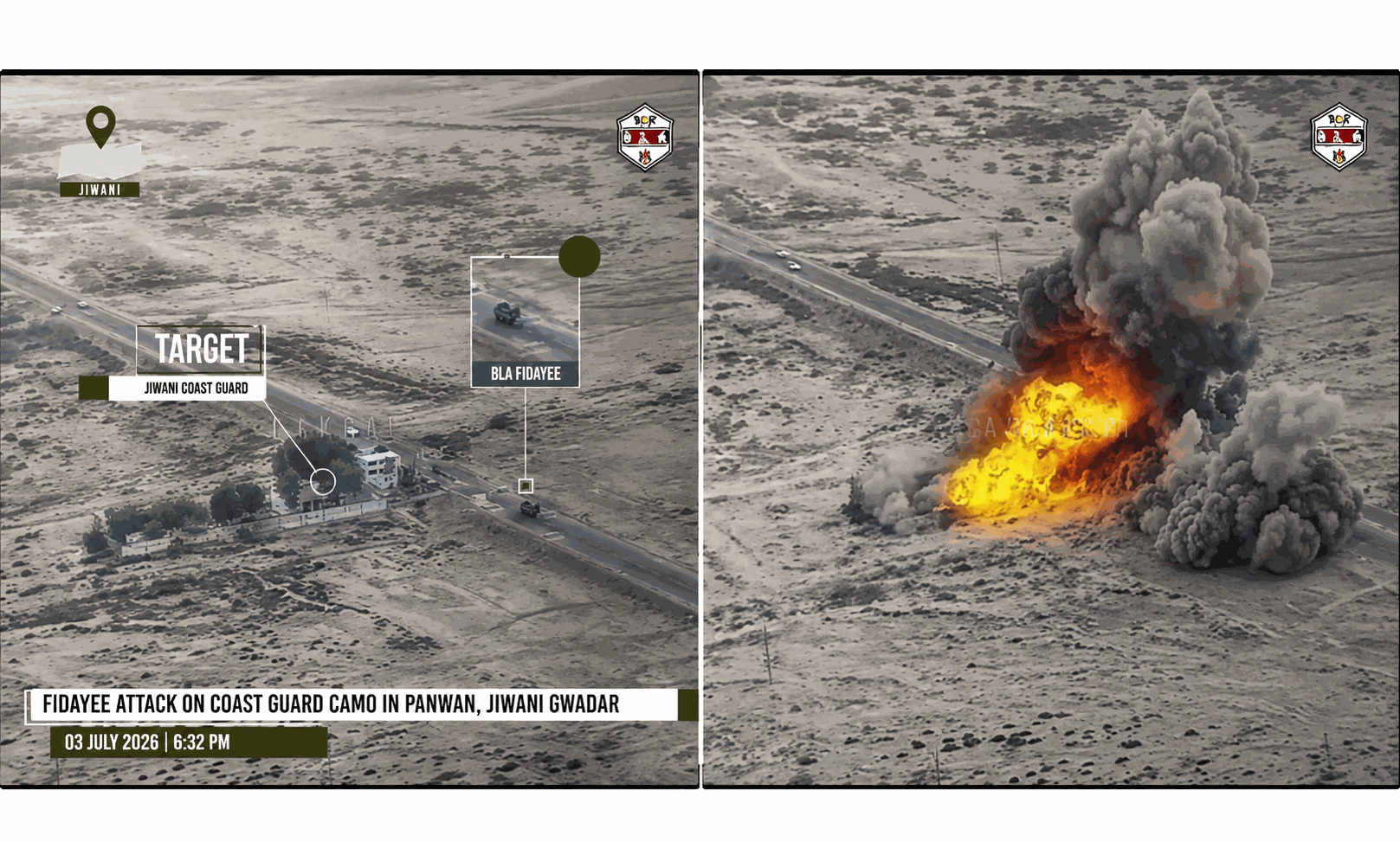
Strip away the trade-corridor language and Gwadar has always been two projects wearing one name: a commercial port that was supposed to move cargo, and a strategic naval foothold that gives China a permanent presence on the Arabian Sea. Friday’s suicide bombing of a Pakistan Coast Guard camp in the Panwan area of Jiwani, inside Gwadar’s own district, is a reminder that this dual identity is exactly what makes the place so hard to defend. You cannot secure a fishing town turned commercial hub with the same playbook you’d use for a naval base, and Gwadar’s planners have spent two decades trying to do both at once – with, so far, uneven results on either front.
The Attack Islamabad Would Rather Not Confirm
The Balochistan Liberation Army says its Majeed Brigade rammed an explosives-laden truck into the fortified camp, killing more than 30 personnel as fighters from its Fateh Squad moved through the wreckage afterward.
Pakistan hasn’t issued an official casualty figure, and it likely won’t rush to one — Islamabad’s standard response to attacks of this scale has been to describe them as the work of hostile foreign actors operating out of Afghanistan or Iran, a framing that avoids engaging with the fact that this is a homegrown insurgency with specific, articulated grievances about who controls Balochistan’s coastline and who profits from it. Whether the death toll settles at three or thirty, the method — a coordinated bombing followed by a ground assault on a hardened security installation — is the more important story.
A Naval Ambition Repeatedly Interrupted
Gwadar’s deeper strategic logic goes back to lessons Pakistan drew from the Kargil War, when the need for a dedicated deep-water naval port became obvious. That ambition is precisely why China’s involvement matters so much to Beijing: a functioning Gwadar shortens the route for Chinese energy imports and reduces reliance on sea lanes that pass through chokepoints far from Chinese control. It is also precisely why the port has become such an attractive target. The Gwadar Port Authority complex and the Turbat naval base have both been stormed in the past. A Coast Guard patrol boat was hit near Jiwani earlier this year, prompting the BLA to announce a standing naval unit shortly afterward — a claim to permanent maritime reach, not a one-time boast. Officials in Islamabad described that unit’s emergence as evidence of outside sponsorship rather than organic growth, but the group’s own trajectory — land attacks, then a drone unit, then a maritime wing, now an assault on a coastal security camp — reads less like externally funded escalation and more like a insurgency methodically working through every domain the port depends on.
The Economics Nobody Wants to Say Out Loud
Pakistani and Chinese officials point to a 2026 order formally opening Gwadar to Iran-bound transit cargo as proof the port is finally earning its keep commercially, after years of criticism that it had strategic symbolism but no real throughput. That’s a genuine development, and it deserves to be counted. But it arrives against a backdrop in which, of roughly 90 projects originally promised under CPEC, only about 38 have been completed and a third were never started — and Gwadar’s own project list remains thin even by that modest standard. Insurance underwriters do not evaluate ports on their potential; they price the risk in front of them, and a coastal security camp reduced to rubble by a suicide bomber is exactly the kind of event that pushes premiums up and cargo elsewhere.
Two Decades In, Still Choosing Between Ambitions
The uncomfortable truth is that Gwadar’s naval ambitions and its commercial ambitions actively work against each other. The military footprint required to make the port a viable strategic asset — checkpoints, special security divisions, a growing garrison, is the same footprint that fuels the resentment producing bombings like Friday’s, which in turn makes the port less attractive to the commercial shippers it needs. Islamabad and Beijing can keep describing this as manageable friction between two compatible goals. The record increasingly suggests they are choosing, attack by attack, which ambition actually wins.