
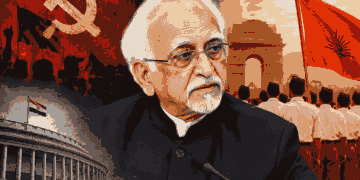






















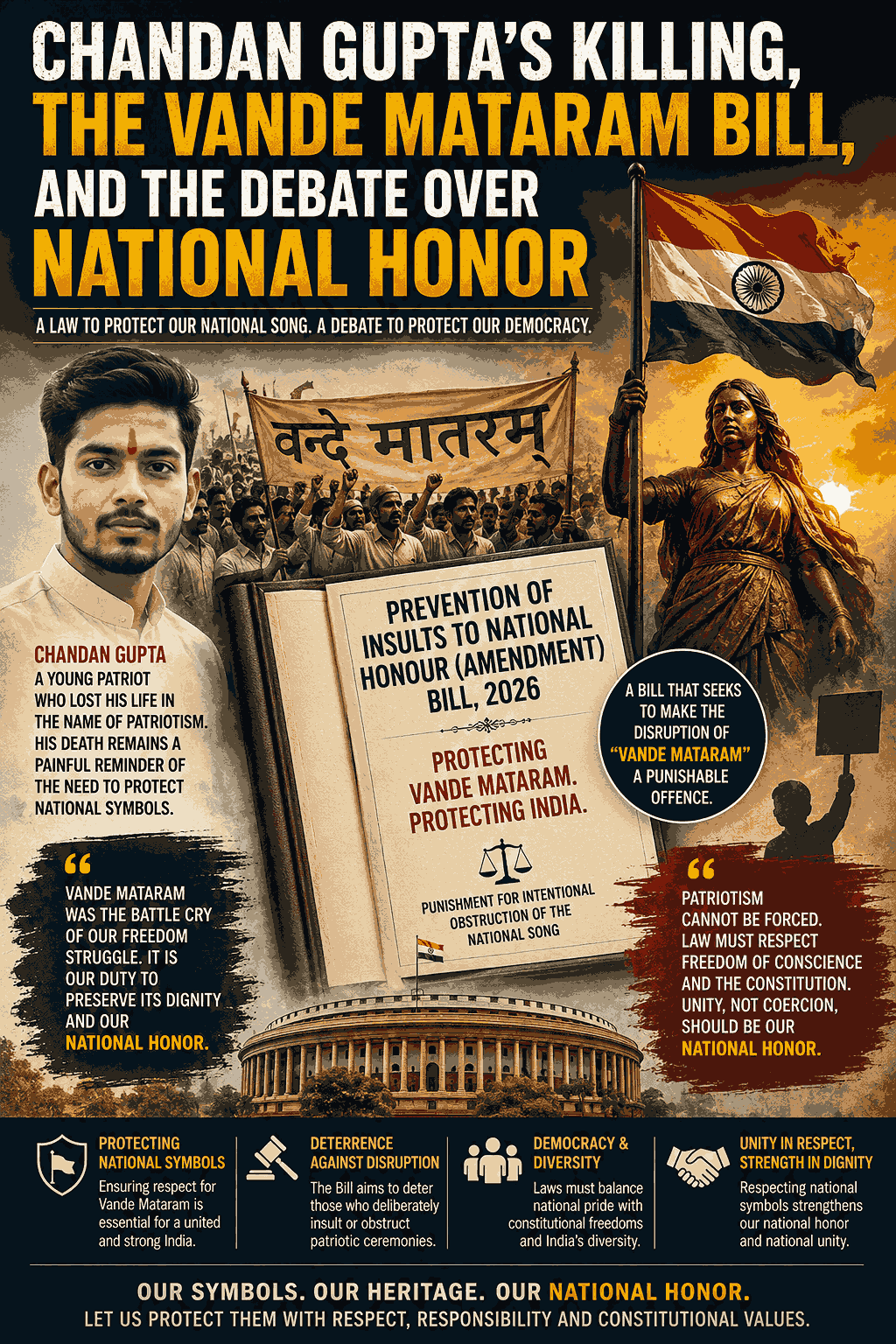
The Union Government’s decision to introduce the Prevention of Insults to National Honor (Amendment) Bill, 2026 has reignited a long-running debate over patriotism, freedom of expression, and the protection of India’s national symbols. The proposed legislation seeks to make the intentional obstruction or disruption of the singing of Vande Mataram a punishable offence, extending legal protection to the National Song in a manner similar to existing provisions for the National Anthem.
Supporters of the legislation argue that the proposal is not merely about regulating public conduct but about reinforcing national honor in official public life. They contend that symbols such as the National Flag, the National Anthem, and Vande Mataram have played a defining role in India’s freedom movement and deserve statutory protection from deliberate acts of disruption. The proposed amendment specifically targets intentional obstruction during official events rather than private beliefs or personal opinions.
The renewed discussion has also brought renewed attention to the 2018 killing of Chandan Gupta in Kasganj, Uttar Pradesh. Gupta, a young participant in a Republic Day motorcycle rally, was fatally shot after communal tensions reportedly escalated during the procession. Over the years, the incident has frequently been cited by commentators as an example of how disputes involving patriotic slogans and national symbols can turn violent. While the exact circumstances of the incident have remained a matter of judicial and public scrutiny, the case continues to occupy an important place in debates surrounding the protection of patriotic expression.
For many advocates of the Bill, the Chandan Gupta case symbolizes the need for stronger legal safeguards to preserve national honor and to deter those who deliberately seek to intimidate citizens participating in officially sanctioned patriotic ceremonies. They argue that while India already penalizes disruption of the National Anthem, extending similar protection to Vande Mataram reflects the historical significance of the National Song during the struggle against British colonial rule.
However, the proposed legislation has also generated criticism. Some religious organisations, political leaders, and civil liberties advocates have questioned whether mandatory participation or criminal penalties could conflict with constitutional guarantees relating to freedom of conscience and religious belief. Others argue that patriotic commitment cannot be legislated and that legal coercion may deepen existing social divisions instead of fostering unity. These concerns have revived an older constitutional debate over the balance between civic duties and individual freedoms.
Supporters counter that the Bill does not criminalize dissent or disagreement with government policies. Instead, they maintain that it focuses on deliberate acts intended to obstruct public ceremonies where citizens have assembled to sing the National Song. From this perspective, the legislation seeks to protect national honor without restricting legitimate democratic debate, provided that such debate does not interfere with officially organised public events.
The controversy also reflects the evolving place of Vande Mataram in India’s national identity. Written by Bankim Chandra Chattopadhyay during the colonial era, the song became a rallying cry for countless freedom fighters and was later accorded the status of the National Song. Its historical association with the independence movement gives it a symbolic significance that extends beyond contemporary politics. At the same time, debates surrounding some of its later verses have periodically resurfaced, illustrating the challenge of reconciling historical tradition with India’s diverse social fabric.
Ultimately, the success or failure of the proposed amendment will depend not only on its legal provisions but also on how fairly and consistently it is implemented. Laws designed to preserve national honor are most effective when they command broad public confidence and are applied without political bias or selective enforcement. A legal framework that protects national symbols while respecting constitutional freedoms is more likely to strengthen civic unity than one perceived as partisan.
As Parliament considers the legislation, the broader conversation extends well beyond one Bill or one tragic incident. It raises fundamental questions about how India should safeguard its national heritage, respond to deliberate acts of disruption, and preserve national honor while remaining faithful to the democratic values enshrined in the Constitution. The debate is therefore not simply about Vande Mataram; it is about defining the relationship between patriotism, law, and citizenship in a modern constitutional democracy.