





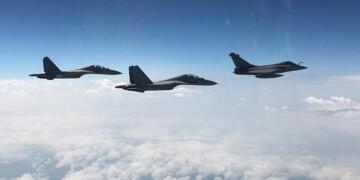










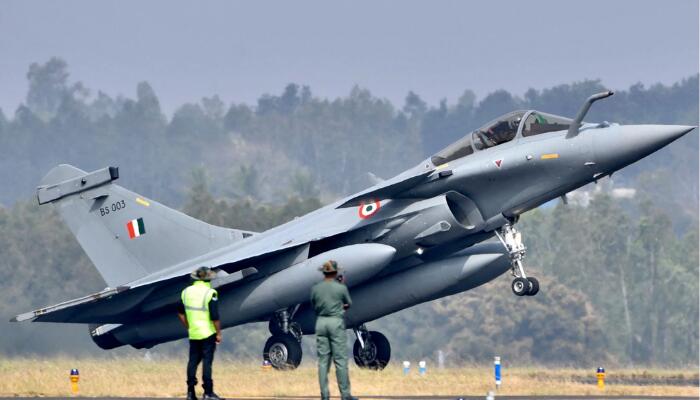
New Delhi has formally moved ahead with one of its most ambitious defence acquisition programmes as Air Chief Marshal AP Singh arrived in France on a four-day visit aimed at advancing discussions surrounding the Indian Air Force’s proposed Rafale fighter jet expansion. The visit comes at a pivotal moment, with India having dispatched a Letter of Request (LoR) to France, formally triggering the next phase of negotiations for the government-to-government acquisition.
The Air Chief is scheduled to engage with senior French military officials and representatives of Dassault Aviation, the manufacturer of the Rafale fighter aircraft, as well as MBDA, the European missile manufacturer that supplies key weapons used by the Indian Air Force, including the Meteor beyond-visual-range air-to-air missile, MICA air-to-air missile and SCALP cruise missile.
The visit is expected to provide strategic momentum to discussions that could shape the future combat capabilities of the Indian Air Force for decades.
Negotiations Move into a Critical Stage
The Letter of Request sent by India outlines the country’s operational requirements, industrial expectations and weapons integration demands. France is expected to respond formally, after which the proposal will enter the Contract Negotiation Committee phase. This stage will focus on commercial terms, production arrangements and contractual obligations before the proposal is considered by the Cabinet Committee on Security.
The Defence Acquisition Council, chaired by Defence Minister Rajnath Singh, had accorded Acceptance of Necessity for the programme in February, paving the way for the formal procurement process.
The proposed acquisition is estimated to be worth around ₹3.25 lakh crore, making it one of India’s largest military purchases in recent years. Officials expect negotiations to progress over the coming months, with the possibility of concluding discussions within a year if the process remains on schedule.
Indigenous Weapons Integration Emerges as India’s Key Demand
A major feature of India’s negotiating position is the insistence on integrating indigenous weapons systems into the Rafale platform.
Defence sources have indicated that the integration of homegrown weapons is a firm requirement and will remain a central issue throughout the negotiations. While India is not seeking access to the Rafale’s source code, which remains closely guarded by original equipment manufacturers worldwide, New Delhi is expected to seek Interface Control Documents and other technical arrangements necessary for future integration and certification of indigenous systems.
These include the Astra beyond-visual-range air-to-air missile, the future BrahMos-NG missile and other Indian-developed weapons that may be incorporated into the aircraft over its operational life.
The Air Chief’s visit is expected to facilitate discussions on these technical and operational requirements.
Major Manufacturing Component Planned for India
According to the proposed structure of the programme, India plans to acquire 114 Rafale fighter aircraft, including 88 single-seat and 26 twin-seat variants.
Only a limited number of aircraft are expected to arrive in fly-away condition, while the overwhelming majority will be manufactured in India. Under another reported framework of the proposal, 94 aircraft are expected to be produced domestically through a partnership involving Dassault Aviation and an Indian company.
Indigenous content is projected to gradually increase to approximately 40 to 50 per cent during the programme’s implementation.
Dassault already maintains a manufacturing ecosystem in India through its partnership with Tata Advanced Systems Limited, which currently produces Rafale aero-structures and components. The two companies have also announced plans to manufacture Rafale fuselage sections in India, potentially laying the foundation for a larger domestic production effort.
Strengthening Combat Capability for the Future
The acquisition is intended to address the Indian Air Force’s declining squadron strength, which has fallen to around 30 squadrons against a sanctioned strength of 42. Delays in the induction of the Tejas Mk-1A have further intensified the need for additional fighter aircraft.
India currently operates 36 Rafale fighters, while the Indian Navy has separately ordered 26 aircraft.
The proposed fleet expansion is expected to complement the Tejas Mk-1A, the upcoming Tejas Mk-2 and the Advanced Medium Combat Aircraft programme. Future upgrades are also built into the plan. The existing Rafale fleet currently operates in the F3 standard and is expected to transition to the F4 configuration, while the new aircraft are likely to include provisions for eventual migration to the future F5 standard.
The visit also follows the Indian Air Force’s recent agreement with MBDA to establish a Maintenance, Repair and Mid-Life Overhaul facility in India for MICA missiles. Under the arrangement, the Air Force will operate the facility, while MBDA will provide machinery, technical support, training and engineering assistance.
As negotiations gather pace, the Rafale programme is emerging as far more than a fighter aircraft purchase. It represents a broader effort to combine advanced foreign technology with indigenous capability, strengthen domestic aerospace manufacturing and ensure that India’s air power remains prepared for the challenges of the coming decades.