























In 2017, the Doklam plateau, located near the India-China-Bhutan tri-junction, suddenly began appearing in global headlines.
At first glance, the issue seemed like a border dispute involving a remote and sparsely populated Himalayan region. However, from a strategic perspective, its significance went far beyond a simple territorial disagreement. This is why the Doklam standoff is still regarded as an important turning point in the context of India’s national security and regional strategy.
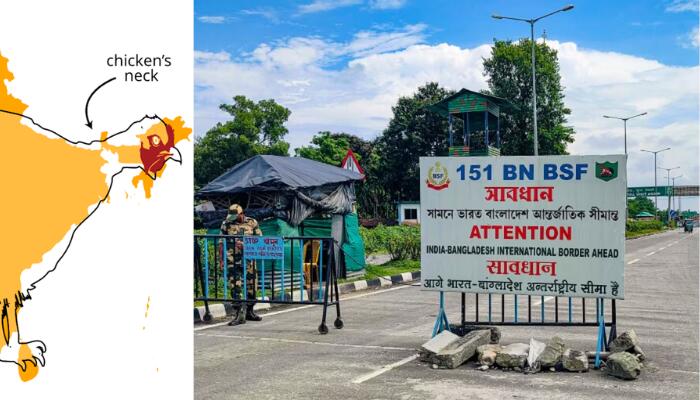
Doklam is a disputed territory between Bhutan and China, situated very close to the India-Bhutan-China tri-junction. The importance of this region is not limited to its geographical location alone. Near Doklam lies India’s Siliguri Corridor, commonly known as the “Chicken’s Neck.” This narrow stretch of land is the most critical land link connecting mainland India with its northeastern states.
In fact, the Siliguri Corridor is one of the most sensitive components of India’s strategic security architecture. At its narrowest point, the corridor is only a few kilometers wide, and any disruption in this area could pose serious challenges for the entire northeastern region. This is why security agencies and strategic planners closely monitor developments in and around this region.
Why Was Doklam More Than Just a Border Dispute?
The Doklam crisis began when China attempted to advance road construction activities in the area. Naturally, this construction was not viewed merely as a local infrastructure project. Both India and Bhutan saw it through the lens of regional security and strategic balance. As a result, Indian and Chinese troops came face to face, leading to a standoff that lasted for nearly 73 days.
Although the confrontation did not escalate into a larger military conflict and both sides eventually agreed to disengage, the episode raised several important questions. Strategic analysts believe that Doklam demonstrated how roads, bridges, and other infrastructure projects in modern geopolitics are not simply development activities. They are also directly linked to military mobility and strategic influence.
During the Doklam crisis, one of the biggest concerns was that any significant change in the security situation in the area could affect the safety of the Siliguri Corridor. While the center of the crisis remained the disputed plateau itself, it became clear that even localized developments in the Himalayan region could influence broader regional security dynamics.
The Strategic Lessons India Drew from Doklam
Experts also point out that Doklam was not merely a border dispute; it became a symbol of growing strategic competition in the Himalayas. The episode showed that regional influence can be established not only through direct military action but also through gradual changes on the ground. Road construction, military deployments, and territorial claims have increasingly become important components of modern strategic competition.
Following Doklam, India began placing greater emphasis on infrastructure development, military preparedness, and rapid response capabilities in border regions. Efforts to strengthen roads, logistics networks, and surveillance systems in frontier areas also gained momentum. The objective was not only to prepare for potential crises but also to maintain strategic balance in sensitive regions.
Today, the Doklam standoff is not viewed merely as a 73-day military confrontation. It is remembered as an important lesson that reminded India of the deep connection between geography, connectivity, and national security. The episode made it clear that maintaining stability in the Himalayan region requires more than military strength alone. Strong infrastructure, effective border management, and constant vigilance are equally important.
The legacy of Doklam continues to influence India’s strategic thinking even today. This is why the event remains an important reference point in discussions on India’s security, border management policies, and Himalayan strategy. Doklam proved that some of the world’s most important strategic messages do not always emerge from major wars. Sometimes, they come from a limited but decisive standoff.
