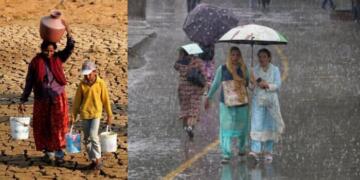























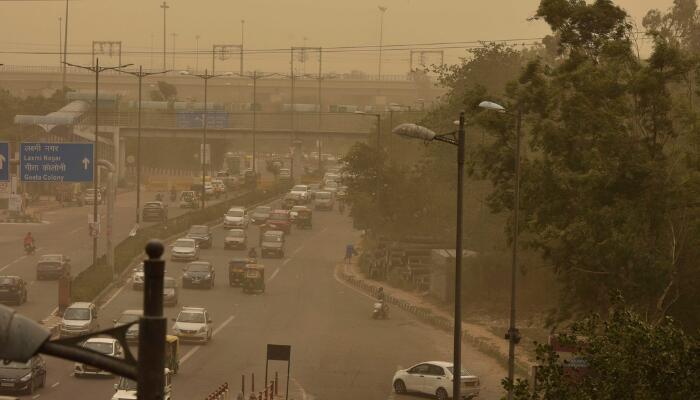
Delhi was hit by one of its most intense weather events of the season on Tuesday evening when a powerful dust storm, accompanied by winds touching 120 kmph, swept across the capital and rapidly transformed the skyline into a dense wall of dust before giving way to heavy overnight rainfall. The abrupt shift from extreme heat to violent weather disrupted daily life across the National Capital Region, delaying more than 400 flights and forcing meteorological agencies to issue red and orange alerts in several pockets.
What unfolded in a matter of minutes was a textbook case of atmospheric instability. After days of scorching heat and high humidity, Delhi’s weather collapsed into chaos, with dust-laden winds engulfing neighbourhoods, cutting visibility sharply and forcing residents indoors.
Dust Storm Turns Skies Brown as Winds Reach Rare Intensity
The most striking feature of the storm was its intensity. The India Meteorological Department (IMD) recorded wind speeds of up to 120 kmph at the Palam station, a level rarely observed in Delhi in recent decades.
Across other parts of the capital, wind gusts ranged between 50 kmph and 80 kmph, sweeping through the city with enough force to uproot loose objects, shake structures and severely reduce visibility. The storm’s dust front moved quickly across Delhi-NCR, turning daylight into a murky brown haze within minutes.
Meteorologists linked the event to a sharp build-up of heat and moisture over northern India, which created unstable atmospheric conditions. This instability eventually triggered the violent wind system, followed by thunderstorms and rain.
Torrential Rain Follows, Brings Relief and Disruption
As the dust storm weakened, heavy rain lashed Delhi, Noida, Gurugram and Ghaziabad late into the night. Thunder, lightning and gusty winds accompanied the downpour, offering brief relief from the prolonged heatwave that had gripped the region.
While temperatures dropped noticeably, the rain also created fresh challenges. Waterlogging was reported in several low-lying areas, and traffic movement slowed significantly as roads struggled to cope with the sudden showers.
For many residents, the weather shift was dramatic — moving from suffocating heat to storm conditions within hours.
Aviation Hit Hard as Over 400 Flights Delayed
The impact on aviation was immediate and widespread. Delhi’s Indira Gandhi International Airport, one of the busiest in the country, witnessed major operational disruptions as strong winds, low visibility and rainfall affected aircraft movement.
More than 400 flights were delayed, while several services were diverted or rescheduled due to adverse weather conditions. Airlines advised passengers to check flight status before heading to the airport, as delays continued even after the storm began to ease.
IMD Forecast Signals More Unsettled Weather Ahead
The IMD has warned that Delhi’s weather will remain unstable over the next several days.
For Wednesday, the forecast indicates a partly cloudy sky with chances of isolated thunderstorms and lightning. Maximum temperatures are expected to hover around 43.5°C to 44°C, while minimum temperatures may remain near 30°C.
On Thursday, thunderstorms accompanied by very light to light rainfall, lightning and gusty winds of 40–50 kmph are expected during evening and night hours.
Friday is likely to bring similar conditions, with thunderstorms, lightning and light rain in the afternoon and evening, along with a significant drop in temperature. The maximum may fall to around 35°C, with minimum temperatures near 25°C.
By Saturday, conditions are expected to gradually stabilise, though isolated thunder and lightning remain possible. Sunday and Monday are likely to see relatively calm, partly cloudy skies with dry weather dominating.
Authorities Urge Caution as Weather Instability Continues
The IMD has advised residents to remain indoors during thunderstorms, avoid sheltering under trees, and secure loose objects that could become hazardous in strong winds. Commuters and air travellers have been urged to check updates before stepping out.
With the monsoon approaching and atmospheric conditions still volatile, meteorologists caution that Tuesday’s storm may not be an isolated event. Instead, it could mark the beginning of a more active and unpredictable weather phase for Delhi-NCR, where extreme heat and sudden storms increasingly define the capital’s summer cycle.